A crypto exchange can freeze or close your account over an internal AML risk flag and legally refuse to explain which rule you tripped.
In November 2023, Bitget blocked 27,000 USDT in a Ukrainian customer's account and cited a $1,500 transfer he had sent to a friend two months earlier - then said nothing else. He wasn't alone. A Reddit user posting as AnnaCrypto001 reported the same week that Bitget had frozen her 8,000 USDT with no reason given, and a Russian client's account stayed locked for four months before the hold lifted on its own, still unexplained. A separate, unverified claim filed against MEXC describes a Kazakhstan-based customer locked out of roughly $160,000 in crypto in 2024, with the exchange citing "high-risk activity" and nothing further. None of this is rare. It is the standard way exchanges handle an AML flag, and the silence is not a bug.
The Freeze Comes From a Risk Flag, Not a Verdict
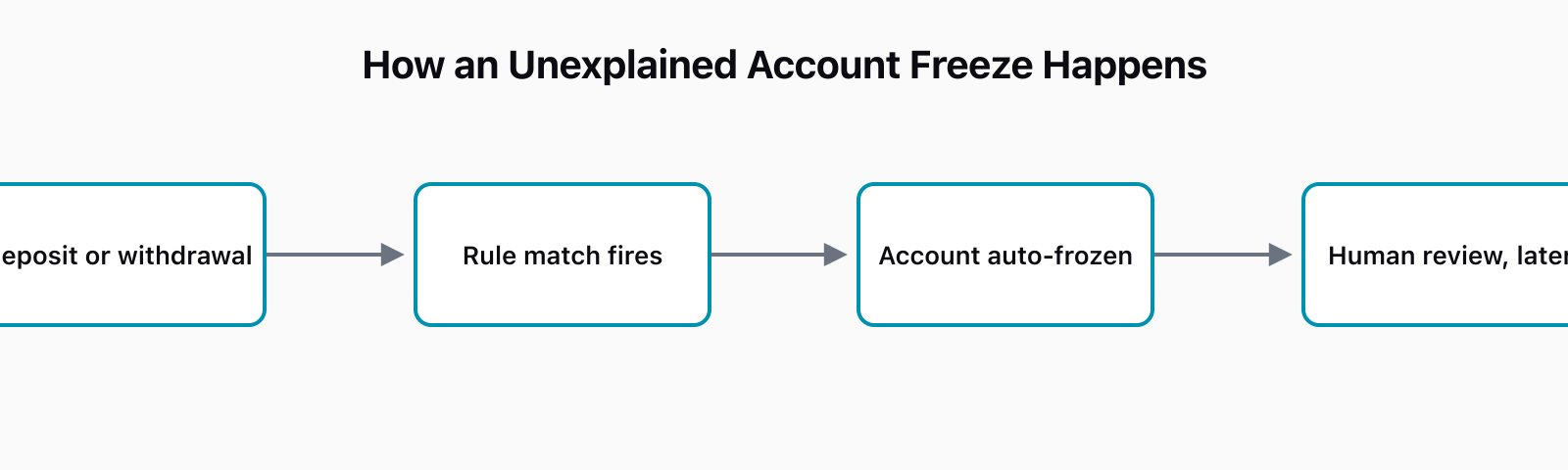
Every exchange runs transaction-monitoring software that scores wallets and accounts against a rulebook, not a human read of your intentions. A deposit linked to a mixer, a withdrawal to an address with no prior volume, three payments under the same reporting threshold in one day - any one of these can fire a rule and freeze the account automatically, before a compliance analyst ever opens the file.
The software decides first. A person reviews later, if at all.
That order matters. The freeze on your account says nothing about guilt. It says a pattern matched a rule written to catch something else entirely, and you happened to be standing where the alarm went off.
Some of the rules are wide by design. The travel rule's reporting threshold, usually a transfer equivalent to $1,000 or $3,000 depending on the jurisdiction, treats a routine remittance to a relative the same way it treats a structured payment meant to dodge reporting. A dormant wallet that wakes up after two years and moves its full balance trips a different rule built for stolen-fund recovery, even when the owner is simply cashing out savings. The rule can't tell the difference between the two stories. It only sees the shape.
Why Won't the Exchange Tell You What Triggered It?
Ask support which rule fired and you'll get a template, not an answer. Kraken's own policy spells it out: closures follow an internal review, and the company will not disclose details about an account closure, citing privacy and security - a rule it says applies across every support channel, Reddit included.
There's a real reason behind the silence, not just caution. Naming the exact trigger, say, "funds that touched a mixer three hops back," would also tell a money launderer exactly how to route around it next time. The confidentiality that frustrates you is the same confidentiality that keeps the rule useful against someone else.
The freeze fires the moment a rule matches. A human looks at the file afterward, not before.
What Counts as High-Risk Activity in Practice
"High-risk activity" is compliance shorthand, and it covers more ground than it sounds like. A deposit that touches an address on the OFAC Specially Designated Nationals list is the clearest trigger. Plastron's own screening corpus carries 780 OFAC-listed addresses alongside 3,907 other labeled high-risk and scam wallets, and a single hop from any of them is often enough to freeze a deposit on sight.
Dormant wallets that suddenly move a large balance, deposits that land minutes after a well-known hack, and P2P payments from an account whose name doesn't match the verified buyer all sit in the same bucket. None of it requires proof you did something wrong. It only requires the pattern.
Scale changes the odds, not the mechanism. A $50 deposit that brushes against a flagged address rarely draws more than an automated note on the file. A five-figure transfer through the same address gets a human look within hours, because the exposure in dollar terms crosses an internal threshold most exchanges never publish. Two accounts can trip the identical rule and land on opposite sides of a freeze, purely on size.
The Appeal Process Most Exchanges Don't Publish
Kraken calls a closure decision "generally final" and says only that a second review is possible if you ask. Most exchanges work the same way under different wording: no published appeals ladder, no deadline, and no guarantee the second look changes anything.
Before you write that appeal, know what the exchange already knows about the wallet in question. You can look an address up by hand on a block explorer like Etherscan and read the raw transaction list yourself, though it won't tell you whether any counterparty is sanctioned or linked to a hack. Screen the wallet with Plastron instead and get the same sanctions, mixer, and stolen-funds exposure check a compliance desk runs, across Ethereum and six other chains, before you send the appeal rather than after it stalls.
How Do You Get an Unexplained Freeze Reversed?
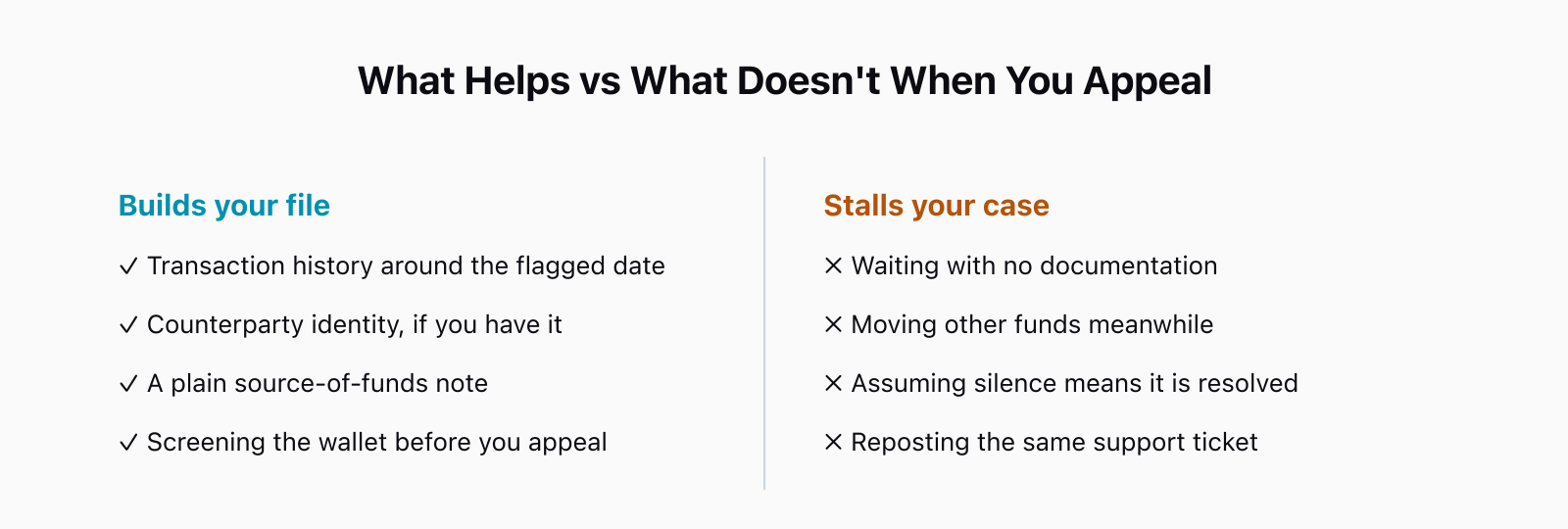
Start by building the file the compliance team would otherwise have to build itself: the transaction history around the flagged date, the counterparty's identity if you have it, and a plain-language account of where the funds came from. Send it even if nobody asked. A silent review often reopens the moment new evidence lands on the desk, instead of sitting in a queue nobody is actively watching.
Patience moves nothing. Paper does.
One habit actively hurts you: moving other funds around while the review is open. Exchanges read sudden transfers out of unrelated accounts during an active freeze as evasion, not caution, and it's a documented way to turn a single flagged deposit into a full account lock. Sit still, answer in writing, and keep every reply from support with a timestamp attached.
The Bitget cases above split exactly on this point. The Russian client with no documentation waited four months for an unexplained, unilateral release. The Ukrainian customer who could name the recipient and point to a specific two-month-old transfer had something to argue with, even though Bitget never closed the loop publicly. See what actually triggers an exchange hold and build your file around that rule, not around a guess, and check how long a comparable review typically runs before you assume the silence means the worst.
The habits that shorten a review are the same ones that build your case while you wait.
FAQ
Can an exchange close my account without saying why?
Yes. Most major exchanges, Kraken included, state outright that they won't disclose the reason for a closure, even on request, and that the decision is generally final absent a successful second review.
Does a frozen account mean I'm under criminal investigation?
Not usually. Automated monitoring software freezes accounts the moment a rule fires, well before any human reviews the case, so most freezes reflect a matched pattern rather than a proven offense.
How long can a crypto account stay frozen with no explanation?
There's no fixed limit. One Bitget customer's hold lifted on its own after four months with no explanation ever given; others resolve in days once documentation is supplied.
What should I send the exchange to get the freeze reviewed?
Send the transaction history around the flagged date, any counterparty identity you can document, and a clear account of where the funds originated, attached before support even asks for it.
Disclaimer: This article is for educational and informational purposes only and is not legal, financial, tax, or compliance advice. Crypto carries risk; you act on this information at your own risk. Always do your own research and consult a qualified professional before making decisions. Views are the author's own and do not constitute financial, legal, or investment advice.
About Plastron
Plastron is a free, non-custodial wallet screening tool. It checks Ethereum and six EVM chains for AML and KYT risk — sanctions exposure, mixer contact, and stolen-funds proximity — and returns a risk report in seconds. It reads public on-chain data only: it never takes custody of funds and never asks for private keys.