TL;DR - Most crypto exchange AML reviews clear within a few days to two weeks, but a source-of-funds request, a sanctions or law-enforcement hit, or a compliance backlog can stretch a hold to 30-90 days or longer.
An account hold lands without warning. One day your withdrawal goes through, the next the funds are stuck and the exchange says only that your account is "under review." There is no statutory clock that forces them to finish by a set date, which is exactly why the wait feels open-ended. What actually decides the timeline is the kind of flag that triggered the review and how fast you answer what the compliance team asks for. This guide breaks down the realistic ranges, what makes one hold clear in days while another drags on for months, and the few things you can do to shorten it.
How long does a crypto exchange AML review take?
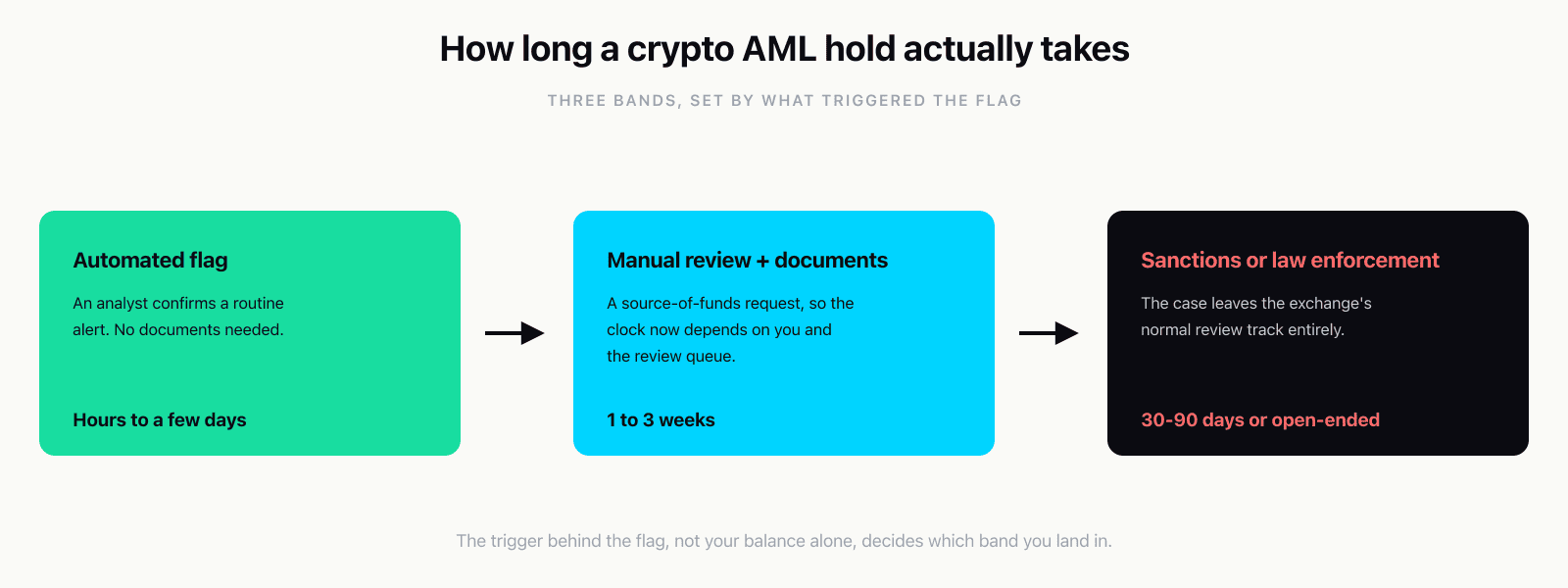
There is no single number, but the cases fall into three rough bands. A routine automated flag, the kind that fires on a large or unusual transaction, often clears in a few hours to a few days once an analyst confirms nothing is wrong. A manual review that comes with a request for documents, usually a source-of-funds check, runs longer: expect one to three weeks while you gather paperwork and the team works through its queue. The third band is open-ended. If the review involves a sanctions match, a confirmed link to stolen funds, or a law-enforcement request, the hold can last 30 to 90 days and sometimes far longer, because the exchange is no longer acting on its own timetable.
The important point is that the exchange sets these windows internally. Anti-money-laundering law tells them to investigate suspicious activity, but it does not give them a deadline to release your funds. So two users flagged on the same day can wait wildly different amounts of time.
Why do some holds clear in days and others drag on for weeks?
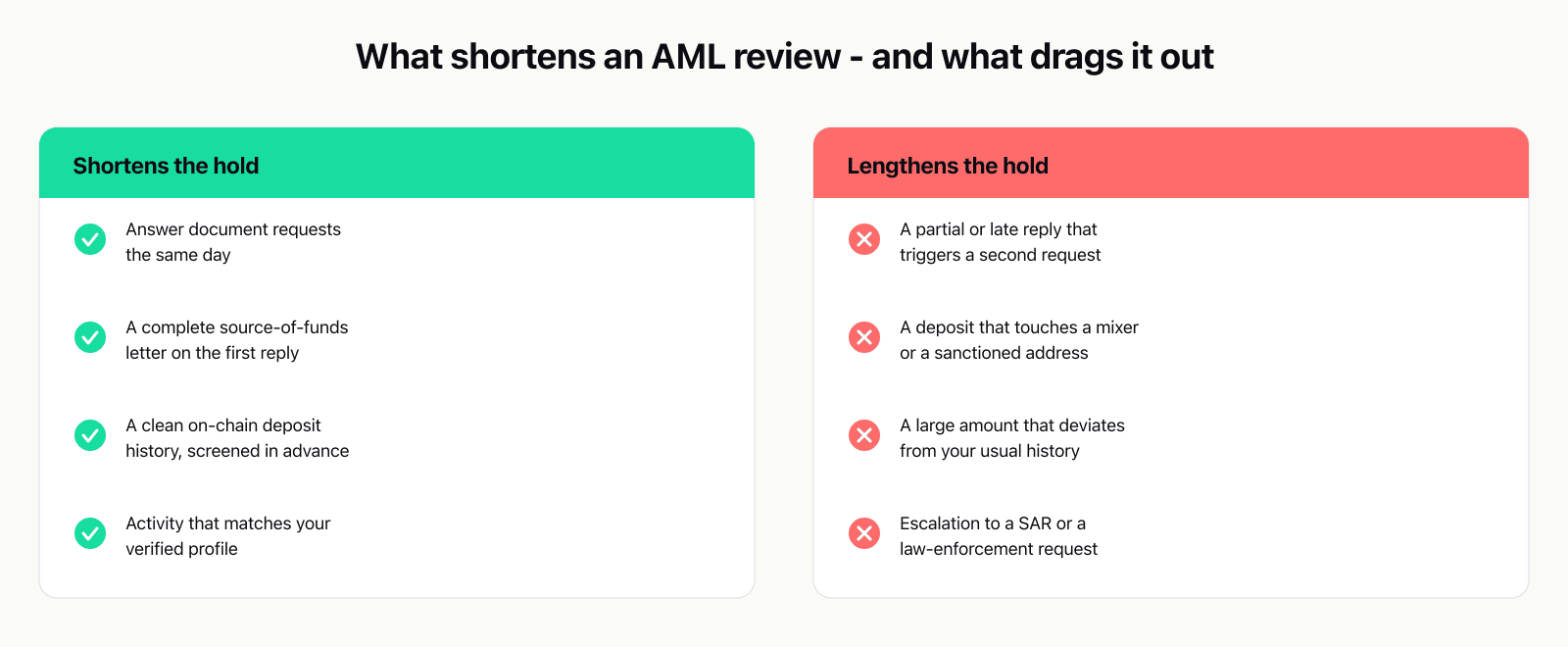
The single biggest factor is whether the exchange asks you for documents. An internal-only check, where an analyst reviews your history and clears it, is fast. The moment they email you for a source-of-funds letter, bank statements, or proof of where the crypto came from, the clock now depends on you and on their backlog.
Several other things lengthen a hold. A large amount draws closer scrutiny than a small one. Deposits whose on-chain history touches a mixer, a sanctioned address, or a known scam wallet take longer to clear because the analyst has to trace the exposure. Trading behaviour that does not match your stated profile - a verified retail user suddenly moving six figures - raises questions. Weekends, holidays, and understaffed compliance desks add days on their own. And if your case gets escalated to a Suspicious Activity Report or a law-enforcement query, it leaves the normal review track entirely.
The trigger behind the flag, not the size of your balance alone, sets which band your hold falls into.
What is the exchange doing while your funds are held?
A review is not the team sitting on your money for no reason. Behind the hold, an exchange runs transaction monitoring and know-your-transaction screening on the deposit. It traces where the incoming crypto came from, checks the counterparties against sanctions and risk lists, and compares your activity to the profile you gave at sign-up.
If the analyst still has doubts, they ask you to explain the source of the funds. In parallel, a regulated exchange may file a Suspicious Activity Report with its financial regulator. By law it cannot tell you a report was filed, and a report on its own is not an accusation - it is a disclosure the exchange is required to make. Knowing this helps you read the silence: limited communication during a hold is often a legal constraint, not a sign that your case is hopeless.
How can you make an AML review go faster?
You cannot control the queue, but you control the half of the timeline that depends on you. Three habits do most of the work.
First, respond fast and respond completely. If they ask for a source-of-funds letter, send a clear, documented one the same day rather than a partial reply that triggers a second request. A well-prepared source of funds letter answers the question in one pass. Second, do not move other funds around or open a new account while the review runs; that reads as evasive and can extend the hold. Third, keep your records straight so you can prove a clean trail in minutes.
It also helps to know what the exchange will see before they see it. You can read your own deposit's history by hand on a block explorer such as Etherscan, tracing each hop back to its origin, though that is slow and only covers one chain at a time. Screen your wallet with Plastron to see the same sanctions, mixer, and stolen-funds exposure across Ethereum and six other chains in seconds, so a source-of-funds request holds no surprises. If you find a high-risk link before you deposit, you can avoid the hold entirely - the same logic behind screening deposits in advance.
Half of the timeline is the exchange's queue; the other half is how fast and complete your answer is.
Can a crypto AML hold last forever?
Most holds end. Once the analyst clears the flag or accepts your documents, funds are released and the account returns to normal. The exceptions are the cases that leave the exchange's hands. A confirmed sanctions match, a court order, or an active law-enforcement seizure can freeze funds indefinitely, and a stablecoin issuer freezing a blacklisted address is a separate action the exchange cannot reverse. If a hold runs past several weeks with no movement, treat it as a documentation and escalation problem: get the exchange's reason in writing, supply everything they ask for, and if the amount is significant, get legal advice. Persistent, well-documented follow-up is what resolves a stalled AML review.
FAQ
Is there a legal time limit on how long an exchange can hold my funds?
No fixed limit applies in most jurisdictions. AML rules require the exchange to investigate suspicious activity, but they do not set a deadline to release funds. The timeline is driven by the exchange's internal process and any law-enforcement involvement.
Why won't the exchange tell me why my account is under review?
Often it legally cannot. If it has filed a Suspicious Activity Report, it is barred from telling you. Limited communication during a hold is usually a compliance constraint, not a sign the case is unresolved against you.
Does sending my source-of-funds documents speed up the review?
Usually yes. A complete, clearly documented reply on the first attempt removes the main reason a review stalls. Partial or late replies trigger follow-up requests that restart the wait.
Can I do anything to avoid an AML hold before I deposit?
Screen the funds before they move. Checking your deposit's on-chain history for mixer, sanctions, or stolen-funds exposure lets you spot a high-risk link before the exchange does, so you can avoid depositing something that would trigger a hold.
Disclaimer: This article is for educational and informational purposes only and is not legal, financial, tax, or compliance advice. Crypto carries risk; you act on this information at your own risk. Always do your own research and consult a qualified professional before making decisions. Views are the author's own and do not constitute financial, legal, or investment advice.
About Plastron
Plastron is a free, non-custodial wallet screening tool. It checks Ethereum and six EVM chains for AML and KYT risk — sanctions exposure, mixer contact, and stolen-funds proximity — and returns a risk report in seconds. It reads public on-chain data only: it never takes custody of funds and never asks for private keys.