TL;DR: Exchanges freeze accounts when a deposit traces back to a high-risk source, so screen the origin of incoming funds before you send them in and you avoid the freeze entirely.
A deposit lands, and instead of a balance update you get a notice that your account is under review and withdrawals are blocked. The funds were not stolen by you, but they passed through an address the exchange's compliance system distrusts. Account freezes almost always trace back to where the money came from, which means the freeze is preventable if you check the origin before the deposit ever leaves your wallet.
Why do exchanges freeze accounts over a deposit?
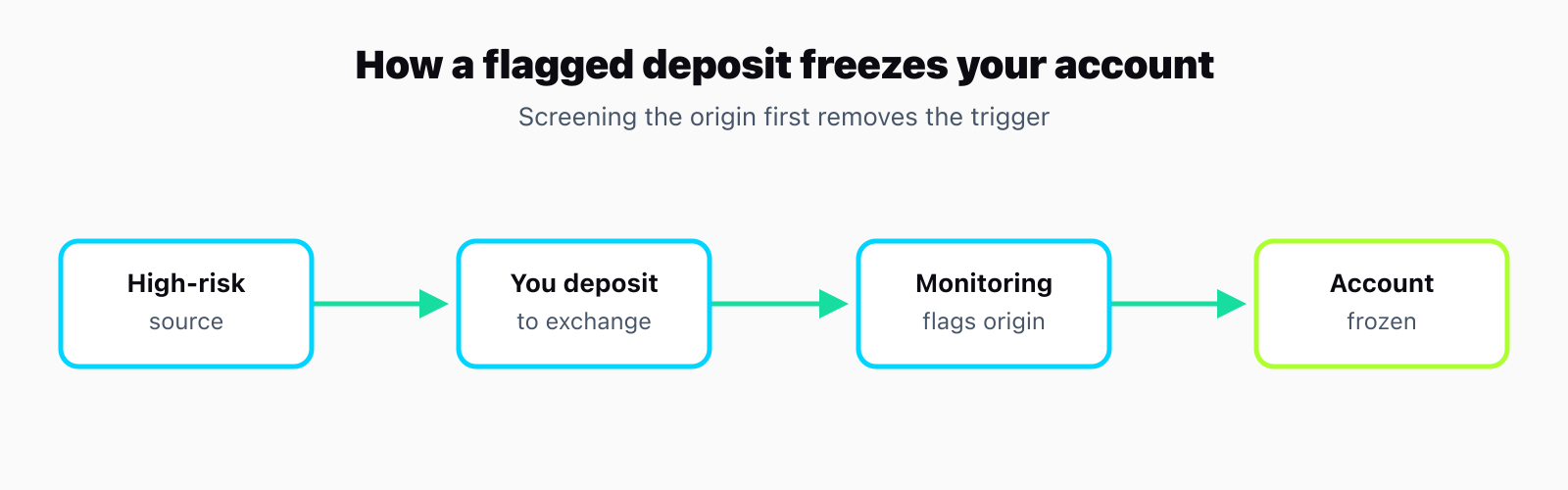
Centralized exchanges are regulated money businesses with anti-money-laundering obligations. They run every incoming transaction through transaction-monitoring tools that trace where the funds have been, and a deposit linked to illicit activity can put the receiving account under a mandatory review.
When the monitoring system flags an inbound transfer, the exchange typically freezes withdrawals and asks you to prove the source of the funds before it releases anything. The hold is not a punishment; it is the exchange protecting its own license. That distinction does not help you when your balance is locked, which is why the origin of a deposit matters more than its amount.
The freeze is triggered by the deposit's origin, not by you, which is exactly why screening the source beforehand prevents it.
What makes a deposit high-risk?
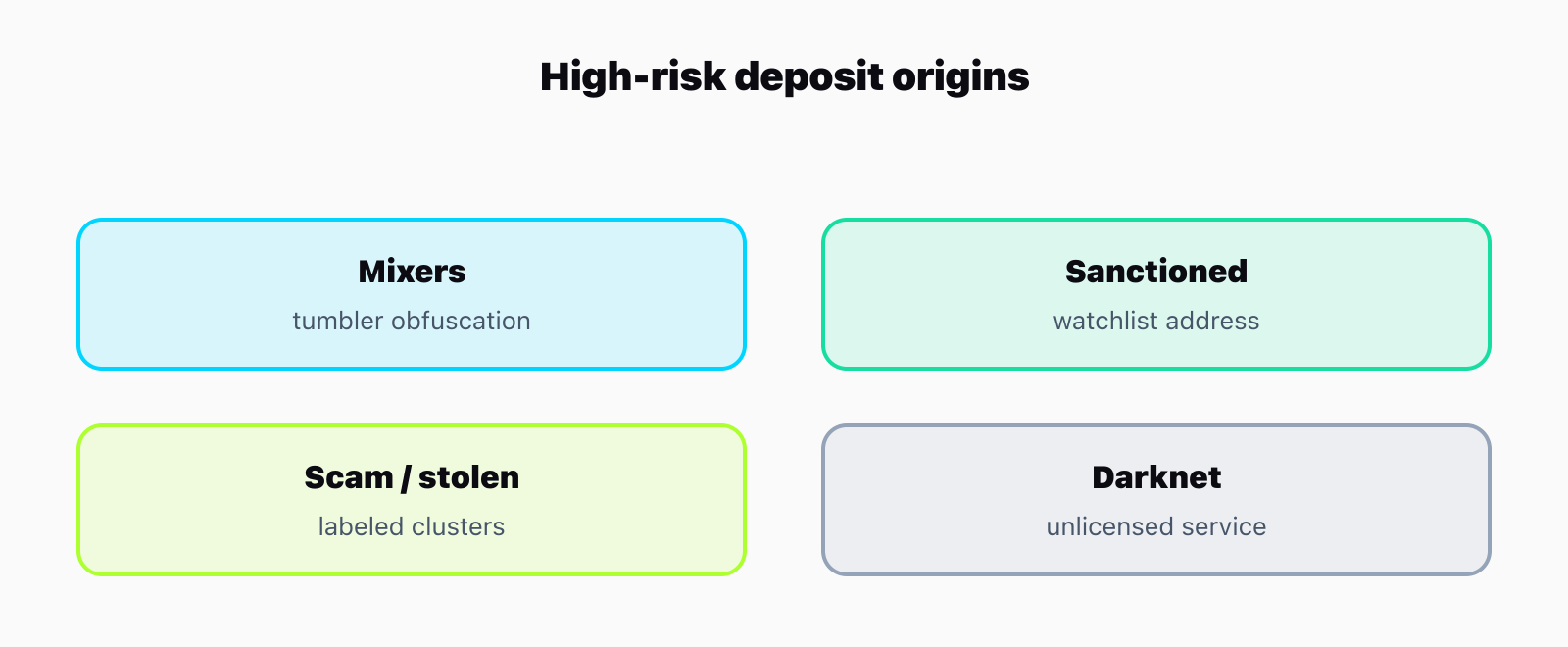
Monitoring tools score an address by its exposure to known illicit activity, both directly and through a few hops of counterparties. A handful of origins reliably raise the alarm.
Funds that recently passed through a mixer or tumbler, which is treated as deliberate obfuscation.
Transfers from sanctioned addresses or entities on an official watchlist.
Proceeds linked to scams, hacks, or stolen-funds clusters that analytics firms have labeled.
Money routed straight from a darknet market or an unlicensed high-risk gambling service.
Distance matters too. A direct transfer from a flagged address is worse than funds that are several independent hops away, but a large, close link is what turns a routine deposit into a frozen account.
Four origins drive most freezes; a close, large link to any of them is what turns a normal deposit into a locked account.
How do you screen a deposit's origin before you send it?
The safe move is to check the sending address before the funds touch an exchange, while you still control where they go.
Trace the address that is paying you and look at where its balance came from, not just the latest transaction.
Check whether that address or its recent counterparties appear on a sanctions list.
Treat any mixer, scam, or stolen-funds link as a reason to route the funds elsewhere first.
Reading a block explorer hop by hop is possible but slow, and it rarely surfaces indirect exposure that an exchange will still catch. Rather than tracing one address at a time, screen the deposit's origin with Plastron to see sanctions, mixer, and stolen-funds exposure across Ethereum and six chains before you send anything in. It is the same logic behind any crypto wallet screening check, applied to money you are about to receive.
What should you do if your account is already frozen?
If the hold has already happened, how you respond decides how fast you get access back. Ignoring the review is the one move that reliably makes it worse.
Respond to the source-of-funds request promptly with transaction hashes and any records you have.
Explain the origin honestly, including how the funds reached you, rather than guessing.
Screen your own address so you understand exactly what the exchange flagged before you reply.
Avoid moving other funds through the same path while the review is open.
The cleaner your records and the clearer the origin, the faster a review resolves. If the deposit came from a fraudster, the situation overlaps with what to do when a wallet receives USDT from a scammer.
FAQ
Can an exchange freeze my account for one small flagged deposit?
Yes. A freeze is driven by the origin of the funds, not the amount. Even a small transfer with a close link to a sanctioned or stolen-funds address can trigger a review.
Will screening a deposit before I send it guarantee no freeze?
No screen is a guarantee, but checking the origin lets you avoid the obvious high-risk sources that cause most freezes, which removes the main trigger before it happens.
Does receiving high-risk funds make me guilty of anything?
Receiving tainted funds is not the same as laundering them, but it can still freeze your access pending review. The practical risk is lost time and blocked funds, not automatic liability.
How far back do exchanges trace a deposit?
Monitoring tools follow funds through several hops of counterparties, so an address can be flagged for exposure it picked up before it ever reached you.
Disclaimer: This article is for educational and informational purposes only and is not legal, financial, tax, or compliance advice. Crypto carries risk; you act on this information at your own risk. Always do your own research and consult a qualified professional before making decisions. Views are the author's own and do not constitute financial, legal, or investment advice.
About Plastron
Plastron is a free, non-custodial wallet screening tool. It checks Ethereum and six EVM chains for AML and KYT risk — sanctions exposure, mixer contact, and stolen-funds proximity — and returns a risk report in seconds. It reads public on-chain data only: it never takes custody of funds and never asks for private keys.