TL;DR - Yes, Circle can freeze any USDC wallet at the smart-contract level without notice, based on someone else's investigation, and there is no public appeal process to reverse it quickly.
USDC isn't bearer money the way cash is. It's a liability on Circle's balance sheet, and Circle can turn it off - for you, not just for the criminals a freeze was aimed at.
How Can Circle Freeze a Wallet That Broke No Rules?
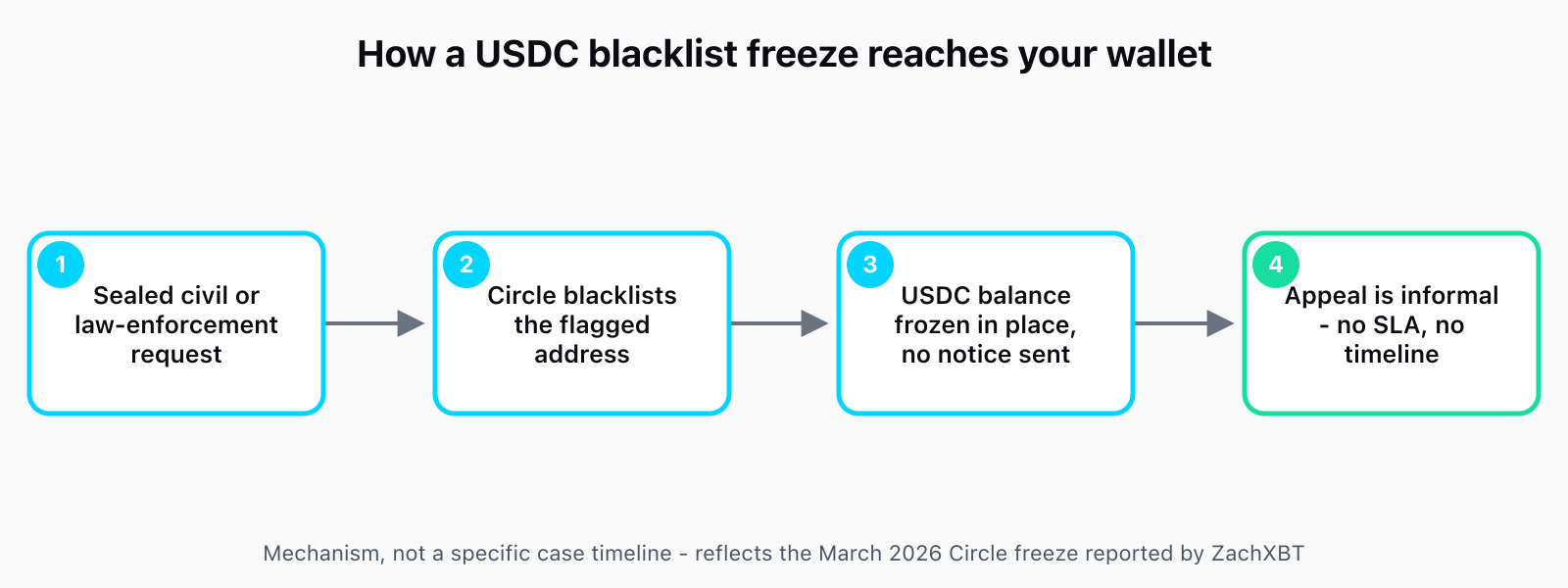
USDC is an ERC-20 token, and Circle's contract carries a blacklist function that Circle alone controls. Add an address to that list and the balance sitting there stops moving - it doesn't matter who holds the private key or what that person actually did. Circle doesn't need a court order naming you specifically. A request tied to an investigation into someone else's business is enough to catch your address in the same net.
That's the part most USDC holders never think about. An exchange freeze comes with a login, a support ticket, a case number. A blacklist entry is just an on-chain flag, applied from outside, with no notification built in.
Plastron's own screening corpus tracks 3,901 labeled addresses, including 780 on OFAC's sanctions list alone - and none of that would have caught this. A sanctions match is public and checkable. A sealed civil request isn't. See how the same blacklist mechanism plays out for USDT and USDC more broadly.
The freeze runs on a four-step mechanism with no notification step and no fixed appeal window at the end of it.
What Actually Happened in the March 2026 Circle Freeze?
On March 25, 2026, Circle froze 16 wallets belonging to operating crypto exchanges, online casinos, and foreign-exchange businesses, tied to a sealed U.S. civil matter. On-chain investigator ZachXBT called it "the single most incompetent freeze" he'd seen in five-plus years of tracking stolen funds - the wallets belonged to functioning businesses, not sanctioned entities.
One of them, run by the crypto casino Goated.com, was unfrozen by March 26. No public explanation followed for why it had been swept up in the first place. The other 15 stayed frozen with no published timeline.
Is There Any Way to Appeal a USDC Freeze?
Not really, and not on any fixed clock. Circle's terms reserve broad discretion to freeze addresses tied to law enforcement or civil requests, but there's no published appeal form and no service-level agreement for review. Circle didn't respond to press inquiries about the March incident either.
Your real lever is the party that requested the freeze - usually a law firm, a court, or an agency working the underlying case. Getting a business wallet unfrozen can take days, sometimes longer, with no guarantee anyone tells you why. If your funds got held for a different reason, check why an exchange might have frozen a deposit instead - the two triggers aren't the same thing.
Does This Happen to Bridged or Wrapped USDC Too?
No. Only native USDC issued directly on Circle's own contract carries Circle's blacklist function. A bridged or wrapped representation on another chain runs on a different contract, owned by the bridge, not by Circle - it can have its own freeze mechanics, but Circle's blacklist can't reach it.
The ticker on your wallet screen doesn't tell you which contract you're actually holding. That distinction is exactly what matters here.
How Do You Avoid Getting Caught in Someone Else's Freeze?
You can't predict a sealed civil case. What you can control is who you transact with before the money lands.
Most people check an unfamiliar address on a block explorer like Etherscan and call it done. That only shows raw transaction history, not a risk classification - screening the address with Plastron shows sanctions exposure, mixer contact, and stolen-funds links across Ethereum and six other chains in the same look, before it becomes your problem instead of theirs.
FAQ
Can Tether Freeze USDT the Same Way Circle Freezes USDC?
Yes. Tether's contract has its own blacklist function, and Tether has frozen addresses tied to law-enforcement requests before, including wallets connected to hacks and scams. The mechanism is the same: an issuer-level blacklist, not an exchange-level account freeze.
How Long Does a USDC Freeze Usually Last?
There's no fixed timeline. In the March 2026 incident, the first reversal came roughly a day after the freeze, and the remaining 15 wallets stayed frozen with no published resolution date. Freezes tied to active investigations can run for weeks.
Does Circle Explain Why It Froze a Specific Wallet?
Not publicly, and rarely to the wallet owner directly. In the March 2026 case, Circle gave no on-record response to press inquiries, and account holders learned only that a transfer request had failed.
Is Bridged USDC Frozen the Same Way as Native USDC?
No. Only the native USDC contract Circle issues carries Circle's blacklist function. Bridged or wrapped versions run on a separate contract controlled by the bridge operator, which has its own freeze mechanics, if any.
Disclaimer: This article is for educational and informational purposes only and is not legal, financial, tax, or compliance advice. Crypto carries risk; you act on this information at your own risk. Always do your own research and consult a qualified professional before making decisions. Views are the author's own and do not constitute financial, legal, or investment advice.
About Plastron
Plastron is a free, non-custodial wallet screening tool. It checks Ethereum and six EVM chains for AML and KYT risk — sanctions exposure, mixer contact, and stolen-funds proximity — and returns a risk report in seconds. It reads public on-chain data only: it never takes custody of funds and never asks for private keys.