TL;DR: Both USDC and USDT are centrally controlled, so Circle and Tether can freeze any address on-chain with a single blacklist transaction, which is why you should check an address before you accept or send stablecoins.
Stablecoins feel like cash, but the two largest ones ship with a kill switch. The issuer can flip a flag on any wallet, and the frozen address can no longer move that token even though it never lost its private keys. Knowing how the freeze works, why issuers use it, and how to read the on-chain flag yourself is the difference between catching a tainted counterparty early and finding your own deposit blocked.
How can Circle and Tether freeze a stablecoin address?
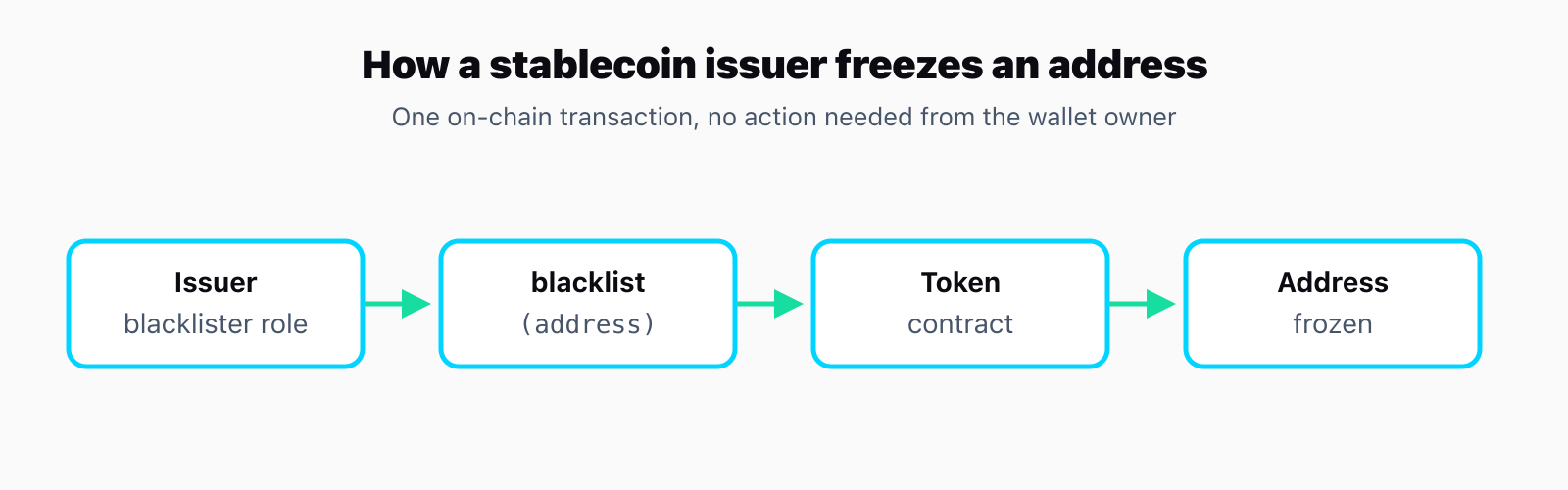
USDC and USDT are ERC-20 tokens with extra administrative powers written into the contract. A freeze is one transaction sent by a privileged role; it does not need your signature and you cannot reverse it.
USDT uses addBlackList(address) to flag a wallet, after which every USDT transfer out of it is rejected at the contract level.
USDT also exposes destroyBlackFunds(address), which permanently burns the entire USDT balance of an already-blacklisted wallet.
USDC uses blacklist(address) to block a wallet from sending or receiving USDC, and unBlacklist(address) to reverse it.
A blacklisted wallet can usually still hold and move unrelated assets like ETH; only the targeted stablecoin is locked. Every freeze is a public on-chain event, which is exactly why you can verify one yourself instead of trusting a screenshot or a counterparty's word.
A single blacklist transaction from the issuer's privileged role locks the token in the target address, with no action needed from the wallet owner.
Why do stablecoin issuers blacklist an address?
Issuers freeze addresses to comply with the law, not on a whim. The usual triggers are sanctions designations, court orders, and confirmed theft where law enforcement asks the issuer to lock stolen funds in place.
The clearest precedent is Tornado Cash. Within hours of the U.S. Office of Foreign Assets Control sanctioning the mixer in August 2022, Circle blacklisted the USDC sitting in the sanctioned addresses, freezing it for everyone who had touched the service. More recently, in a 2026 civil case a U.S. federal court ordered Circle to blacklist about $12.6 million in USDC tied to an alleged misappropriation of funds. Tether runs the same playbook far more often, acting on requests from prosecutors and exchanges across dozens of jurisdictions.
How is USDC freezing different from USDT freezing?
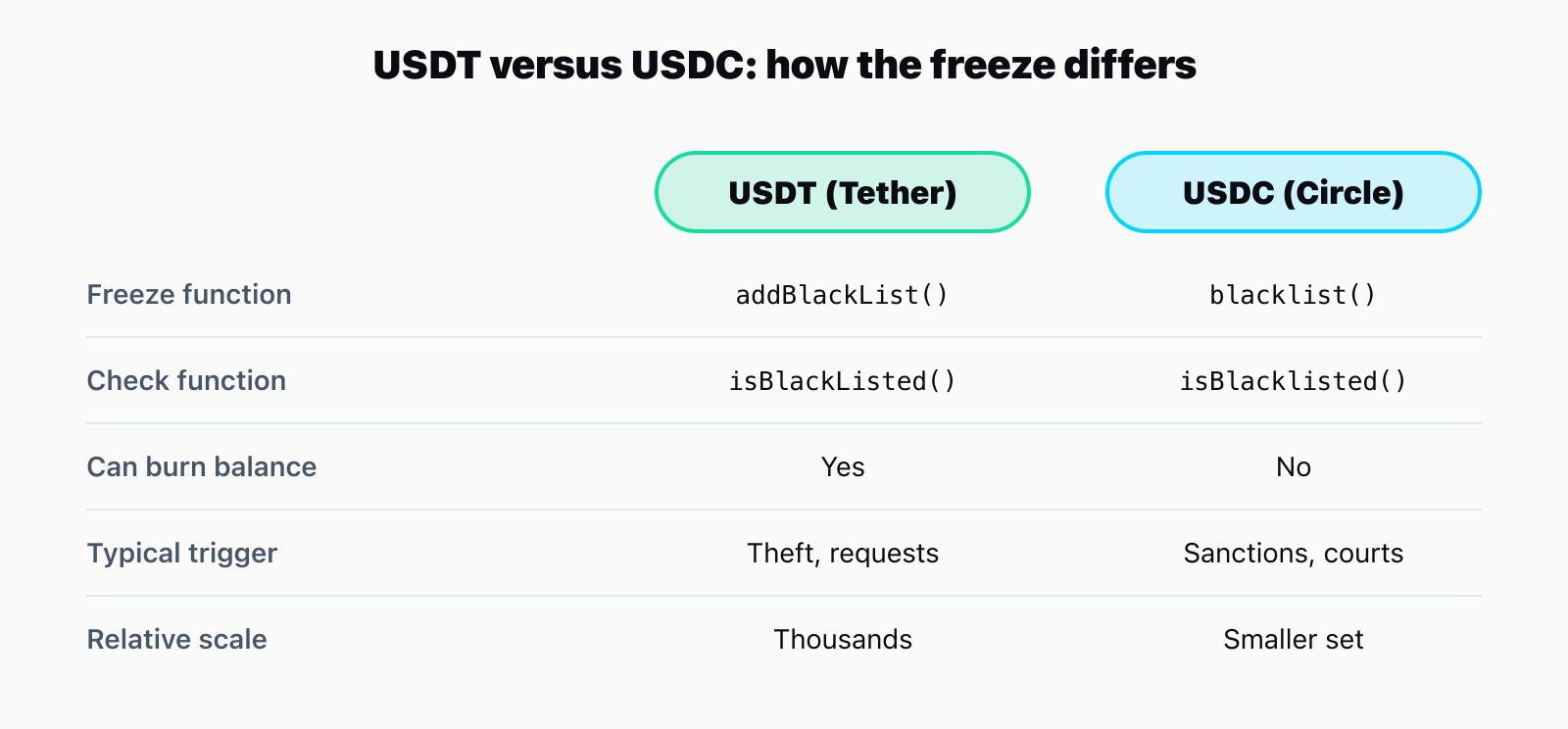
Both issuers can freeze, but they do it at very different scales and for different reasons. Tether has blacklisted thousands of addresses holding billions of dollars of USDT over the years, while Circle freezes a far smaller set, almost always tied to sanctions or a court order.
Dimension
USDT (Tether)
USDC (Circle)
Freeze function
addBlackList
blacklist
Check function
isBlackListed
isBlacklisted
Can burn balance
Yes, via destroyBlackFunds
No burn function
Typical trigger
Prosecutor and exchange requests, theft
OFAC sanctions, court orders
Relative frequency
Thousands of addresses
A much smaller set
The practical takeaway: USDT exposure is more likely to involve a direct freeze or burn, while USDC exposure usually centers on sanctions and legal seizures. Either way, the flag lives on-chain and you can read it.
Tether freezes far more often and can burn balances outright, while Circle freezes a smaller set, mostly for sanctions and court orders.
How do you check if an address is frozen before you transact?
You can read the freeze flag straight from the contract in under a minute. The check is free, read-only, and never asks you to connect a wallet or sign anything.
For USDT, open the contract 0xdAC17F958D2ee523a2206206994597C13D831ec7 on Etherscan, go to Read Contract, and call isBlackListed with the address.
For USDC, open the contract 0xA0b86991c6218b36c1d19D4a2e9Eb0cE3606eB48 on Etherscan, open Read as Proxy, and call isBlacklisted with the address.
A true result means the address is frozen for that token, while false means it is not blacklisted at that moment.
A clean blacklist result is necessary but not sufficient. It tells you the issuer has not frozen the wallet yet, but says nothing about whether the address sits one hop from sanctioned or stolen funds, which is what a centralized exchange flags on deposit. Rather than checking one contract at a time, screen the address with Plastron to see blacklist status alongside sanctions, mixer, and stolen-funds exposure across Ethereum and six chains at once. This is the same logic behind any crypto wallet screening check, and it pairs naturally with a sanctions screen of the Ethereum address.
What should you do if a stablecoin address is frozen or exposed?
If your own address is already blacklisted, recovery runs through the issuer and usually law enforcement, not a quick fix. If the address is only exposed rather than frozen, act before you move the funds.
Do not forward frozen or tainted stablecoins to a centralized exchange, because that is what converts quiet exposure into a blocked deposit.
Screen the address to see how close the flagged funds sit and what else is attached to them.
Keep records of the sender address, the transaction hash, and any report you filed.
Ignore any service offering to unfreeze an address for a fee, because issuers never charge to lift a blacklist and the offer is a scam.
If you received tainted stablecoins from a fraudster, the response overlaps heavily with what to do when your wallet receives USDT from a scammer.
FAQ
Can Circle or Tether freeze my USDC or USDT without warning?
Yes. A freeze is a single administrative transaction the issuer can send at any time, with no prior notice and no need for your signature.
Does a blacklisted address lose all of its crypto?
No. Only the targeted stablecoin is locked. USDT can also be burned with destroyBlackFunds, but unrelated assets like ETH usually stay movable.
Is checking isBlacklisted safe and free?
Yes. Reading isBlacklisted or isBlackListed on Etherscan is free, read-only, and never requires connecting your wallet or signing a transaction.
Can a frozen stablecoin address ever be unfrozen?
Sometimes. The issuer can reverse a freeze with unBlacklist or removeBlackList, but it typically does so only after a court order or a completed investigation.
Disclaimer: This article is for educational and informational purposes only and is not legal, financial, tax, or compliance advice. Crypto carries risk; you act on this information at your own risk. Always do your own research and consult a qualified professional before making decisions. Views are the author's own and do not constitute financial, legal, or investment advice.
About Plastron
Plastron is a free, non-custodial wallet screening tool. It checks Ethereum and six EVM chains for AML and KYT risk — sanctions exposure, mixer contact, and stolen-funds proximity — and returns a risk report in seconds. It reads public on-chain data only: it never takes custody of funds and never asks for private keys.