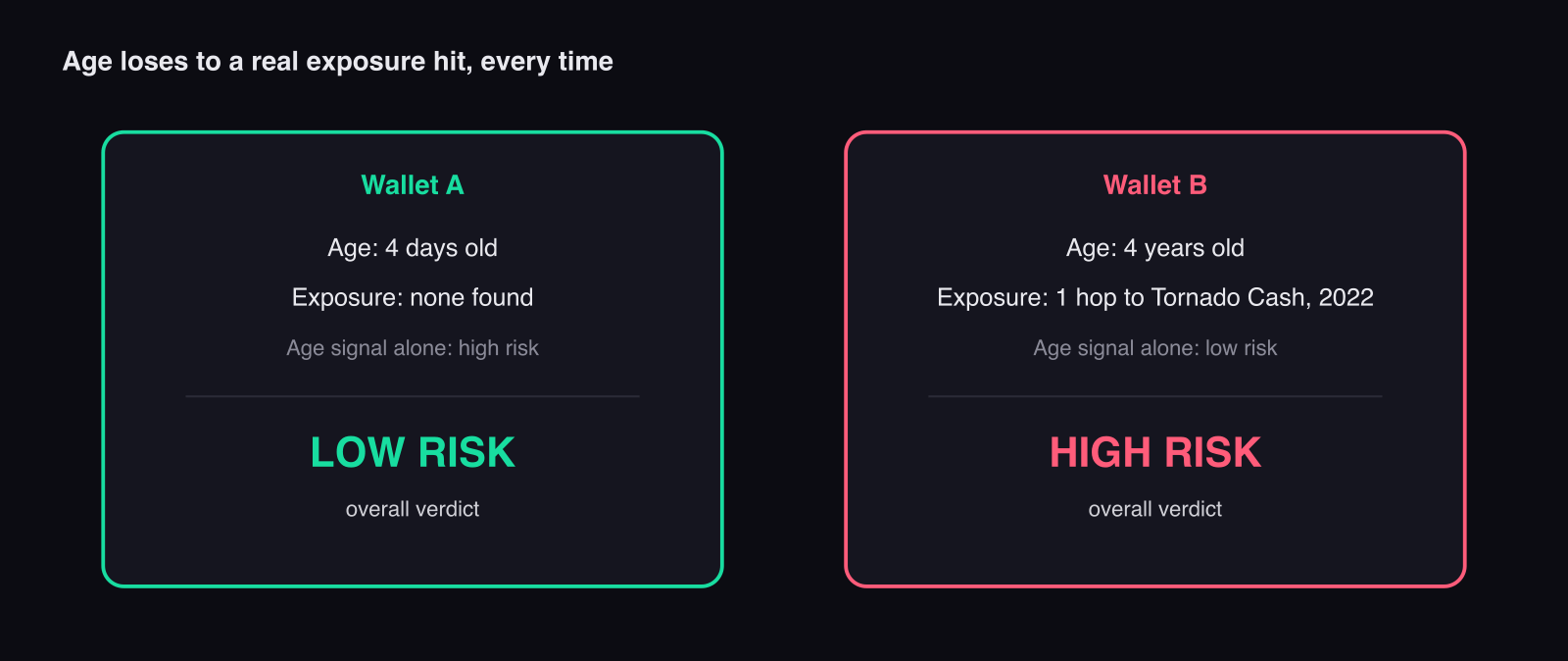
TL;DR - A wallet's age is treated as a risk signal on its own, before it sends a single transaction, because every screening model weights how new an address is.
A flagged wallet isn't proof of wrongdoing. It's proof the wallet hasn't existed long enough to earn the benefit of the doubt.
Your wallet is 4 hours old, it holds exactly one deposit, and the exchange you're trying to withdraw to wants a selfie and a source-of-funds explanation before it lets the transfer through. Nothing about the transaction itself looks wrong. The address does.
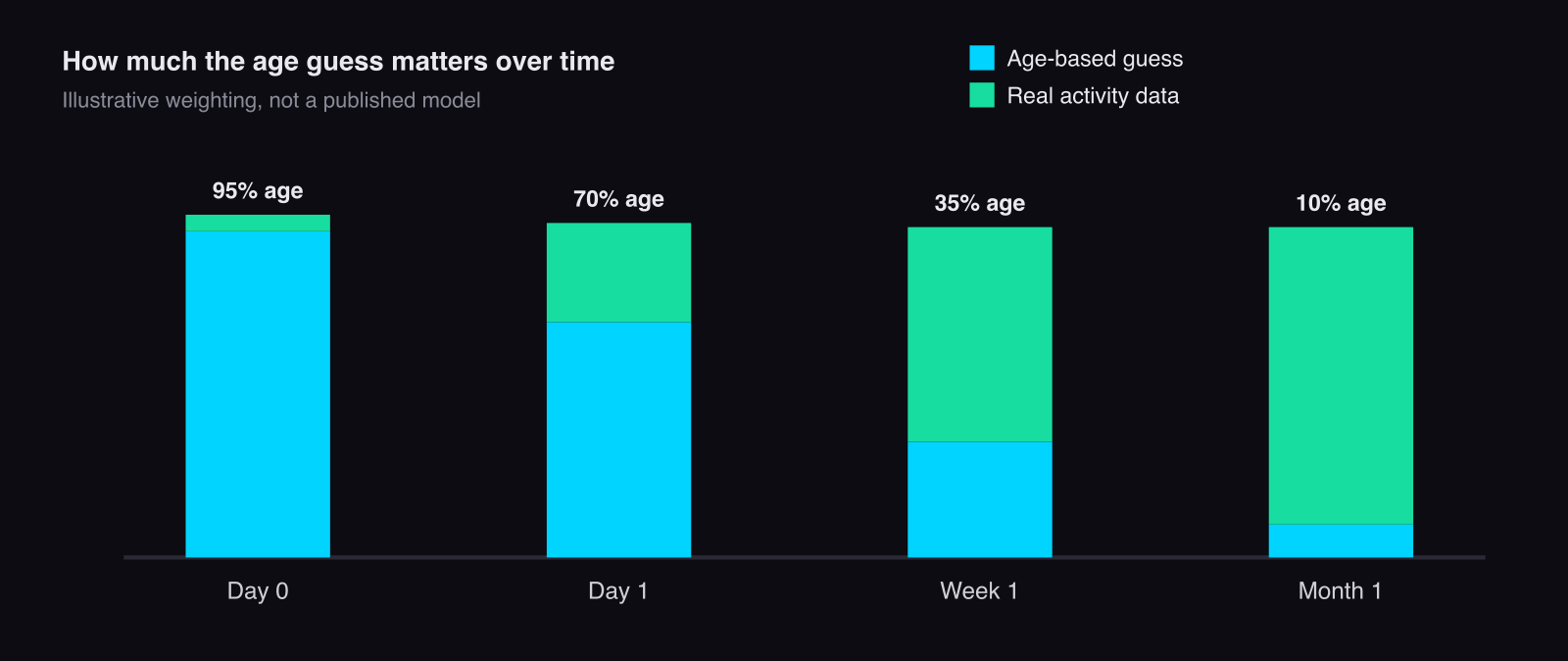
Most explanations of wallet screening treat age as a footnote behind sanctions hits and mixer exposure. That ordering is backwards for a first-time depositor. Age is one of the only signals a screening model can read before a wallet has done anything at all, and it gets weighted that way on purpose. It fades fast once real activity arrives, but on day one it's doing most of the work.
Why does a wallet's age matter to a screener?
Every wallet carries a firstSeen timestamp: the date of its earliest transaction on-chain. A screening model reads that date before it reads anything else, because it's often the only signal available on an address with zero transaction history. A 4-hour-old wallet has no counterparties to trace and no labels to check, so age becomes a stand-in prior - a rough starting guess at risk that gets revised the moment real activity shows up.
Webacy's wallet risk model lists age next to transaction count, contract approvals and restricted-address hits as one of a handful of inputs that set a wallet's starting score. Elliptic's compliance guidance goes further: it tells screening teams to grade retail wallets against different age thresholds than exchange hot wallets, because the same 3-day-old timestamp means something different depending on whose wallet it is.
That prior doesn't sit still. The moment a wallet starts transacting, the model has real counterparties, real labels and real exposure to weigh, and the age-based guess gets pushed out of the way. A wallet that opens clean and stays clean for a month carries almost none of its original age penalty by the time it reaches that milestone.
Age also isn't always available. A wallet that's never sent or received anything an indexer can find shows up as "Unknown" rather than a date, which is its own signal - a funded address with no discoverable history is a narrower, odder case than a wallet that's simply 3 days old. Plastron records a firstSeen value for every scan on this basis: a real date when one exists, and an explicit unknown when it doesn't, rather than guessing.
A "new" wallet is a moving target, not a fixed cutoff
There's no single industry cutoff, but the pattern in the data points to roughly 3 months. Harpie's wallet-security analysis found that the large majority of the phishing and scam addresses it tracks are younger than that - new enough that the wallet has no track record to vouch for it, and no aged-in trust to borrow from.
That same threshold catches a lot of innocent wallets too. HD wallets generate a fresh receive address for every payment. Exchanges rotate deposit addresses by design. A newly funded wallet is normal behavior dressed up as a red flag just as often as it's an actual one, which is exactly why age works as a weight, not a verdict, in any serious risk model.
Block every wallet under 3 months old and a compliance team drowns in manual reviews for deposits that were never going to be a problem. Ignore age entirely and the same team misses the exact pattern attackers rely on. Neither extreme survives contact with real volume, which is why age ends up as one input among many instead of a gate on its own.
Smart-contract wallets complicate the cutoff further. A freshly deployed account-abstraction wallet can inherit funds and even transaction history from the owner who deployed it, so "new" by deployment date and "new" by actual usage are two different clocks. A screener that only reads the contract's creation block can misjudge both a genuinely fresh scam wallet and a day-old smart wallet backed by a five-year-old owner key.