TL;DR: A crypto risk score is a rating that blockchain analytics tools assign to a wallet based on its exposure to illicit activity, and exchanges use it to decide whether to clear, review, or block your funds.
Two wallets can hold the same balance and be treated completely differently the moment they touch an exchange. The difference is the risk score: a single number or tier that compresses an address's entire on-chain history into a verdict. Understanding what drives that score is the difference between a smooth withdrawal and a frozen account.
What is a crypto risk score?
A crypto risk score is a measure of how closely a wallet is tied to illicit activity, calculated from the addresses it has transacted with. Analytics firms label known bad actors, then trace how value flows to and from your address to estimate exposure. The result is usually expressed as a number, often on a 0 to 100 scale, or as a tier such as low, medium, high, or severe.
The score is not a credit rating and it is not permanent. It reflects the funds and counterparties attached to an address right now, so it can rise after a single risky transfer and ease as clean activity accumulates.
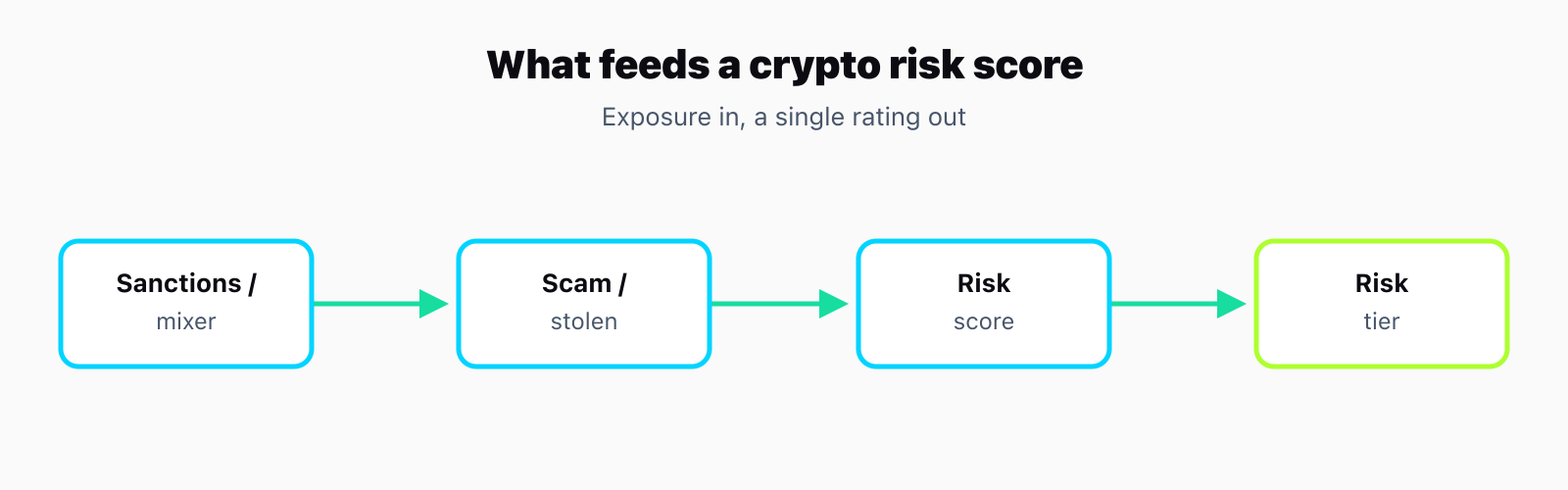
A risk score compresses sanctions, mixer, scam, and stolen-funds exposure into one rating that maps to a risk tier.
What factors raise a wallet's risk score?
Not every input weighs the same. The score reacts most to the type of exposure, how direct it is, and how much value is involved.
Exposure type: sanctioned, stolen, or mixer-linked funds push a score far higher than ordinary exchange activity.
Proximity: a direct transfer from a flagged address counts more than exposure several independent hops away.
Volume and share: a large flagged inflow, or one that dominates the wallet's balance, weighs more than a token amount.
Direction: both receiving from and sending to a flagged address add risk, since either can signal involvement.
This is why two wallets with identical balances score differently. The number is about company kept, not money held.
How do exchanges and analytics tools use the score?
The score is the trigger behind most compliance decisions you never see. Exchanges and custodians run it at deposit, at withdrawal, and during onboarding.
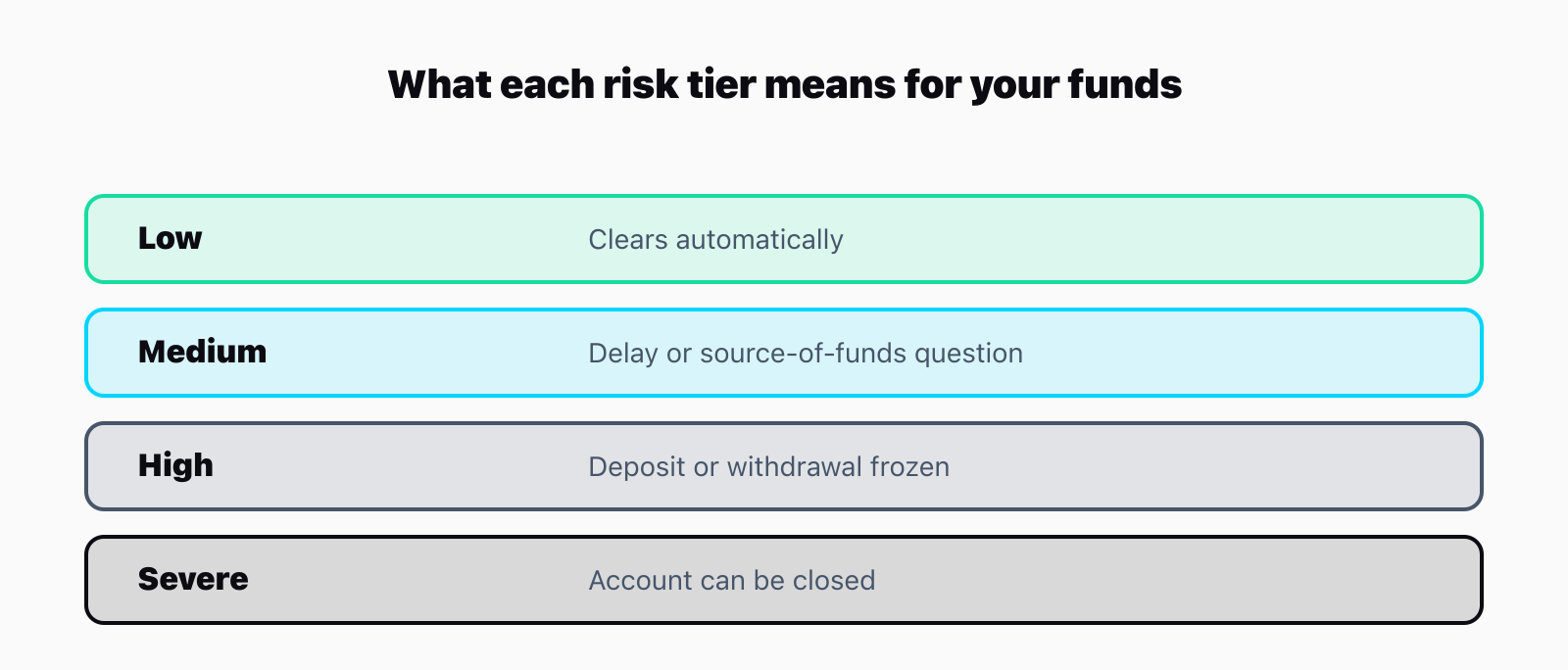
A low score usually clears automatically. A medium score may add friction such as a delayed withdrawal or a source-of-funds question. A high or severe score can freeze a deposit, block a withdrawal, or close an account outright. The same rating drives whether a counterparty wants to transact with you at all, which is why the score matters well beyond a single exchange.
Each tier maps to a concrete exchange action, from an automatic clear at low risk to a possible account closure at severe.
How do you check and lower your wallet's risk score?
You do not have to wait for an exchange to surprise you with a score. You can read it yourself and act on it.
Screen your address to see its current exposure and which counterparties are driving the score.
Avoid accepting funds straight from mixers, sanctioned addresses, or scam-linked clusters.
Keep risky and clean activity separated rather than pooling everything in one wallet.
No. The score reflects current exposure, so it can fall as clean activity accumulates and the share of flagged funds shrinks, though direct sanctioned exposure is hard to dilute.
Can my wallet be high-risk if I never did anything illegal?
Yes. Exposure is transitive, so receiving funds that recently passed through a mixer or a flagged address can raise your score even though you broke no rule.
Do all exchanges use the same risk score?
No. Providers weight factors differently, so scores vary between tools, but the underlying signals such as sanctions, mixer, and stolen-funds exposure are broadly consistent.
Does checking my own risk score affect it?
No. Screening an address is a read-only lookup of public on-chain data. It never moves funds, never touches your keys, and does not change the score.
Disclaimer: This article is for educational and informational purposes only and is not legal, financial, tax, or compliance advice. Crypto carries risk; you act on this information at your own risk. Always do your own research and consult a qualified professional before making decisions. Views are the author's own and do not constitute financial, legal, or investment advice.
About Plastron
Plastron is a free, non-custodial wallet screening tool. It checks Ethereum and six EVM chains for AML and KYT risk — sanctions exposure, mixer contact, and stolen-funds proximity — and returns a risk report in seconds. It reads public on-chain data only: it never takes custody of funds and never asks for private keys.