TL;DR - Form 1099-DA reports gross proceeds from crypto you sold on a custodial exchange in 2025, but it does not cover self-custody transfers or DeFi swaps.
The first Form 1099-DA forms land in mailboxes and exchange dashboards in early 2026, and most crypto holders have never seen one. It is the first tax form built specifically for digital assets, and it changes what the IRS sees about your trading without changing what you actually owe. The confusion is real: people assume the form tracks every wallet move, or that it replaces their own record-keeping. Neither is true, and getting the scope wrong is how an accurate trader ends up with a mismatch notice.
What is Form 1099-DA, and what will it report?
Form 1099-DA is titled Digital Asset Proceeds From Broker Transactions. Custodial brokers - centralized exchanges that hold your coins for you, such as Coinbase or Kraken - must file it with the IRS and send you a copy, the same way a stock brokerage sends a 1099-B. It exists because the 2021 infrastructure law told Treasury to treat digital-asset brokers like securities brokers for reporting purposes.
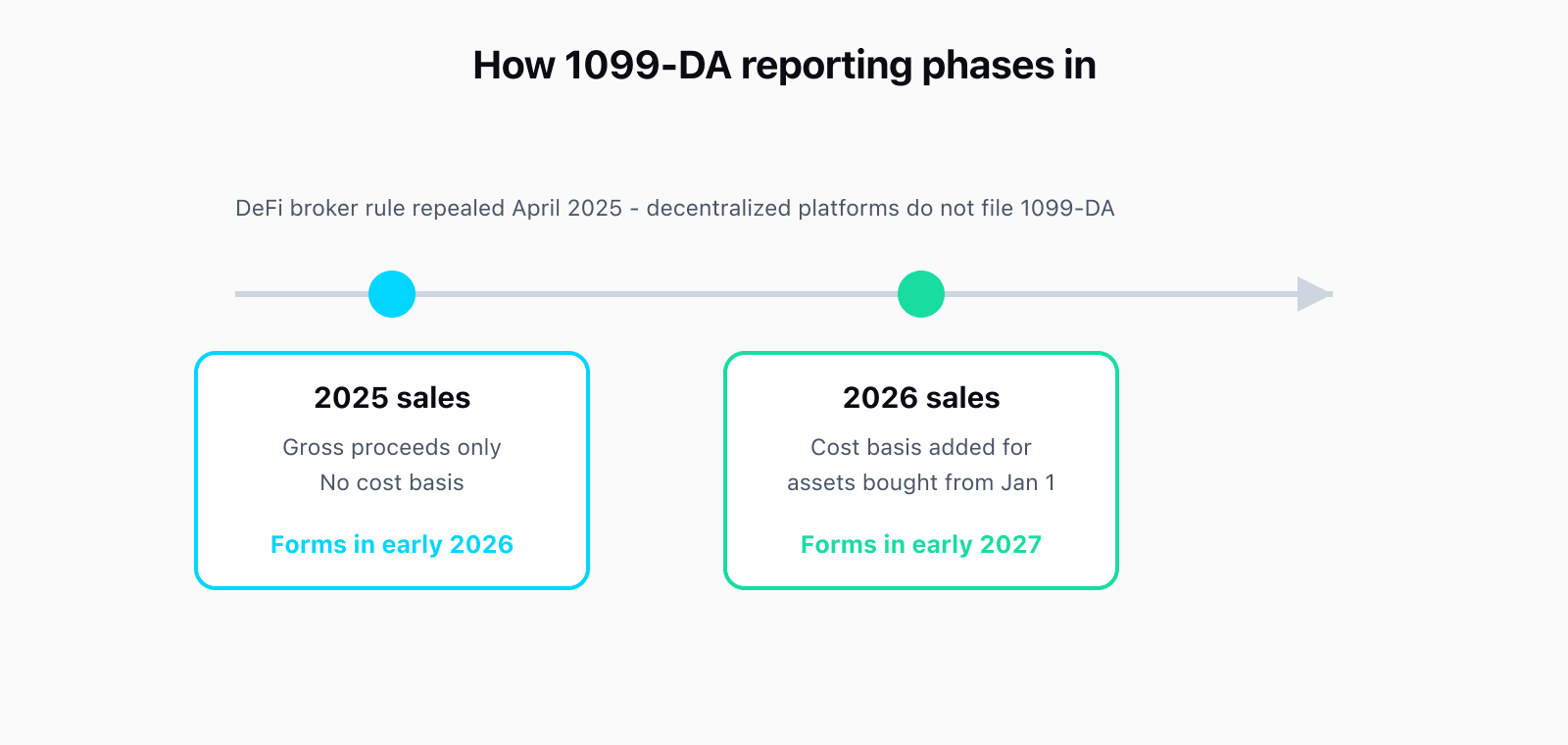
For sales in the 2025 tax year, the form reports gross proceeds only: the dollar amount you received when you sold or exchanged crypto on that platform. It does not yet report your cost basis, meaning what you originally paid. Cost-basis reporting starts for the 2026 tax year, and only for digital assets you buy on or after January 1, 2026 and keep in the same broker's account until you sell. So the first wave of forms, arriving in early 2026, shows proceeds with a blank where the purchase price should be.
The rollout is staged: 2025 forms show gross proceeds only, and cost-basis reporting phases in for assets bought from 2026 onward.
Which of my crypto transactions show up on a 1099-DA?
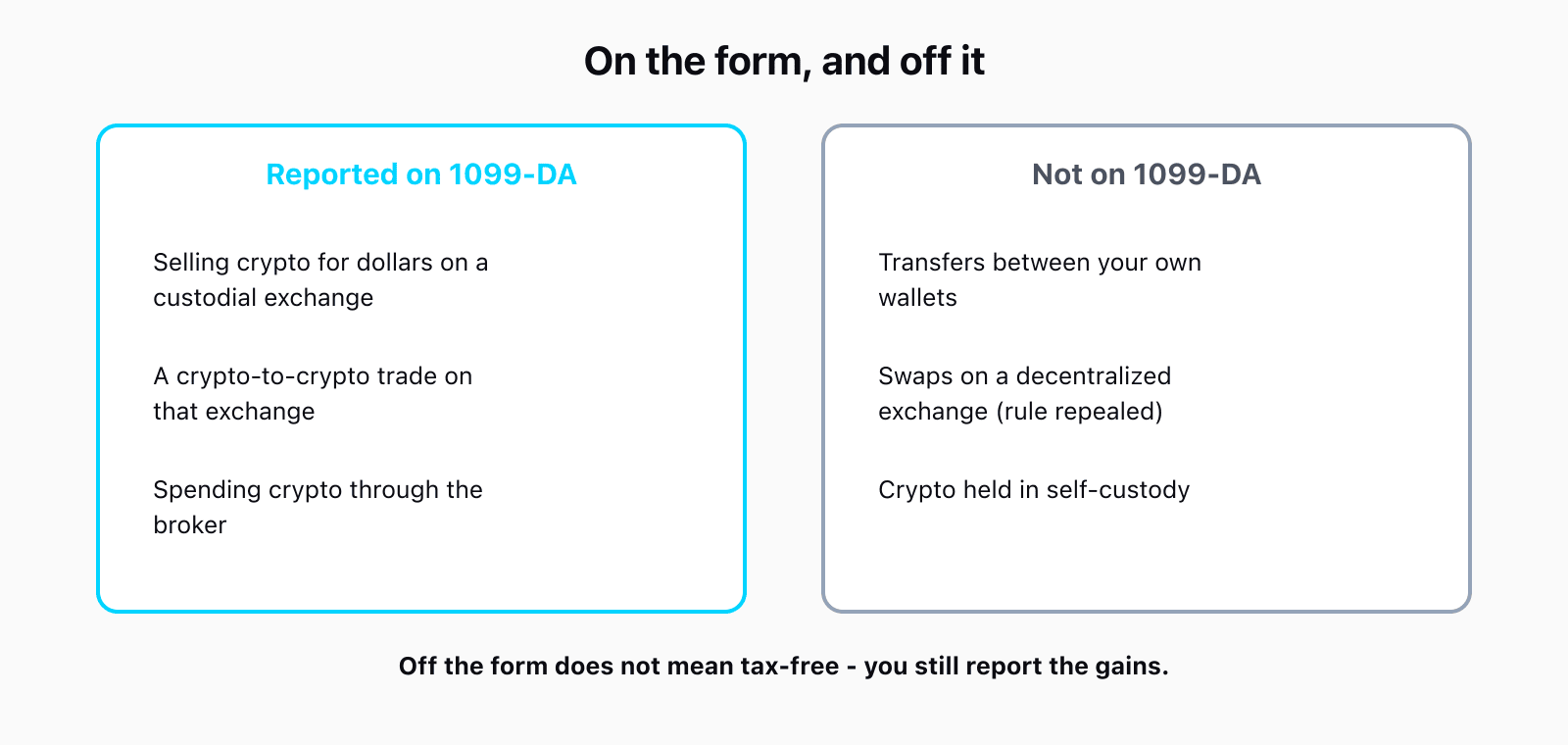
A 1099-DA is triggered by a disposition on a custodial platform: a sale for dollars, a crypto-to-crypto trade, or using crypto to buy something through the broker. Each of those is a taxable event, and the broker reports the proceeds. If you traded on a centralized exchange during 2025, expect a form covering those sales.
What does not appear is just as important. Buying crypto and holding it is not a sale, so a pure purchase is not reported. Moving coins between two accounts you own is a transfer, not a disposition, so it does not generate proceeds on the form either. The form captures the moment you exit a position on the broker, not the full life story of your coins.
The form covers custodial dispositions; self-custody transfers and DeFi swaps fall outside it - which is not the same as being tax-free.
Are my self-custody wallet and DeFi transactions reported on Form 1099-DA?
For the most part, no. A transfer from an exchange to your own hardware wallet, or between two wallets you control, is not a sale, so no 1099-DA is issued for the move itself. The form is a broker document, and a self-custody wallet has no broker standing behind it to file one.
Decentralized platforms are also off the hook, but for a different reason. Treasury had finalized a separate rule that would have forced DeFi front-ends to report like brokers, but Congress repealed it under the Congressional Review Act, and the President signed that repeal into law in April 2025. Because of how that law works, the IRS cannot reissue a similar DeFi rule without new legislation. So a swap on a platform like Uniswap produces no 1099-DA today.
Here is the trap. Off-form is not off the books. You still owe tax on gains from self-custody sales and DeFi swaps, and you are still responsible for reporting them. The 1099-DA simply means the IRS now receives a parallel record for your custodial trades, which it can match against your return.
What should I do when my Form 1099-DA arrives in 2026?
Start by reconciling the form against your own records. Because 2025 forms carry gross proceeds with no cost basis, the IRS could treat your basis as zero if you do nothing, which can inflate your apparent gain and trigger an automated notice. Match each reported sale to your acquisition records so you can report the real cost basis on Form 8949 and pay tax only on the actual gain.
Watch transfer timing too. If you moved coins onto an exchange and then sold, the broker may not know what you paid, so the proceeds can look like pure profit until you supply the basis. Keep a dated log of every acquisition and transfer, the same discipline that helps with a source-of-funds request later.
A 1099-DA also says nothing about whether your coins are clean. It reports what you sold, not where the funds came from, so it will not warn you that a deposit traces back to a sanctioned address, a mixer, or a hack - the kind of exposure that gets a later withdrawal frozen. You can inspect an address by hand on a public explorer such as Etherscan, reading each counterparty backward, but that stops at the first hop and is slow. Rather than tracing it manually, screen the address with Plastron to see sanctions, mixer, and stolen-funds exposure across Ethereum and six other chains at once, with no wallet connection needed. Pairing your tax records with a risk check is how you stay ready for both the IRS and your exchange - see how exchanges trace a deposit's origin for the other half of that picture.
FAQ
Does Form 1099-DA report all of my crypto to the IRS?
No. It reports dispositions on custodial brokers, such as sales and trades on a centralized exchange. Buying and holding, transfers between your own wallets, and swaps on decentralized platforms are not reported on the form, though gains from taxable events still have to be reported on your return.
Will I get a 1099-DA for moving crypto to my own wallet?
No. Moving coins between accounts you control is a transfer, not a sale, so it does not generate a 1099-DA. Only a disposition on the broker, like selling or trading, produces the form.
Why is the cost basis missing on my 2025 Form 1099-DA?
Brokers are not required to report cost basis for 2025 sales, so those forms show gross proceeds only. Cost-basis reporting begins with the 2026 tax year for assets acquired on or after January 1, 2026 and held in the same account. Until then, supply your own basis on Form 8949.
Do decentralized exchanges have to send a 1099-DA?
No. The rule that would have required DeFi front-ends to report was repealed under the Congressional Review Act and signed into law in April 2025. Decentralized platforms do not issue the form, but you are still responsible for reporting gains from those trades.
Disclaimer: This article is for educational and informational purposes only and is not legal, financial, tax, or compliance advice. Crypto carries risk; you act on this information at your own risk. Always do your own research and consult a qualified professional before making decisions. Views are the author's own and do not constitute financial, legal, or investment advice.
About Plastron
Plastron is a free, non-custodial wallet screening tool. It checks Ethereum and six EVM chains for AML and KYT risk — sanctions exposure, mixer contact, and stolen-funds proximity — and returns a risk report in seconds. It reads public on-chain data only: it never takes custody of funds and never asks for private keys.