TL;DR - A business that accepts more than $10,000 in crypto for goods or services generally has a Form 8300 duty, but IRS Announcement 2024-04 paused the digital-asset part of that rule until Treasury issues final regulations.
This question lands on small merchants, freelancers, art dealers, car sellers, and over-the-counter desks the first time a customer pays in Bitcoin or a stablecoin instead of cash. The $10,000 reporting line is old news for physical currency, but the 2021 infrastructure law quietly pulled digital assets into the same statute. Most people who accept crypto have never heard of the form, and the rules are mid-transition right now, which is exactly why the answer is easy to get wrong in both directions.
Does my business owe a Form 8300 for a crypto payment over $10,000?
Form 8300 is the long-standing requirement that a trade or business report receiving more than $10,000 in cash in one transaction or in related transactions. The filing goes jointly to the IRS and FinCEN, and it is due within 15 days of the payment. Until recently it covered only physical currency and a few monetary instruments such as cashier's checks and money orders.
The 2021 Infrastructure Investment and Jobs Act amended the underlying statute, Section 6050I of the tax code, to treat digital assets as cash for this purpose. On paper, a business that receives over $10,000 of crypto in a sale carries the same reporting duty as one handed a briefcase of bills. The key word is business: the rule targets payments received in the course of a trade or business, not personal transfers between individuals or ordinary investing through an exchange.
What counts as a $10,000 crypto payment, and what are related transactions?
The threshold is measured by the fair-market value of the crypto in US dollars at the moment you receive it, not what you paid earlier or what it is worth at tax time. A single payment above $10,000 triggers the rule on its own.
Related transactions matter just as much. Two or more payments from the same buyer within a 24-hour period are added together, and so are payments spread over a longer stretch when they are part of one connected deal. Splitting a $15,000 sale into two $7,500 transfers does not dodge the threshold, and deliberately structuring payments to stay under it is itself an offense. If your total from one customer crosses $10,000 across linked payments, the duty attaches to the combined amount.
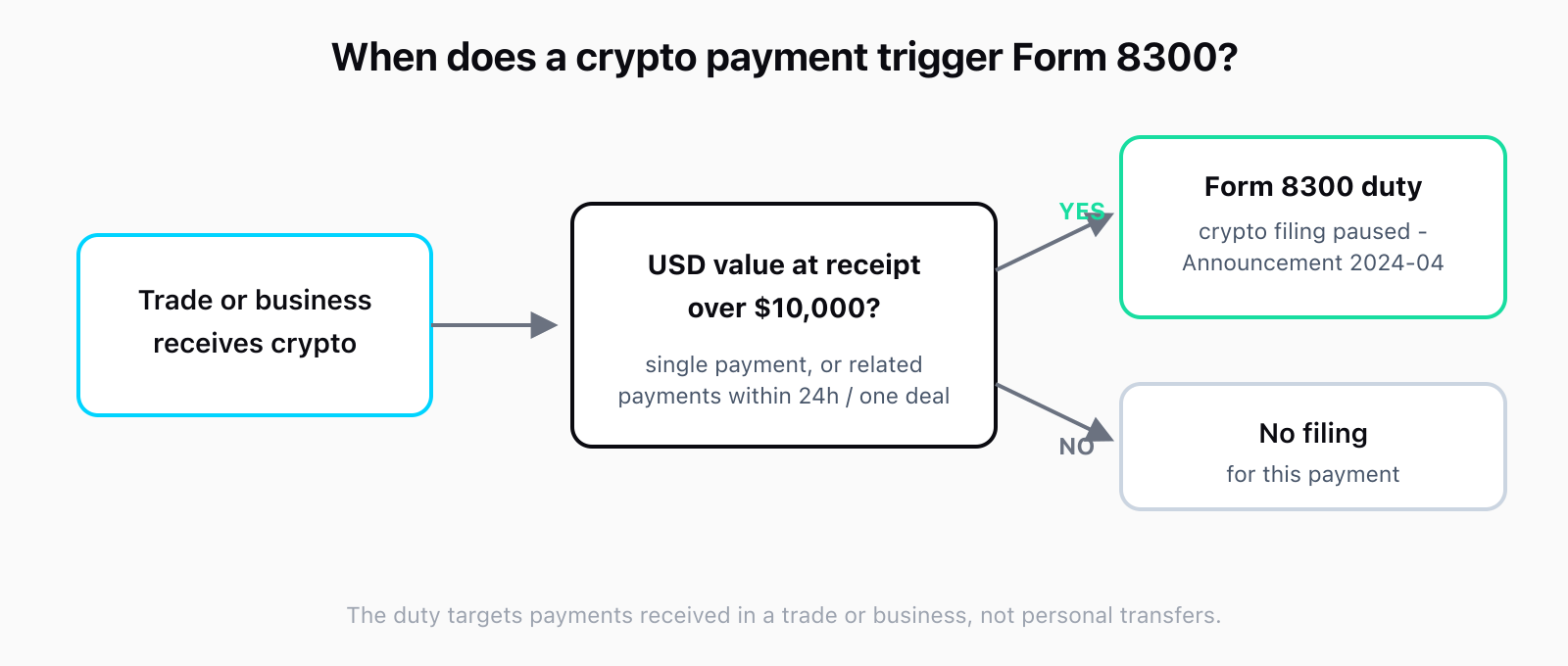
A crypto payment triggers the rule when its dollar value at receipt crosses $10,000, whether in one transfer or several linked ones from the same buyer.
Why did the IRS pause Form 8300 filing for digital assets?
Here is the part that trips people up. Shortly after the digital-asset change took effect on January 1, 2024, the IRS and Treasury issued Announcement 2024-04, which states that businesses do not have to report the receipt of digital assets on Form 8300 until the agencies publish regulations spelling out how. The pause exists because the statute was written for physical cash and leaves open questions, such as how to value and report a token received on-chain.
The pause is narrow. Reporting of ordinary cash and monetary instruments over $10,000 continues unchanged, so a business that takes $10,000 in physical bills still files as before. Only the digital-asset piece is on hold, and only until the rule-making finishes. Treating the pause as permanent is the mistake to avoid: once final regulations land, the filing duty for crypto switches back on, and businesses that accept large payments should be ready before then.
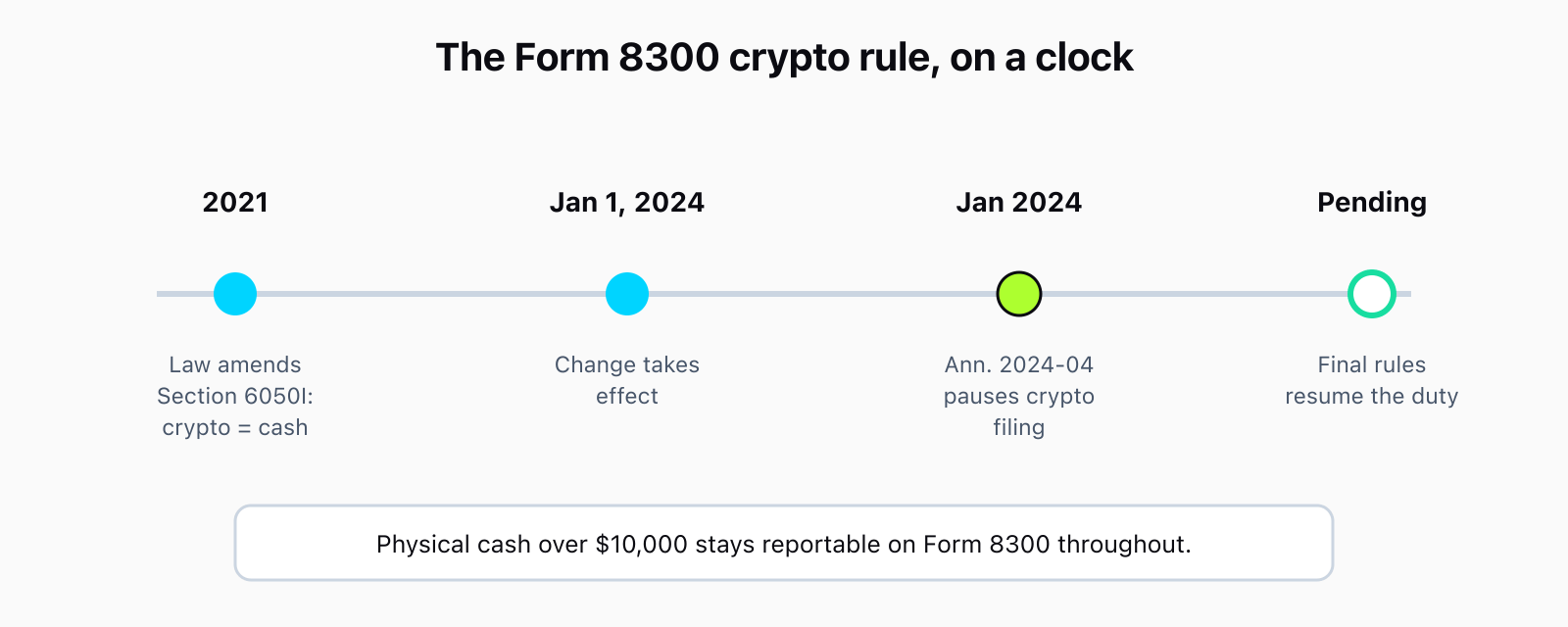
The crypto filing duty is on a clock: enacted in 2021, effective in 2024, then paused the same month pending regulations that will switch it back on.
How do you file Form 8300 and stay ready when the rule resumes?
The mechanics are the same ones cash-heavy businesses already follow. You file electronically through the FinCEN BSA E-Filing System, or on paper, within 15 days of receiving the reportable payment. You record the payer's name, address, and taxpayer identification number, the amount and date, and a description of the transaction. You also send the person named on the form a written statement by January 31 of the following year.
Practical preparation matters more than the form itself. Keep a dated record of the dollar value of every crypto payment as it arrives. Collect payer identity details at the point of sale, because chasing them down 15 days later is hard. And keep your own source records, since a large crypto sale can later prompt your bank or exchange to ask where the funds came from - the same kind of source-of-funds question that follows any sizable on-chain deposit.
How can you screen a crypto payment before you accept it?
Form 8300 is a reporting duty, not a risk check. It tells the government you received the money; it tells you nothing about whether the coins themselves are clean. A business can file the form perfectly and still end up holding funds tied to a sanctioned address, a hack, or a mixer, which can get a later deposit frozen by its exchange. Those are separate problems, and the second is worth handling before the payment ever settles.
You can inspect the payer's address by hand on a public block explorer such as Etherscan, reading its incoming transfers and following each counterparty backward, but that is slow and stops at the first hop. Rather than tracing it manually, screen the address with Plastron to see sanctions, mixer, and stolen-funds exposure across Ethereum and six other chains at once, with no wallet connection needed. Checking before you accept is the cheapest moment to walk away from a bad payment - see our guide on screening a wallet before accepting crypto for the full workflow.
FAQ
Do individuals have to file Form 8300 for crypto?
The rule applies to payments received in the course of a trade or business, not to personal transactions. Someone selling a personal car for crypto as a one-off generally falls outside it, while a dealer who does this regularly does not. Ordinary personal transfers and investing through an exchange do not trigger Form 8300.
Is Form 8300 filing for crypto required right now?
The digital-asset filing duty is paused under IRS Announcement 2024-04 until Treasury and the IRS issue final regulations. Reporting of physical cash and monetary instruments over $10,000 continues as normal. Businesses should prepare to file for crypto once the rules are finalized.
Does receiving over $10,000 in crypto get reported to the IRS automatically?
No. Form 8300 is the business's own filing duty, not something a blockchain reports for you. Once the digital-asset rule resumes, the business that receives the payment is responsible for filing within 15 days and notifying the payer.
Can splitting a payment below $10,000 avoid Form 8300?
No. Related payments from the same buyer within 24 hours, or as part of one connected deal, are added together. Deliberately structuring transactions to stay under the threshold is itself a federal offense, separate from the reporting rule.
Disclaimer: This article is for educational and informational purposes only and is not legal, financial, tax, or compliance advice. Crypto carries risk; you act on this information at your own risk. Always do your own research and consult a qualified professional before making decisions. Views are the author's own and do not constitute financial, legal, or investment advice.
About Plastron
Plastron is a free, non-custodial wallet screening tool. It checks Ethereum and six EVM chains for AML and KYT risk — sanctions exposure, mixer contact, and stolen-funds proximity — and returns a risk report in seconds. It reads public on-chain data only: it never takes custody of funds and never asks for private keys.