TL;DR - A centralized exchange can screen and freeze your wallet at several points because it holds the keys; the DEX protocol you're trading on can't be screened at all, though the website you use to reach it sometimes blocks you anyway.
In August 2022, Uniswap Labs blocked 253 wallet addresses from its own front end - a decision made by one company, not by the Ethereum network. That line between a company's website and a protocol's code is the whole story here. Centralized exchanges like Binance, Coinbase, and Kraken sit on one side of it: they hold custody, so they can act as a checkpoint at every step. Decentralized exchanges sit on the other: the smart contract itself has no concept of a blocked address, no matter what the interface in front of it decides to do.
Why Can a Centralized Exchange Freeze Your Wallet When a DEX Can't?
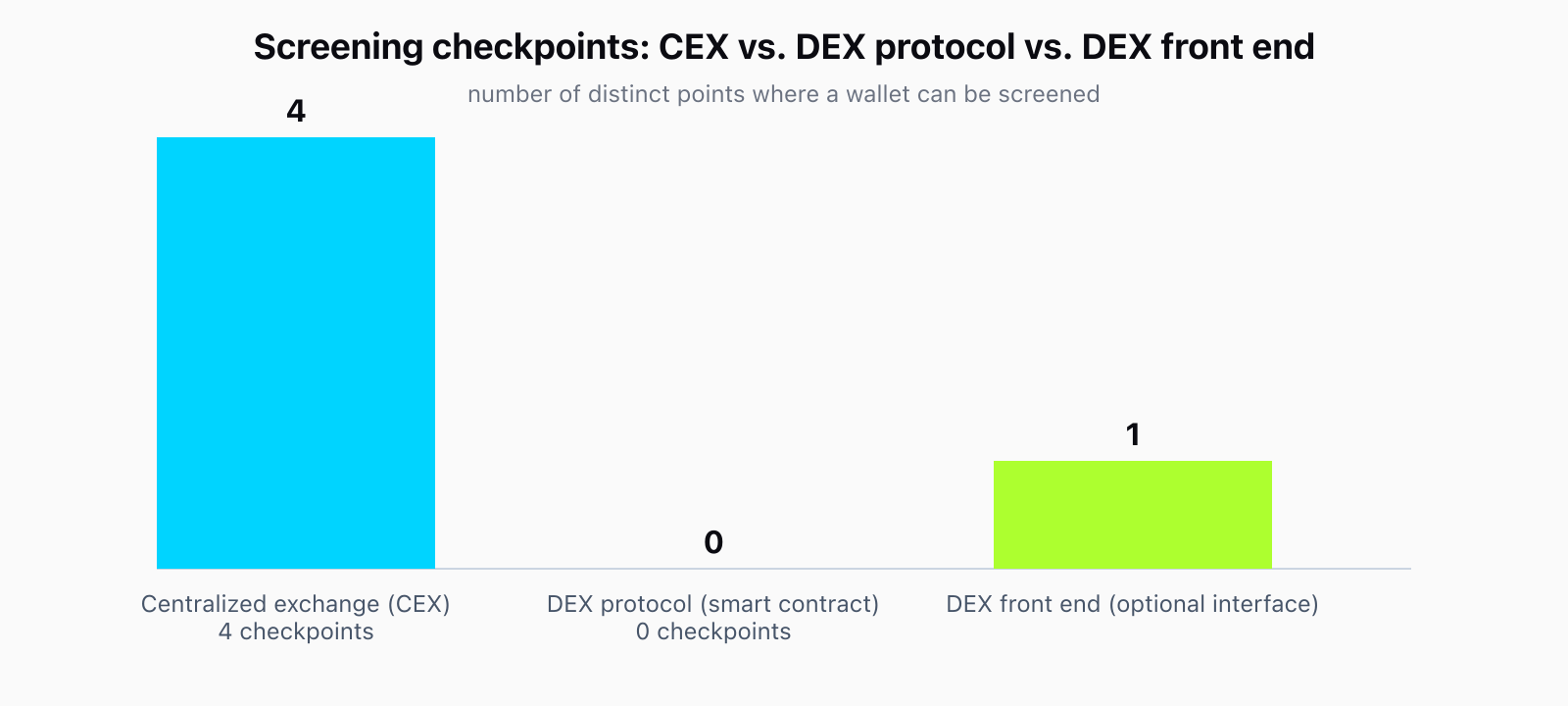
Custody is the whole explanation. When you deposit funds on Binance, Coinbase, or Kraken, the exchange holds the private keys, and your balance becomes an entry in its internal ledger rather than a transaction on-chain. That gives it four separate points to screen you: when the deposit lands, when you request a withdrawal, when the withdrawal transaction gets built, and again after it confirms. Any one of those checks can hold the funds before they move, and the exchange can see both sides of an in-house transfer the moment it happens.
A DEX protocol has none of that. Uniswap's smart contracts execute a swap the instant the transaction is valid - there's no custodian in the loop to pause it, no ledger entry to flag, no compliance queue reviewing the trade before it settles. Screening needs a chokepoint. A DEX protocol simply doesn't have one.
What Happened When Uniswap Blocked 253 Wallets in 2022?
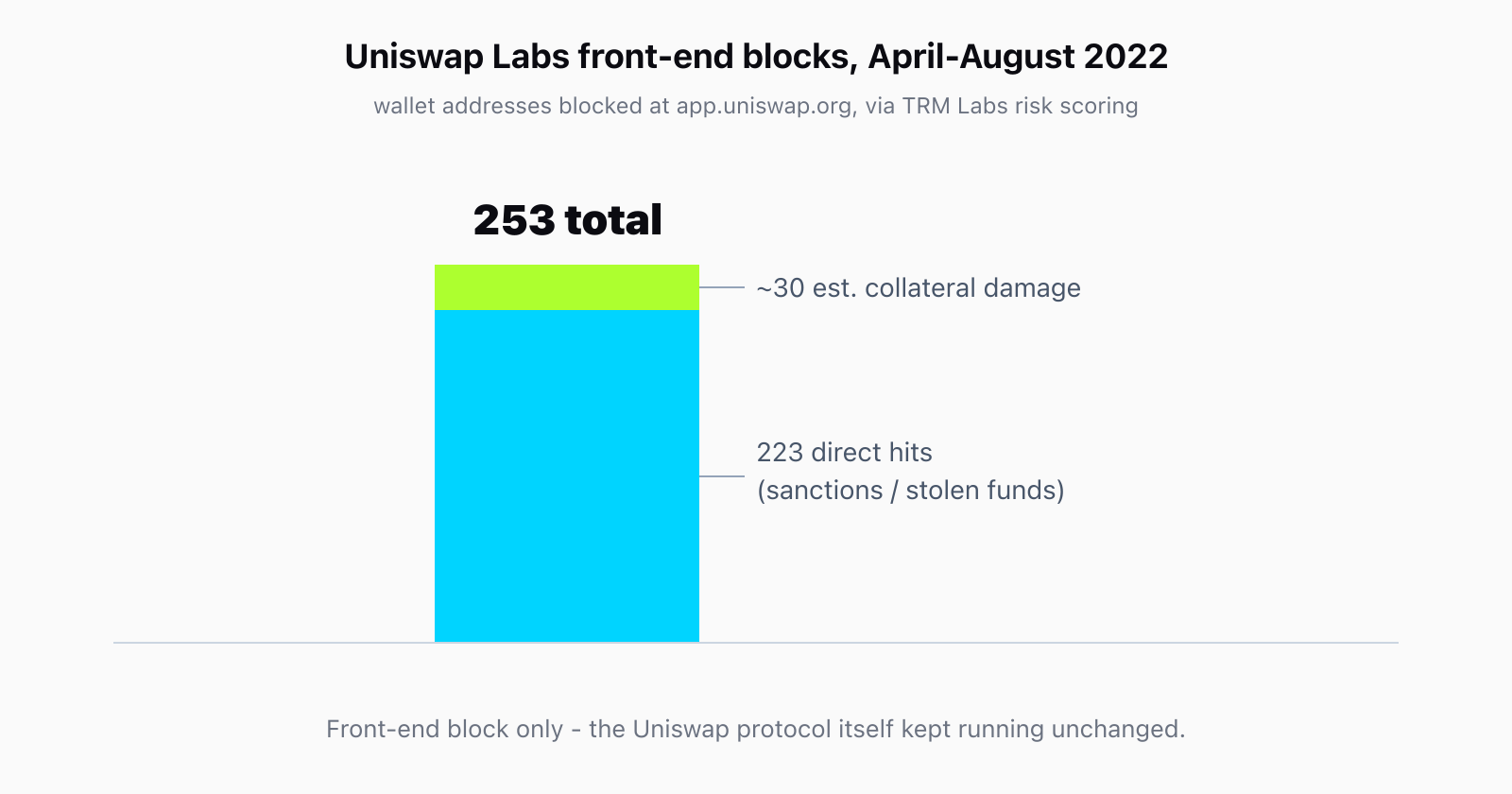
Uniswap Labs started screening wallets at its front end in April 2022, using risk scores supplied by TRM Labs. By August, the company had blocked 253 addresses, most of them tied to stolen funds or to Tornado Cash in the months after the US Treasury sanctioned the mixer. None of this touched the Uniswap protocol itself. The smart contracts kept running exactly as before; only the official Uniswap website refused to build a transaction for a flagged address.
The screening wasn't clean. Yearn Finance developer Banteg estimated that roughly 30 of those 253 addresses were collateral damage - ordinary wallets caught by TRM's risk model with no real connection to a hack or a sanctions list. Uniswap later narrowed its own rule, dropping addresses that were merely indirectly linked to a flagged one and keeping only direct hits. For one of those 30 wallets, the fix was never an appeal to Uniswap. It was switching to a different front end that reaches the same contract - see why a Uniswap block happens at the front end, not the contract for the mechanics.
253 addresses blocked, about 30 of them estimated false positives - and none of it touched the Uniswap protocol, which kept running unchanged.
Why Do Some DEX Front Ends Screen Wallets Anyway?
A website is not a protocol, and most DEX front ends have figured out they're the one piece of the stack regulators can actually reach. Aave hit this the same month as Uniswap. After Tornado Cash was sanctioned, an unknown account sent small, unsolicited transfers - a "dusting" attack - to wallets belonging to Coinbase CEO Brian Armstrong and Tron founder Justin Sun, among others. Aave's TRM integration flagged every wallet that had merely received a dusted transfer from a Tornado Cash address, locking Sun out of app.aave.com with a message calling his wallet "blocked." Aave later called it a misconfiguration and said wallet monitoring at the protocol level would need DAO approval it had never sought.
Some front ends screen on purpose rather than by accident. OKX's Web3 wallet runs its own non-custodial DEX aggregator, and according to Elliptic's own case study, OKX built Elliptic Lens directly into that product to screen wallets and block risky trades in real time - even though OKX never takes custody of the assets being swapped. That's the DEX version of what a CEX does at deposit, just applied one layer up, at the interface instead of the ledger.
If you bypass the official front end entirely - connecting straight to the Uniswap or Aave contract through a different wallet or interface - nothing in that chain checks your counterparty at all. The manual option is looking the address up yourself on a block explorer like Etherscan, one transaction at a time. Running a wallet screening tool against sanctions, mixer, and stolen-funds exposure before you connect - matched against a labeled corpus of 3,907 high-risk addresses and the full 780-entry OFAC SDN list - takes one search with Plastron instead, and it works the same whether you're using a CEX, a DEX front end, or the raw contract underneath.
How Do CEX and DEX Screening Actually Compare?
Line the two models up side by side and the custody gap explains almost every row.
A CEX can check a wallet at four separate steps. The DEX protocol underneath has none at all - only the optional front end can add one.
Criteria
Centralized exchange (CEX)
DEX protocol / front end
KYC required
Yes, before you can trade
No for the protocol; some front ends add wallet checks instead
Who actually screens you
The exchange itself, at multiple steps
The front end you chose, if it chooses to - never the contract
At most one: the moment the front end builds your transaction
Can freeze funds already in custody
Yes
No - non-custodial, nothing to seize
Can the base layer itself be blocked
Not applicable, it is the base layer
No - only the interface in front of it can refuse you
What you can still do if screened
Appeal, or move to a different exchange
Switch to a different front end for the same contract
That last row is the one most people miss. A CEX freeze follows your identity, since you had to prove who you are to open the account in the first place. A DEX front-end block follows an interface, not a person - which is exactly why it's so easy to route around.
Is a DEX Actually Safer From Screening Than a CEX?
Not safer from risk. Safer from one specific kind of mistake. If a vendor's risk model flags your wallet by accident, a DEX user has an exit a CEX user doesn't: open a different front end, same contract, trade goes through. A frozen CEX account has no equivalent move. Your funds sit in someone else's ledger until that exchange, not you, decides to release them. That's the one case where the alternative genuinely wins.
For the ordinary question - which side is actually doing the screening in the first place - the CEX wins by a wide margin. It sees both halves of an internal transfer, holds the funds, and can act before a single wei leaves its own ledger. A DEX protocol sees none of that, and most of its front ends still don't bother screening at all. Custody is the only real choke point. Everything past it is a front end's choice, not the protocol's.
FAQ
Can a DEX freeze my wallet the way Binance can?
No. A DEX protocol like Uniswap's has no custody and no mechanism to freeze funds - it just executes valid transactions. Only the website you use to reach it can refuse to build your transaction, and that block never touches funds already sitting in your own wallet.
Does Uniswap still block wallets in 2026?
Uniswap Labs' front end still screens addresses through a risk-scoring vendor, but it narrowed the rule after the 2022 collateral-damage cases - it now blocks addresses with direct hits, such as sanctions or stolen funds, rather than anything merely indirectly connected to one.
Why did Aave block Justin Sun's wallet?
In August 2022, Aave's risk-screening integration flagged his wallet after it received a small, unsolicited "dusting" transfer from a Tornado Cash address. Aave later called it a misconfiguration and said it did not reflect the protocol's intended screening rules.
Is OKX's DEX aggregator screening wallets?
According to Elliptic's own case study, OKX built Elliptic Lens into its non-custodial Web3 wallet to screen addresses and block risky trades in real time, even though the aggregator itself never holds user funds.
Can I avoid front-end screening on a DEX entirely?
Usually, yes. The same smart contract is reachable from multiple interfaces, and a block on one doesn't carry over to the others. That also means nothing is screening you by default, which is exactly the gap worth checking yourself before you trade.
Disclaimer: This article is for educational and informational purposes only and is not legal, financial, tax, or compliance advice. Crypto carries risk; you act on this information at your own risk. Always do your own research and consult a qualified professional before making decisions. Views are the author's own and do not constitute financial, legal, or investment advice.
About Plastron
Plastron is a free, non-custodial wallet screening tool. It checks Ethereum and six EVM chains for AML and KYT risk — sanctions exposure, mixer contact, and stolen-funds proximity — and returns a risk report in seconds. It reads public on-chain data only: it never takes custody of funds and never asks for private keys.