TL;DR - Etherscan confirms a transaction happened, but a dedicated wallet screening tool is what actually flags sanctions, mixer, and stolen-funds exposure before you send.
A block explorer and a screening tool answer two different questions. One shows you what happened. The other tells you whether it's safe to happen again. That distinction matters most right before you accept a payment, vet a counterparty, or move funds off an exchange - the moment when "I looked it up on Etherscan" feels like due diligence but usually isn't.
What Does Etherscan Actually Show You?
Etherscan is a block explorer. It reads the Ethereum blockchain and shows you the balance, the transaction history, the token transfers, the internal calls, and the verified source code for any address. For proving a transaction happened, nothing beats it.
What it doesn't do is score risk. Etherscan's only safety signal is a crowdsourced flag: an address gets a public warning label, something like Fake_Phishing184810, only after enough users report it through Etherscan's own address-reporting form. Until that threshold is hit, a wallet tied to an active scam looks exactly like any other address - a clean balance, an ordinary transaction list, no warning at all.
That's a reactive system. It catches addresses after the damage, once victims are already reporting them. It was never built to catch wallet screening categories like sanctions exposure, mixer contact, or stolen-funds tracing, because none of those require a user complaint to exist.
Take Tornado Cash. OFAC sanctioned the mixer's smart contracts in August 2022, delisted them that November after a court challenge, then kept individual addresses tied to it flagged elsewhere in enforcement guidance. None of that history shows up as a warning on Etherscan. The contract still verifies. The transaction list still looks like any other set of deposits and withdrawals. You'd need a dataset built specifically to track mixer contact to see the exposure at all.
What Does a Dedicated Wallet Screening Tool Add?
A wallet screening tool runs the address against curated datasets instead of waiting on crowd reports. That means checking it against:
The full OFAC SDN list, which currently carries 780 unique sanctioned Ethereum addresses in the mirrored dataset used for screening.
A broader labeled corpus of scam, fraud, and hack-linked addresses - 3,901 entries in one such dataset, with 3,478 flagged high risk or critical.
Known crypto-mixer contact, traced hop by hop rather than as a single yes-or-no flag.
Stolen-funds exposure carried across multiple chains, not just the one an address happens to transact on.
Sanctions lists move fast, and that's the part a static lookup can't keep up with. OFAC added new Iran-related designations on July 24, 2026, alongside sanctions-list removals the same week. An address clean on Monday can be designated by Friday. A screening tool that pulls the current list catches that the moment it updates. A block explorer shows nothing different at all, because nothing about the address's own transaction history changed.
Screen the same address instantly with Plastron against the sanctions list, known scam and mixer datasets, and stolen-funds exposure across seven EVM chains, all before you decide to send.
Head-to-head
Criteria
Etherscan
Dedicated screening tool
Detection method
Crowdsourced user reports
Automated match against curated datasets
Sanctions coverage
None built in
Full OFAC SDN list, 780 addresses and growing
Mixer / stolen-funds exposure
Not surfaced
Multi-hop exposure, cross-chain
Update speed
As fast as a user files a report
Same day as a new designation
Best for
Proving a transaction occurred
Deciding whether to accept one
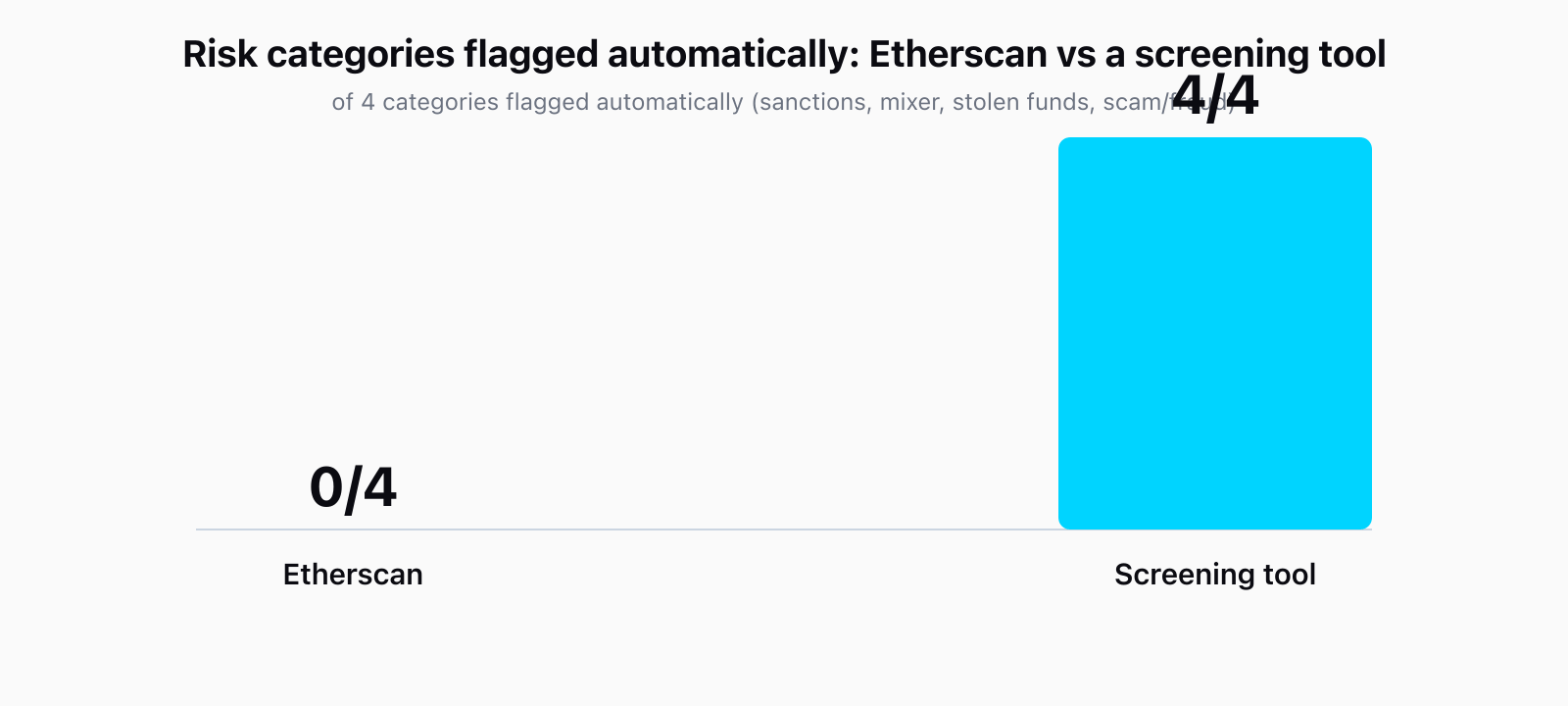
Etherscan surfaces none of these four risk categories on its own. A screening tool checks all four before you decide to send.
When Should You Trust Etherscan Alone?
Etherscan wins when you already know the answer and just need proof. Attaching a transaction hash to a support ticket, confirming a deposit actually landed, checking a contract's verified source before you approve it - none of that needs a risk score. It needs the raw record, and Etherscan is the fastest way to get it.
A screening tool is overkill for that job. You're not deciding anything. You're confirming something you already believe. Save the screening pass for the address you haven't dealt with before.
Verdict
Etherscan is a record. A screening tool is a decision. Use the block explorer to prove a transaction happened. Use a wallet screening check before you decide whether the next one should. They're not competing products - they answer different questions, and most people only reach for one of them, which is exactly how a sanctioned or mixer-linked address slips through looking perfectly ordinary.
FAQ
Does Etherscan flag sanctioned wallets automatically?
No. Etherscan has no built-in sanctions check. It only shows a warning label after users report an address through its own reporting form, and OFAC designations aren't part of that reporting flow at all.
Can a wallet look clean on Etherscan but still be high risk?
Yes. An address one hop from a known mixer, or holding funds traced to a hack, shows the same plain transaction list as any other wallet unless something surfaces its labeled history separately.
How often does the OFAC sanctions list change?
Often enough that a static check goes stale fast. OFAC posted new designations and list removals in the same week of July 2026 - a screening tool that pulls the current list reflects that immediately. A block explorer doesn't reflect it at all.
What is mixer exposure, and why doesn't Etherscan show it?
Mixer exposure means funds have passed through, or received from, a service designed to break the link between sender and receiver. Etherscan shows the raw transfer. It takes hop-tracing across the full dataset, the kind analytics firms build for compliance teams, to surface that the funds touched a mixer three steps back.
Do I need to pay for a wallet screening tool?
Not necessarily. Free screening tools exist that check an address against sanctions lists, known scam datasets, and mixer exposure without requiring an account, though paid tiers usually add deeper transaction history and monitoring.
Disclaimer: This article is for educational and informational purposes only and is not legal, financial, tax, or compliance advice. Crypto carries risk; you act on this information at your own risk. Always do your own research and consult a qualified professional before making decisions. Views are the author's own and do not constitute financial, legal, or investment advice.
About Plastron
Plastron is a free, non-custodial wallet screening tool. It checks Ethereum and six EVM chains for AML and KYT risk — sanctions exposure, mixer contact, and stolen-funds proximity — and returns a risk report in seconds. It reads public on-chain data only: it never takes custody of funds and never asks for private keys.