TL;DR - Hyperliquid, GMX, and similar perpetual exchanges skip identity checks, but they block access by IP address only, so a sanctioned or flagged wallet is never actually screened.
No KYC doesn't mean no compliance checks. It means the checks look at your IP address, never your wallet.
That gap matters most for the exact users these platforms attract: traders who don't want to hand over an ID, and traders based somewhere the platform already blocks. A sanctioned wallet routed through an allowed IP clears the same single checkpoint as anyone else - once, at the browser, and never again.
How Hyperliquid and GMX Handle Compliance
Hyperliquid restricts the United States, Ontario, and OFAC-sanctioned jurisdictions - Cuba, Iran, North Korea, and Syria among them - under its own terms of use. GMX and dYdX run close to the same playbook: block the browser session by IP, and leave the underlying smart contracts open to anyone who can reach them directly.
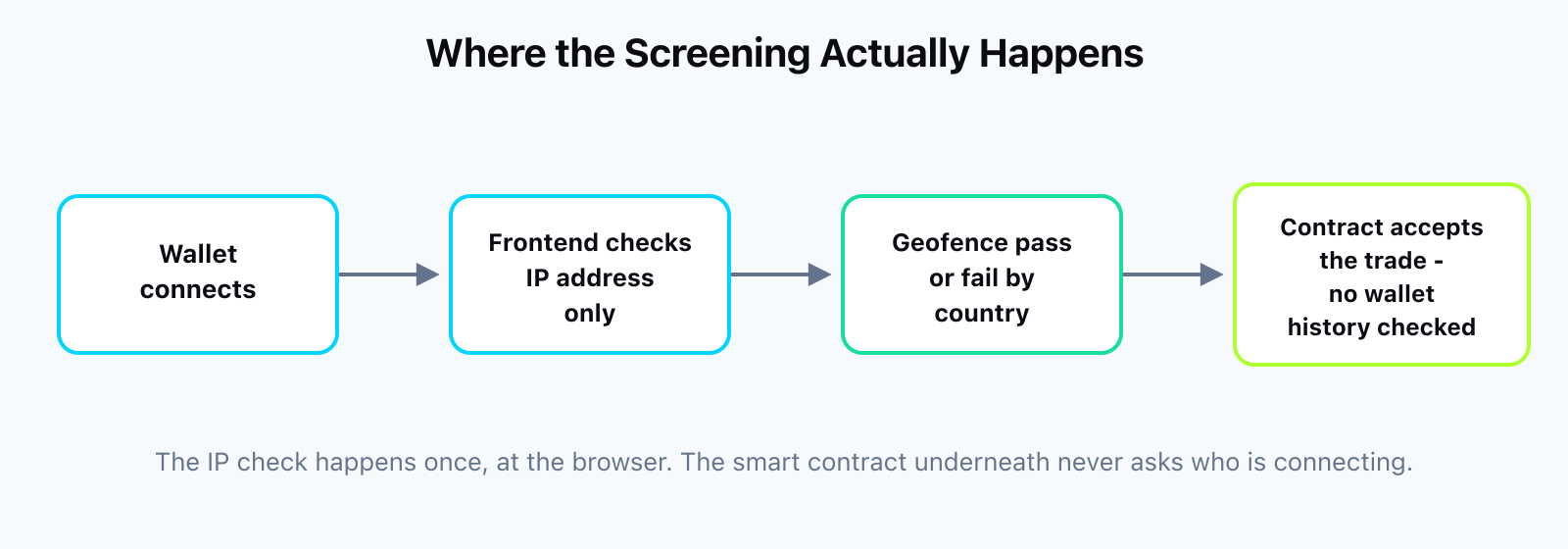
None of that happens at the wallet level. Connect an address from an allowed IP and the frontend lets it trade. It never asks where the funds came from, and it never checks the address against a sanctions list.
The choice isn't an oversight. Wallet-level screening means running every connecting address through a sanctions and risk database in real time, and that's a cost and an engineering commitment most no-KYC platforms haven't taken on. IP geofencing is cheaper, faster to ship, and enough to satisfy the specific rule most of these terms of use are written against - keep out a named list of countries, not a named list of wallets.
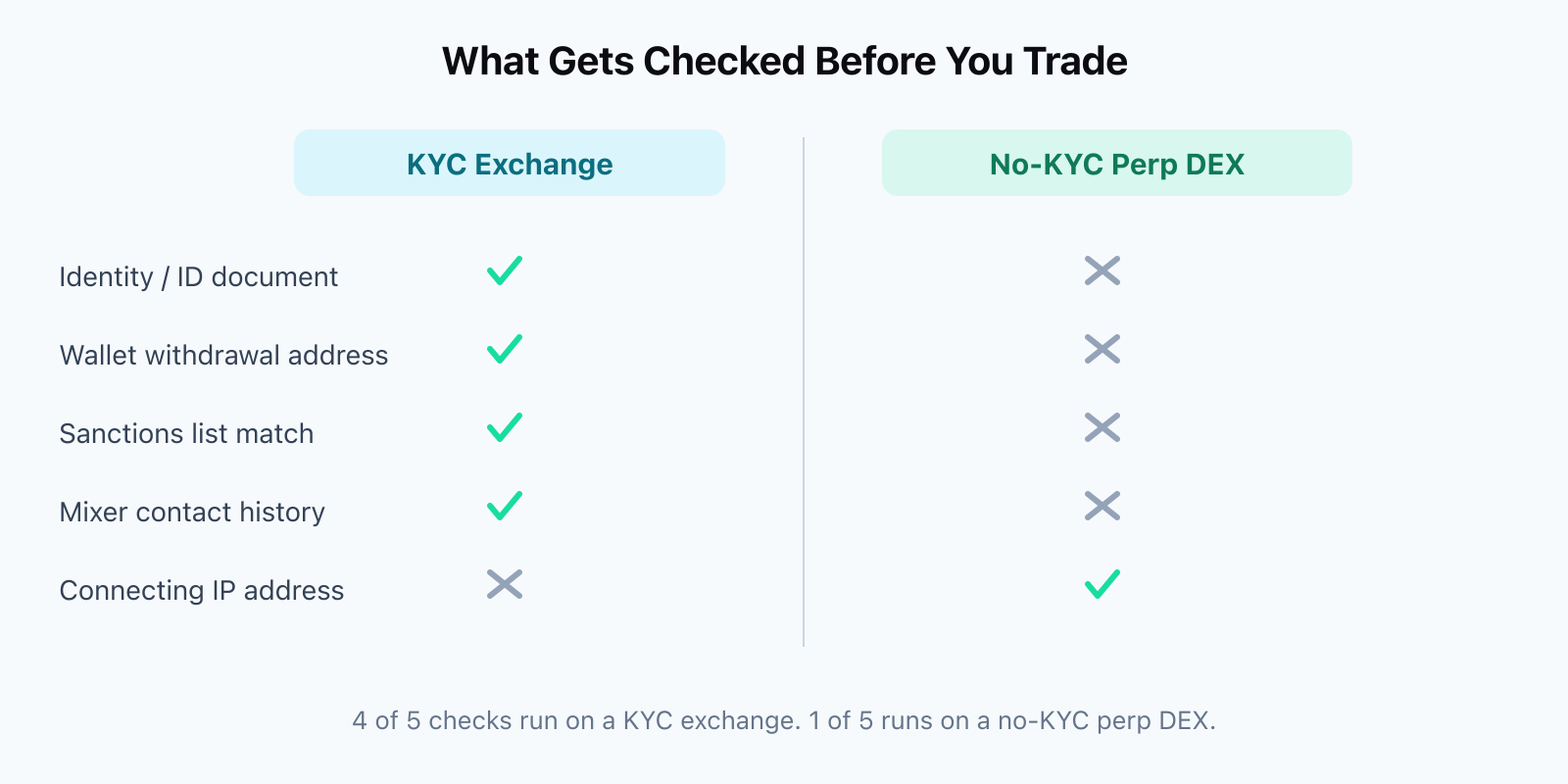
A KYC exchange screens four things before a trade clears. A no-KYC perp DEX screens one.
Does Skipping KYC Mean No Screening at All?
Not quite - it means the screening is aimed at your internet connection instead of your funds. A KYC exchange like Coinbase checks a government ID, a selfie, and increasingly the wallet address a user withdraws to. A no-KYC perpetual exchange checks none of that. It reads the IP, matches it against a restricted list, and moves on.
The wallet's own transaction history - mixer contact, sanctioned counterparties, stolen-fund links three hops back - never enters the decision. That's a real gap, not a hypothetical one.
Why Geo-Blocking Isn't the Same as Wallet Screening
IP geofencing answers one question: where is this browser session right now? It says nothing about who controls the connected wallet or where the crypto sitting in it came from.
A VPN defeats the IP check in minutes, and traders on these platforms know it. A sanctioned wallet operating from anywhere outside the handful of restricted countries never trips the check at all, because there's nothing built to look at the wallet itself. Geofencing and wallet screening solve different problems. Only one of them runs on these platforms today.
The IP check happens once, at the browser. The smart contract underneath never asks who is connecting.
Could a Sanctioned Address Actually Trade on a Perp DEX?
Yes, and the pattern behind it is already on the public record. On March 12, 2026, OFAC sanctioned six individuals and two entities tied to North Korean IT-worker schemes that moved close to $800 million in crypto payments during 2024 alone, funding the country's weapons programs.
Those funds moved through ordinary crypto payment rails long before any single wallet got flagged. A frontend built to check only IP addresses has no mechanism to catch that kind of exposure - the connecting address could sit one hop from a designated entity and still clear the geofence without friction.
What Happens After the Trade Clears?
Trading on a no-KYC perp DEX doesn't make wallet-level exposure disappear. It just delays the moment someone actually checks. That moment usually arrives the first time profits move to a centralized exchange, and a CEX runs exactly the kind of wallet-level screening the DEX skipped.
A flagged withdrawal at that stage doesn't look like a blocked trade. It looks like a held deposit, a frozen account, and a compliance team asking for a source-of-funds explanation - for funds that already cleared dozens of trades on the DEX with no warning along the way.
How to Check Your Wallet Before You Connect It
Most traders run an unfamiliar or newly funded address through a block explorer like Etherscan and call it verified. That only shows raw transaction history. It doesn't flag sanctions exposure, mixer contact, or stolen-funds links, and it was never built to.
Screen the address against the OFAC SDN list and known illicit-fund clusters first, before connecting it anywhere, with Plastron's free wallet check. Plastron's own screening corpus tracks 3,901 labeled addresses, including 780 tied to OFAC's sanctions list alone, across Ethereum and six other chains - none of which an IP geofence can see.
FAQ
Does Hyperliquid Require KYC to Trade?
No. Traders connect a non-custodial wallet instead of creating an account, though access still gets blocked for the United States, Ontario, and OFAC-sanctioned jurisdictions under its terms of use.
Can a Sanctioned Wallet Actually Connect to Hyperliquid or GMX?
Nothing in the current frontend architecture stops it if the connecting IP address falls outside the restricted list. Only the location gets checked, never the wallet's transaction history.
Is the Underlying Protocol Restricted the Same Way as the Website?
No. The blockchain layer stays permissionless. Restrictions live only in the frontend, so a wallet blocked on one interface could still reach the same smart contracts through another.
How Do I Know if My Wallet Has Sanctions or Mixer Exposure?
Run the address through a dedicated wallet screening tool that checks the OFAC SDN list, mixer contact, and stolen-funds links. A block explorer alone won't show any of that.
Disclaimer: This article is for educational and informational purposes only and is not legal, financial, tax, or compliance advice. Crypto carries risk; you act on this information at your own risk. Always do your own research and consult a qualified professional before making decisions. Views are the author's own and do not constitute financial, legal, or investment advice.
About Plastron
Plastron is a free, non-custodial wallet screening tool. It checks Ethereum and six EVM chains for AML and KYT risk — sanctions exposure, mixer contact, and stolen-funds proximity — and returns a risk report in seconds. It reads public on-chain data only: it never takes custody of funds and never asks for private keys.