TL;DR - A Zcash TEX address proves your deposit's last hop was transparent, not that the shielded funds behind it are clean.
Binance forced this fix onto Zcash in 2024. Three other major exchanges still don't bother with it, and the address only solves one of the two problems a shielded deposit actually creates.
The stakes went up this year. ZEC traded near an all-time high around $1,249 on September 6, 2026, and Grayscale's spot Zcash ETF, ticker ZCSH, started trading on NYSE Arca on August 25, 2026. More money moving through Zcash means more deposits an exchange has to decide whether to accept.
What Is a Zcash TEX Address?
A TEX address is a Zcash receiving address that accepts transparent funds only. It comes from ZIP-320, created on January 12, 2024, and it's a Bech32m re-encoding of an ordinary transparent output, starting with "tex" on mainnet. A compliant wallet checks for that prefix before it will spend shielded notes toward one.
The address itself holds no magic. What changes is the sending wallet's behavior.
Why Did Binance Force Zcash to Build One?
In November 2023, Binance told Zcash's developers it would delist ZEC unless rejected deposits could be refused and sent back automatically. A refund needs a return address. Binance set a deadline: February 29, 2024.
A shielded note has no return address. That's the entire problem.
ZIP-320 is the fix: force the last leg of any exchange-bound transfer through a real transparent address, so a rejected deposit has somewhere to go back to.
Does a TEX Address Prove an Exchange Can See Where the Funds Came From?
No. It only guarantees the immediate sender's address is transparent, not that every hop before it was too.
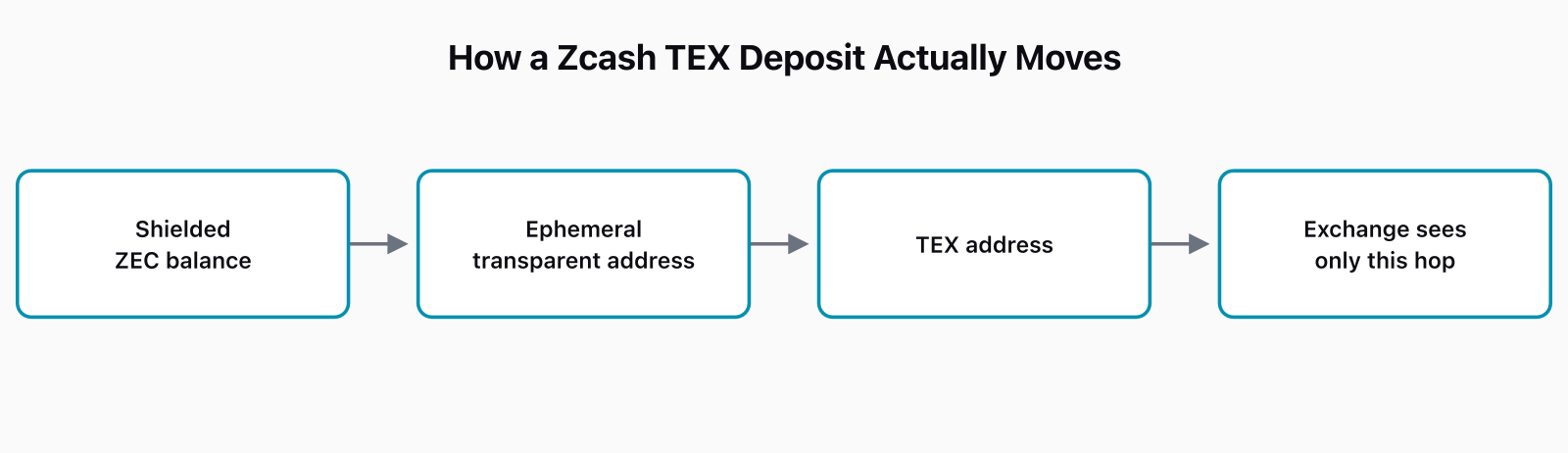
Zcash's own Zashi wallet handles the mechanics for you. It generates a one-time, throwaway transparent address, moves your shielded balance there, then forwards it on to the TEX address. The exchange sees that disposable address and nothing upstream of it.
The exchange sees the last hop. Everything before it stays shielded.
Which Wallets and Exchanges Actually Use TEX Addresses?
Zashi and the independent Zenith wallet, which added ZIP-320 support in a November 2024 update, both generate and spend to TEX addresses correctly. Coinbase added support for sending Zcash to a TEX address too.
Adoption on the receiving side is thinner. Per the Zcash community's own ecosystem tracking, no exchange besides Binance has required or used a TEX address since the standard shipped.
One exchange asked for it. The rest never bothered.
What Can You Actually Screen Before You Send Zcash Proceeds Somewhere Else?
Looking up a transparent Zcash output on a block explorer like Blockchair will show its balance and transaction history. It will not tell you whether that address touched a sanctioned entity, a mixer, or a known scam cluster. The same cash-out problem shows up whenever you convert Monero or Zcash through any swap, not only through a TEX deposit.
Once you convert ZEC proceeds into ETH, BTC, or a stablecoin and withdraw to a wallet you'll use elsewhere, screen that address with Plastron first: a direct sanctions and known-illicit-label check across Ethereum and six other EVM chains, plus Bitcoin, in seconds, free, before you send anything further.
Plastron's own labeled corpus carries more than 100,000 addresses, and all 1,061 OFAC-sanctioned crypto addresses are in there too. That's the same type of list an exchange checks a deposit against, just maintained independently, on its own update schedule.
FAQ
Is a TEX address the same thing as a normal transparent Zcash address?
Not quite. A TEX address is a distinct Bech32m encoding, the "tex" prefix, defined in ZIP-320 specifically to signal "transparent funds only" to a sending wallet, even though the underlying output is an ordinary transparent P2PKH address.
Can you send shielded ZEC directly to a TEX address?
No. ZIP-320 requires the final transaction into a TEX address to spend only transparent inputs, so a compliant wallet converts shielded funds to transparent first, then forwards them.
Does Coinbase require a TEX address for Zcash deposits?
Coinbase added support for sending to TEX addresses, but Binance is still the only exchange that requires one.
Will other exchanges start requiring TEX addresses?
Nothing has been announced. The Zcash community's own tracking shows adoption stopped at Binance, so treat this as what's true today, not a trend.
Disclaimer: This article is for educational and informational purposes only and is not legal, financial, tax, or compliance advice. Crypto carries risk; you act on this information at your own risk. Always do your own research and consult a qualified professional before making decisions. Views are the author's own and do not constitute financial, legal, or investment advice.
About Plastron
Plastron is a free, non-custodial wallet screening tool. It checks Ethereum and six EVM chains for AML and KYT risk — sanctions exposure, mixer contact, and stolen-funds proximity — and returns a risk report in seconds. It reads public on-chain data only: it never takes custody of funds and never asks for private keys.