TL;DR - Using a no-KYC exchange or instant swap does not automatically make your wallet "dirty," but it can raise its AML risk score. Blockchain analytics firms label many no-KYC venues as high-risk counterparties, and any funds that move through one leave a permanent on-chain trail. When you later deposit to a regulated exchange, its screening sees that exposure and may hold or question the funds. The fix is to know what your wallet looks like to those tools before you deposit.
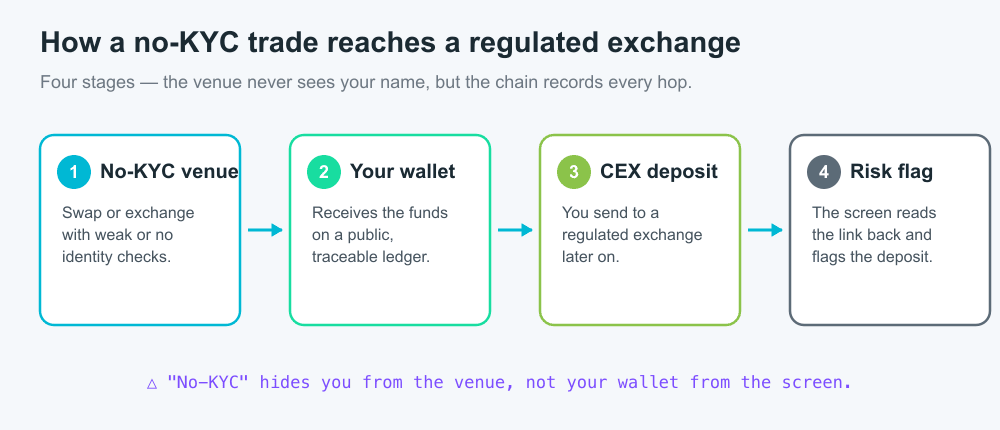
"No-KYC" is one of crypto's most misunderstood promises. Skipping identity checks at a swap service feels like staying anonymous, so a lot of people assume it also keeps their on-chain history clean. It does not. The venue may never learn your name, but the blockchain records every hop the funds take - and that record is exactly what AML screening reads. This guide explains whether a no-KYC trade actually flags your wallet, how screening tools see it, and what you can do about it.
Does using a no-KYC exchange flag your wallet?
Not automatically - but it adds risk, and the risk is real. The confusion comes from conflating two separate things:
- Identity privacy: the venue did not collect your passport or selfie.
- On-chain exposure: the transaction the venue created still sits on a public ledger, tied to your address forever.
Privacy from the venue does nothing for the second one. Blockchain analytics firms such as Chainalysis classify exchanges by how strong their compliance controls are, and venues with weak or absent KYC fall into a "high-risk exchange" category. When your wallet sends to or receives from one of those services, screening tools record a counterparty link to a high-risk category - and that link contributes to your wallet's risk score whether or not you ever revealed your identity.
How do screening tools even see a no-KYC trade?
Because the trade happens on a transparent ledger. Every address you interact with, and every address those addresses interact with, is public. AML tools build a graph of these connections and measure your wallet's "exposure" - how close it sits to addresses in flagged categories like sanctioned entities, mixers, scams, and high-risk exchanges.
Two kinds of exposure matter here. Direct exposure means your wallet transacted with the flagged venue itself - the heaviest signal. Indirect exposure means the link runs through one or more intermediary hops, which carries less weight but does not disappear. A single hop between your wallet and a high-risk exchange is usually still enough for a deposit screen to surface it.
Why "no-KYC" does not mean "no risk profile"
The phrase "no-KYC" describes what the venue asks you for. It says nothing about who else uses that venue. Because no-KYC exchanges and instant swaps require no identity, they are attractive to people moving stolen, scam, or sanctioned funds - which is precisely why analytics firms rate them as high-risk in the first place. Funds that emerge from such a service inherit that reputation, and so does the wallet that receives them.
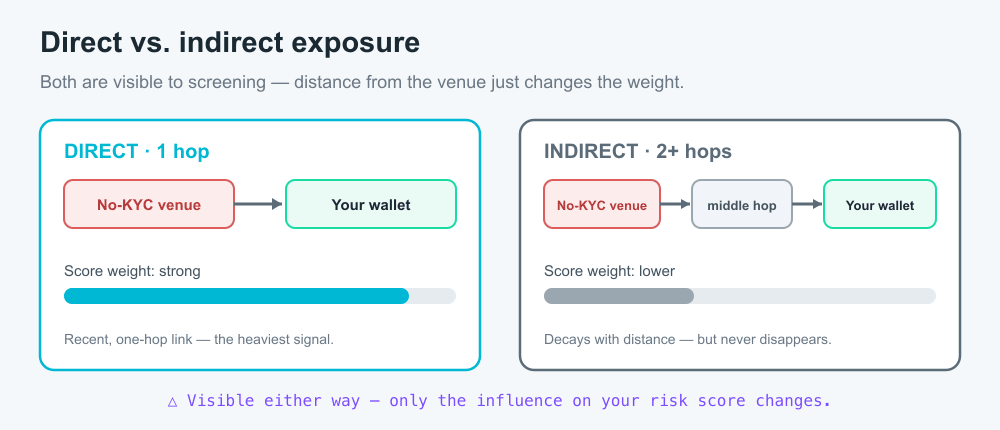
This is why two wallets that both touched a no-KYC service can end up scored very differently. One that received funds directly from a high-risk exchange carries a strong, recent signal. One that is two or three hops removed carries a weaker, decaying one. Neither is automatically "banned," but both are visible, and a regulated exchange's risk team decides what to do with that visibility.
How do you check your wallet before depositing to a regulated exchange?
You can do part of this manually. Open your address on a block explorer such as Etherscan and trace where your incoming funds came from, hop by hop. The problem is that an explorer shows raw transactions but no reputation: it will not tell you that the address two hops back is a known high-risk exchange, a mixer, or a sanctioned entity. You would have to recognise every counterparty by hand.
Screen your wallet with Plastron and you get that reputation layer instantly: it maps your direct and indirect exposure to sanctions lists, mixers, scam clusters, and high-risk exchanges across Ethereum and six other chains, with no wallet connection required. Running that check before you deposit means you see what the exchange's compliance team will see - and you can decide whether to proceed or to use clean funds instead.
How do you lower your AML risk if you value privacy?
- Separate your wallets. Keep funds that touched no-KYC or privacy services apart from the wallet you use to deposit to regulated exchanges. Co-mingling spreads the exposure.
- Screen counterparties first. Before accepting funds from any swap, OTC desk, or P2P trade, check the sending address's risk category. It takes seconds and avoids inheriting someone else's history.
- Prefer venues with transparent compliance when your end goal is to off-ramp at a regulated exchange. Privacy and a clean deposit path are often in tension.
- Keep records. If you have a legitimate explanation for funds, document the source. A source-of-funds story is far easier to make when you can point to the on-chain trail yourself.
Frequently asked questions
Is using a no-KYC exchange illegal?
Using one is not inherently illegal in most jurisdictions, and many people use them for legitimate privacy reasons. What creates risk is not the act of using the venue but the on-chain exposure it leaves and what flagged funds may pass through it. The legal picture varies by country, so treat this as general information, not legal advice.
Will a no-KYC swap get my Coinbase or Binance deposit frozen?
It can, but it is not guaranteed. Regulated exchanges screen incoming deposits and may hold, question, or in serious cases freeze funds with strong exposure to high-risk venues, mixers, or sanctioned addresses. A single distant hop is usually less alarming than receiving funds directly from a flagged service. Screening your own wallet first tells you which situation you are in.
How long does no-KYC exposure stay on my wallet?
The on-chain transaction is permanent - it never leaves the ledger. What changes over time is its weight: direct, recent exposure scores higher, and indirect exposure that sits several hops and many transactions back decays in significance. The record stays forever, but its influence on a risk score fades as cleaner activity accumulates.
Can I remove a no-KYC exchange flag from my wallet?
You cannot delete or "clean" the underlying transaction; anyone can still trace it. What you can do is understand the exposure, avoid compounding it, and use a separate wallet with a clean history for deposits to regulated platforms. Screening your wallet shows you exactly which links are driving the flag so you can decide how to handle them.