TL;DR - Converting Monero or Zcash and depositing the proceeds can flag your exchange account, because regulated venues treat privacy-coin history as high-risk and increasingly delist these assets under MiCA and AML pressure.
Privacy coins promise untraceable transactions, and on-chain Monero largely delivers. The friction starts at the edge, where crypto meets a regulated exchange. That is where a compliance system decides whether your deposit is clean, and a privacy-coin trail is one of the loudest signals it listens for. If you have held, swapped, or received Monero or Zcash, here is what a regulated venue can see, why it matters, and how to avoid a frozen account.
Why do exchanges treat privacy coins as a red flag?
Most blockchains are transparent. Bitcoin and Ethereum record every sender, amount, and timestamp in the open, so an exchange can trace a deposit back toward its source. Privacy coins are built to break that trace. Monero hides the sender, receiver, and amount by default using ring signatures, stealth addresses, and confidential transactions. Zcash can shield the same details inside an encrypted pool. From a compliance desk's point of view, that is the problem: if the history cannot be inspected, the standard source-of-funds check has nothing to read. Analytics vendors such as Chainalysis and TRM Labs can label and score a transparent address, but they cannot reconstruct what happened inside a Monero ring. An asset that defeats tracing gets treated as high-risk by default, no matter how you actually used it.
What happens when privacy-coin funds reach your account?
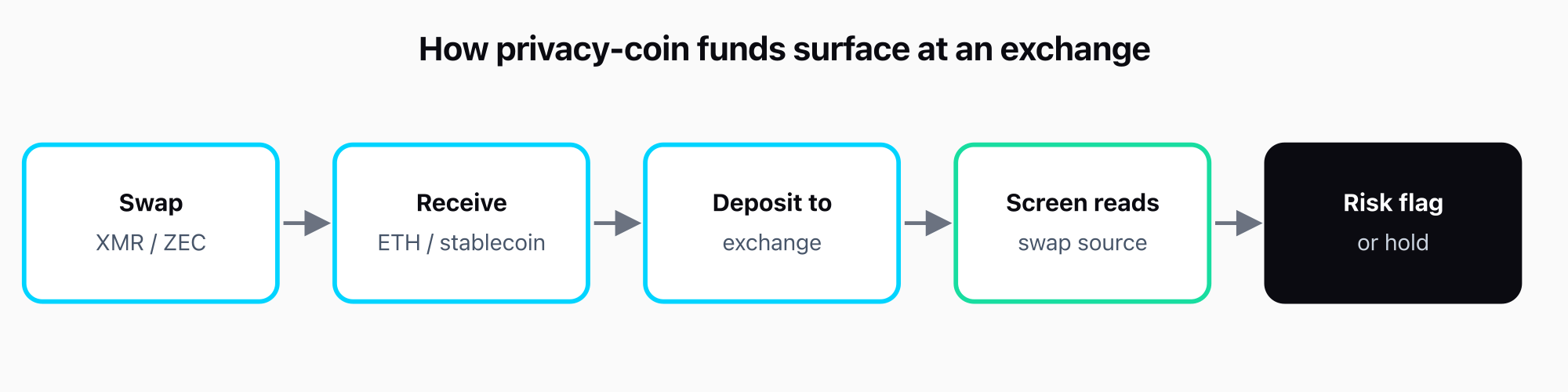
You rarely deposit Monero straight to a major exchange anymore, because most no longer accept it. The common path is a swap: you convert XMR or shielded ZEC into ETH, BTC, or a stablecoin through a swap service or a smaller venue, then send the proceeds on. The receiving address is transparent, so the exchange can read its recent history, and that history shows funds arriving from a privacy-coin swap. That single hop is often enough to raise the risk weight on your deposit.
A privacy-coin swap is opaque, but the transparent leg you deposit carries a readable fingerprint back to it.
Depending on the exchange and the amount, the outcome ranges from a quiet note on your file, to a source-of-funds request, to a hold while a human reviews the deposit. The funds are not necessarily lost. The burden simply shifts to you to explain where they came from, and you have to do it after the deposit has already landed.
Which exchanges have delisted Monero and Zcash?
The direction of travel is one-way. Binance delisted Monero in February 2024 and converted users' remaining XMR balances to USDC that September. Kraken removed Monero for customers in the European Economic Area, and OKX and others dropped privacy pairs on similar timelines. The driver in Europe is regulation: the EU's Markets in Crypto-Assets rules, in force since December 2024, together with the Transfer of Funds Regulation, bar regulated platforms from listing assets whose transaction history cannot be identified. By 2025, dozens of exchanges worldwide had delisted at least one privacy coin. Fewer venues accepting these assets means fewer clean exit routes, which is exactly why the cash-out step now draws the most scrutiny.
Does the privacy model change your risk?
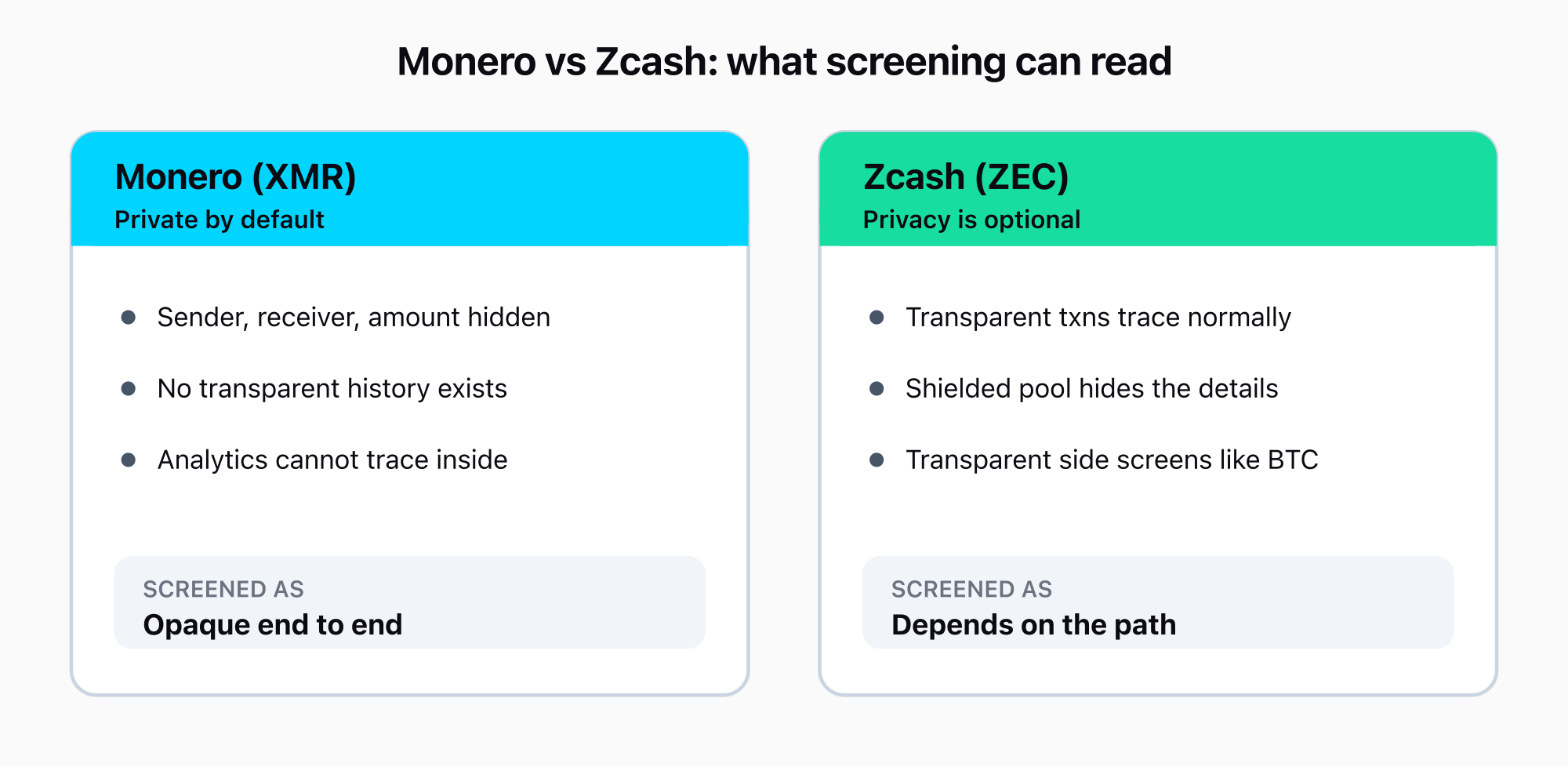
Yes, and the difference is worth understanding. Monero is private by default: every transaction is opaque, so there is no such thing as a transparent Monero history to hand a compliance team. Zcash is optional. It has transparent transactions that behave like Bitcoin, and shielded transactions that hide the details. Funds that stayed transparent on Zcash can be traced and screened normally. Funds that passed through the shielded pool carry the same can't-see-inside problem as Monero.
Monero is opaque end to end; a Zcash deposit's risk depends on whether the funds used the transparent or the shielded side.
So a Zcash deposit's risk depends on which side of that line the funds sat, while a Monero deposit is treated as opaque from start to finish. Either way, the moment you convert into a transparent asset, the screening clock starts again at the swap.
How do you cash out privacy-coin funds without a freeze?
You cannot un-ring a Monero transaction, but you can manage the cash-out. The point is to know what the exchange will see before you deposit, not after.
Check the transparent leg yourself. After a swap, look up the output address on a block explorer such as Etherscan to confirm the trail and the counterparties on the visible side. Screen the address with Plastron to see the full risk picture in seconds, including sanctions exposure, mixer and privacy-service contact, and proximity to stolen-funds clusters across Ethereum and six other chains, with no wallet connection needed.
Keep records of the swap. Save the swap receipt, dates, and amounts. A source-of-funds request is a two-minute reply when you can show the conversion, and a week-long hold when you cannot.
Use venues that still support the asset. Cashing out where the coin is actually listed avoids forcing the funds through an obscure swap that itself looks suspicious.
Avoid stacking red flags. Privacy-coin proceeds routed through a mixer, or split into structured amounts to dodge reporting thresholds, turn a yellow flag into a red one.
None of this turns lawful funds unlawful, or the reverse. It just means you arrive at the deposit screen with an answer ready instead of a problem to untangle.
In most jurisdictions, no. Owning, using, and converting Monero or Zcash is legal for individuals. The friction is commercial and regulatory: many exchanges choose not to list them, and EU rules restrict regulated platforms from doing so. Legality and exchange acceptance are two separate questions.
Will my account be banned just for one privacy-coin deposit?
A ban is uncommon for a single, documented deposit. The usual outcome is added scrutiny, such as a source-of-funds request or a temporary hold. Repeated unexplained privacy-coin activity is what pushes a review toward account closure.
Can an exchange actually see that my funds came from Monero?
It cannot see inside Monero, but it can see the transparent asset you swapped into and the service that sent it. That swap fingerprint is usually enough to infer a privacy-coin origin and weight the deposit accordingly.
Does using Zcash's transparent address avoid the problem?
Largely, yes. Transparent Zcash transactions can be traced and screened like Bitcoin, so they do not trigger the can't-see-inside flag. Funds that passed through Zcash's shielded pool are treated like Monero.
Disclaimer: This article is for educational and informational purposes only and is not legal, financial, tax, or compliance advice. Crypto carries risk; you act on this information at your own risk. Always do your own research and consult a qualified professional before making decisions. Views are the author's own and do not constitute financial, legal, or investment advice.
About Plastron
Plastron is a free, non-custodial wallet screening tool. It checks Ethereum and six EVM chains for AML and KYT risk — sanctions exposure, mixer contact, and stolen-funds proximity — and returns a risk report in seconds. It reads public on-chain data only: it never takes custody of funds and never asks for private keys.