Tether's blacklist function can freeze any USDT wallet at a law enforcement agent's informal request, with no warrant required and no advance notice to the holder.
Tether says it needs law enforcement's cooperation to freeze illicit funds. In October 2025, it froze $42.4 million in USDT on nothing more than a phone call.
On October 30, 2025, a Homeland Security Investigations agent asked Tether, informally, to blacklist ten Ethereum addresses. No warrant. No court order. No legal process directed at the company. Tether did it the same day.
The addresses belonged to Nutthawat Rukthammachalern and Natthawat Kasamvilas, two Thai businessmen who say they acquired the USDT through ordinary commercial deals and never opened an account with Tether or agreed to its terms. On August 31, 2026, they sued four Tether entities in the Southern District of New York. Tether called the lawsuit "a baseless attempt to interfere with Tether's important work with global law enforcement."
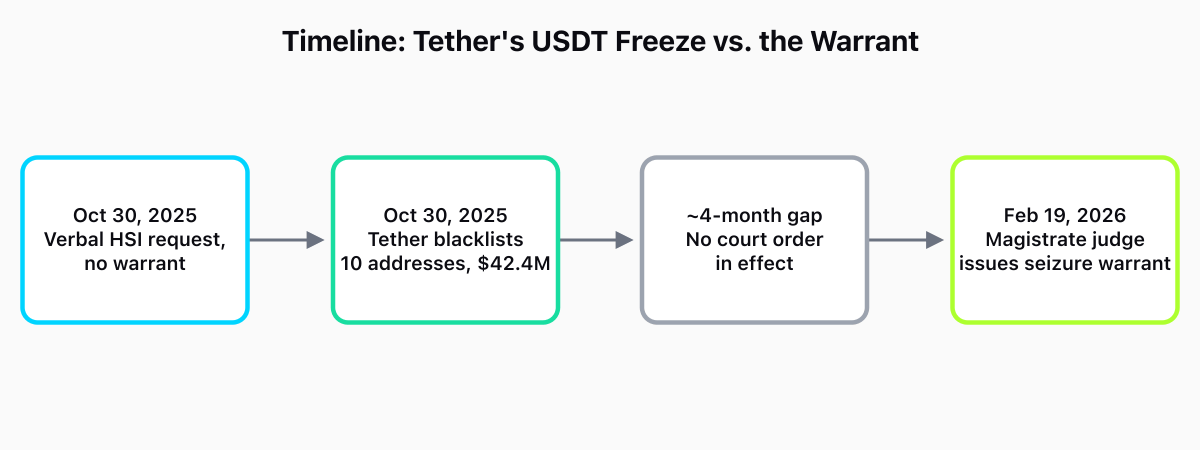
Tether froze the funds the same day it got a phone call, and a court order didn't arrive for almost four months.
Tether Doesn't Need a Court Order to Freeze You
USDT is an ERC-20 token, and Tether's contract carries a blacklist function that Tether alone controls. Add an address to it and the balance stops moving, regardless of who holds the keys or what a court has actually decided. A verbal ask from one agent was enough here.
That's the gap most holders never think about. A bank freeze comes with a subpoena on file somewhere. A stablecoin blacklist is just a flag on a smart contract, and the issuer can flip it before anyone outside the request has seen a shred of paperwork.
Plastron's own screening corpus tracks 3,901 labeled addresses, including 780 on the OFACsanctions list - and none of that would flag a wallet like this one. A sanctions match is public and checkable in seconds. An informal law enforcement request to a stablecoin issuer isn't published anywhere until someone files a lawsuit about it.
The Four-Month Gap Between the Freeze and the Warrant
Tether blacklisted the wallets on October 30, 2025. A federal magistrate judge in the Eastern District of North Carolina didn't sign a seizure warrant until February 19, 2026 - almost four months later. For that entire stretch, $42.4 million sat frozen under nothing more than one agent's say-so.
The plaintiffs' lawyer put it plainly: "Tether froze our clients' funds following an informal government request with no warrant, no court order, no legal process directed to Tether and no notice." A warrant that shows up months later doesn't undo the months it wasn't there.
What Are the Plaintiffs Asking the Court to Do?
Three things. A ruling that the freeze was unlawful from day one. An order blocking Tether from moving or burning the tokens before any forfeiture case is actually decided. And damages, including whatever income Tether made off the frozen balance while it sat blacklisted.
None of that unfreezes the money today. The case could run for months, maybe longer, before a judge rules on any of it.
Could This Happen to You?
Yes, if the wallet you're holding ever touches an address a law enforcement agent decides to flag informally - even a wallet you funded through routine business, with no sanctions link and no criminal charge against you personally.
Most people check an unfamiliar counterparty on a block explorer like Etherscan and stop there. That shows raw transaction history, not exposure to sanctioned entities, mixers, or stolen funds - screening the address with Plastron flags that risk across Ethereum and six other chains before you're the one filing a lawsuit to get your money back.
FAQ
Can Tether Freeze USDT Without Any Legal Process at All?
Based on this case, yes - at least in practice. Tether blacklisted ten addresses in October 2025 on an informal verbal request from a single Homeland Security Investigations agent, with no warrant, subpoena, or court order in hand at the time.
How Long Can a USDT Freeze Last Before a Court Gets Involved?
In this case, almost four months. Tether froze the addresses on October 30, 2025, and a seizure warrant wasn't issued until February 19, 2026.
Does Tether Notify You Before Freezing Your Wallet?
No. The plaintiffs say they received no notice before or after the freeze, and only discovered the blacklist when their USDT stopped moving.
Is This Different From an Exchange Account Freeze?
Yes. An exchange freeze locks your access to a custodial account you opened under its terms. A Tether blacklist targets the token itself, at the contract level, and can catch a wallet whose holder never had any relationship with Tether.
Disclaimer: This article is for educational and informational purposes only and is not legal, financial, tax, or compliance advice. Crypto carries risk; you act on this information at your own risk. Always do your own research and consult a qualified professional before making decisions. Views are the author's own and do not constitute financial, legal, or investment advice.
About Plastron
Plastron is a free, non-custodial wallet screening tool. It checks Ethereum and six EVM chains for AML and KYT risk — sanctions exposure, mixer contact, and stolen-funds proximity — and returns a risk report in seconds. It reads public on-chain data only: it never takes custody of funds and never asks for private keys.