TL;DR - No, swapping coins on a decentralized exchange leaves a public on-chain record at every step, so blockchain analytics still trace tainted funds straight through a Uniswap trade and back to their origin.
It is a common assumption that converting one token into another on a decentralized exchange resets its history. You send in ETH that came from somewhere questionable, you get back USDC, and the new balance feels like a fresh start. On a public blockchain it is not. The swap is just another transaction in the open ledger, and the firms that score wallet risk are built to read straight through it. Here is what a DEX swap actually changes, what it leaves untouched, and how to tell where you stand before a trade.
Does swapping crypto on a DEX hide where it came from?
No. A trade on Uniswap, Curve, or any other on-chain venue is recorded as a smart-contract interaction that anyone can read. The transaction shows the address that sent the input token, the router contract that executed the swap, and the address that received the output token. None of that is hidden, and none of it is deleted when the asset changes form.
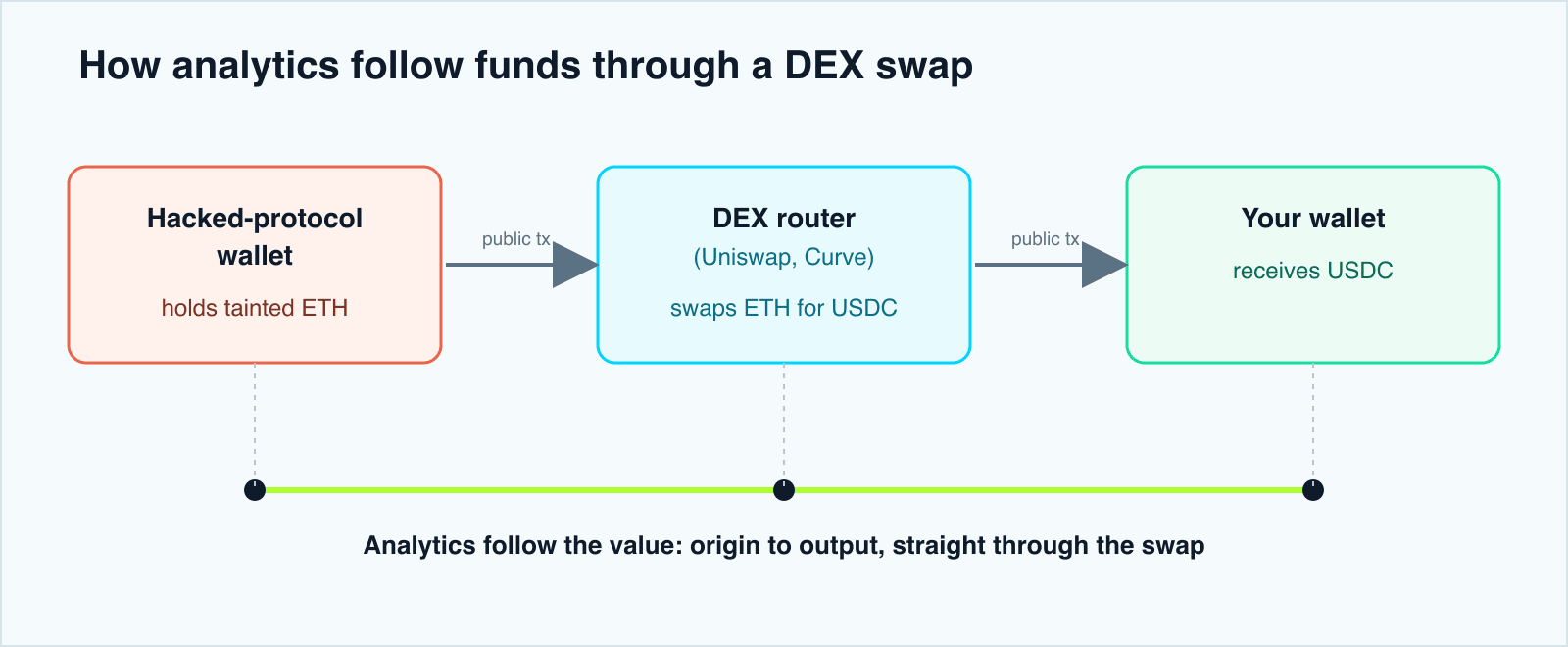
Blockchain analytics firms treat a swap as one more hop in a chain of transfers. If the ETH you swapped traced back to a hacked protocol three transactions ago, the USDC you walk away with is still three-plus-one hops from that hack. The asset on your screen looks different. The graph that connects it to its source does not break.
Why do people think a token swap cleans tainted coins?
The confusion comes from mixing up two very different tools. A mixer like the sanctioned Tornado Cash pools many users' deposits together and pays out from a shared reserve, which is a deliberate attempt to sever the link between a deposit and a withdrawal. A DEX does the opposite: it matches your trade against a liquidity pool and writes every detail to the chain. One is designed to obscure; the other is designed to settle trades transparently.
The "fresh asset" feeling is also misleading. Changing ETH into a stablecoin, or bridging it to another network, swaps the label on the value but not the trail behind it. Investigators follow value, not ticker symbols, and a swap is exactly the kind of conversion their tooling expects to see.
How do analytics follow funds through a DEX swap?
Every DEX swap settles through a smart contract, and that contract call is permanent and public. Tracing software reads the input transfer, identifies the router and pool involved, and links the output transfer that lands in your wallet. Because the amounts and timestamps line up, attributing the incoming token to the same actor who sent the original funds is straightforward.
A swap changes the token but not the trail: every step is a public transaction, and tracing tools follow the value straight through the router.
This is why a swap does little to slow an investigation. The same techniques that handle funds moving across blockchains apply to funds moving across token types. Even when a launderer chains several swaps together, the repeating pattern of in-and-out conversions becomes its own signal, much like the way mixed crypto can still be traced through clustering and timing analysis.
Can a DEX swap actually raise your risk score?
Sometimes, yes. Swapping does not lower the exposure that already attaches to your funds, and in certain cases it adds new flags. Interacting with a flagged or unaudited contract, routing through a pool that a monitoring system associates with laundering, or producing a burst of rapid back-and-forth swaps can all read as obfuscation behaviour rather than ordinary trading.
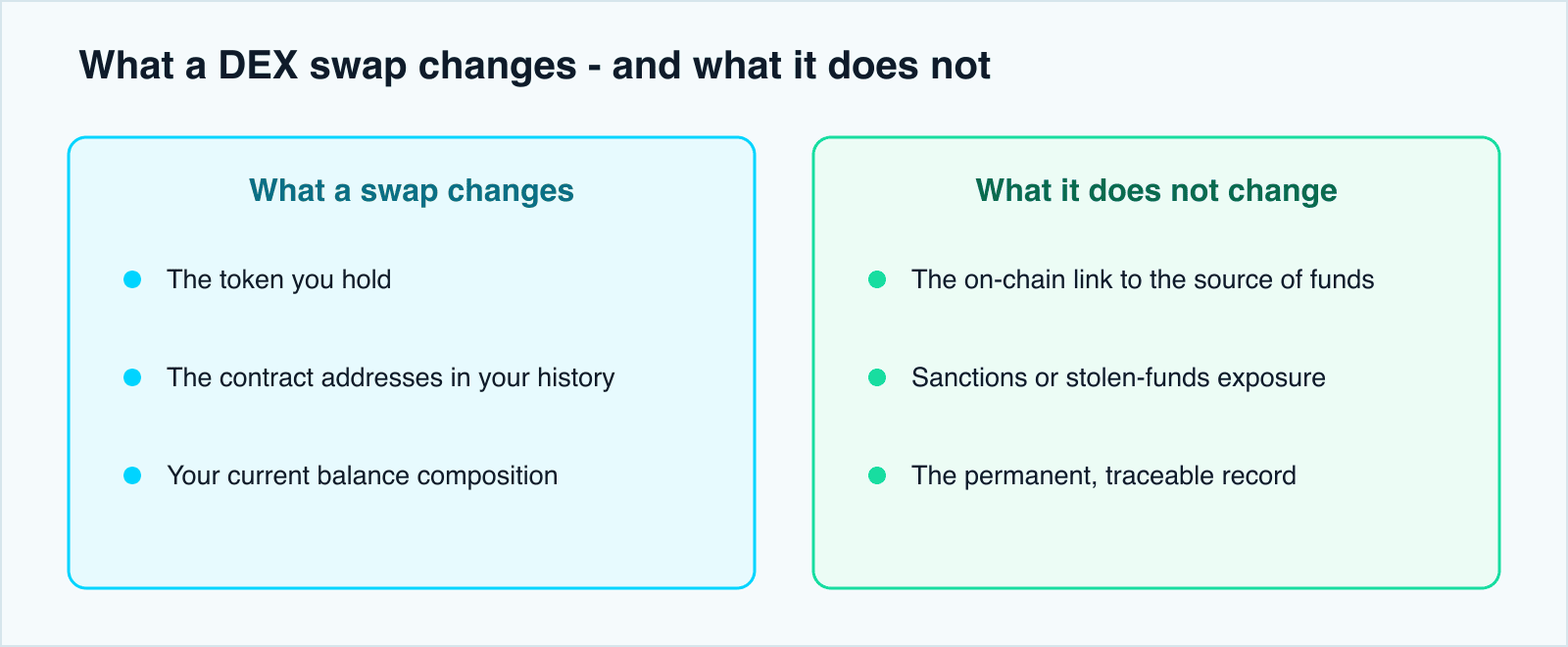
A swap changes the asset you hold and the contracts in your history, but not the exposure attached to the value or the public record of the trade.
So the realistic outcome is not a clean slate. At best the exposure carries forward unchanged; at worst the swap pattern itself becomes another thing a reviewer points to when an exchange asks you to explain a deposit. If the underlying funds carry sanctions or stolen-funds exposure, that risk follows the value into the new token, which is the core idea behind what it means for crypto to be tainted.
How do you check an address before you swap or cash out?
You can do a basic check by hand on a block explorer such as Etherscan, opening the address, reading its incoming transfers one at a time, and tracing each counterparty backward to see whether the funds sit near a hack, a mixer, or a sanctioned entity. It is slow, it stops at the first hop unless you keep clicking, and it will not tell you how an exchange's monitoring system scores the same history.
Rather than walking that trail one transaction at a time, screen the address with Plastron to see sanctions, mixer, and stolen-funds exposure across Ethereum and six other chains at once, with no wallet connection needed. Checking the source before you swap or send to an exchange is the difference between a clean record and an unexpected source-of-funds request. For the exchange side of the same question, see how exchanges trace a deposit's origin.
FAQ
Does swapping ETH for a stablecoin remove its history?
No. The swap is a public transaction that links the ETH you sent to the stablecoin you received. Any sanctions, mixer, or stolen-funds exposure attached to the ETH carries forward to the stablecoin, and analytics tools follow the value across the conversion.
Is using a DEX itself a red flag?
Using a decentralized exchange is normal and legal, and ordinary trading does not flag a wallet on its own. Risk comes from the source of the funds and from patterns such as rapid back-and-forth swaps or routing through pools tied to laundering, not from the simple act of trading on-chain.
Can an exchange see that I swapped on Uniswap before depositing?
Yes. When you deposit, the exchange's monitoring system reviews your wallet's on-chain history, which includes any DEX swaps and the addresses that funded them. A swap shortly before a deposit does not hide the origin and can itself draw attention if the prior funds were high-risk.
Does bridging to another chain hide funds better than swapping?
Not reliably. Bridges record both the deposit on the source chain and the release on the destination chain, so cross-chain tracing reconnects the two sides. Moving value to a new network changes the label, not the underlying link back to where the funds came from.
Disclaimer: This article is for educational and informational purposes only and is not legal, financial, tax, or compliance advice. Crypto carries risk; you act on this information at your own risk. Always do your own research and consult a qualified professional before making decisions. Views are the author's own and do not constitute financial, legal, or investment advice.
About Plastron
Plastron is a free, non-custodial wallet screening tool. It checks Ethereum and six EVM chains for AML and KYT risk — sanctions exposure, mixer contact, and stolen-funds proximity — and returns a risk report in seconds. It reads public on-chain data only: it never takes custody of funds and never asks for private keys.