TL;DR - Yes, exchanges and the analytics firms behind them can follow crypto across blockchains, because every bridge and swap leaves matching on-chain records, so chain-hopping rarely hides where funds came from.
A common assumption is that moving funds from Ethereum to another chain wipes their history clean. Bridge the coins, swap them on the far side, and the trail supposedly goes cold. Investigators have a name for this tactic - chain-hopping - and tracing across chains is now a standard part of how deposits get screened. Here is what actually survives the hop, and why a fresh-looking address on a new chain can still carry the risk of its origin.
What is chain-hopping?
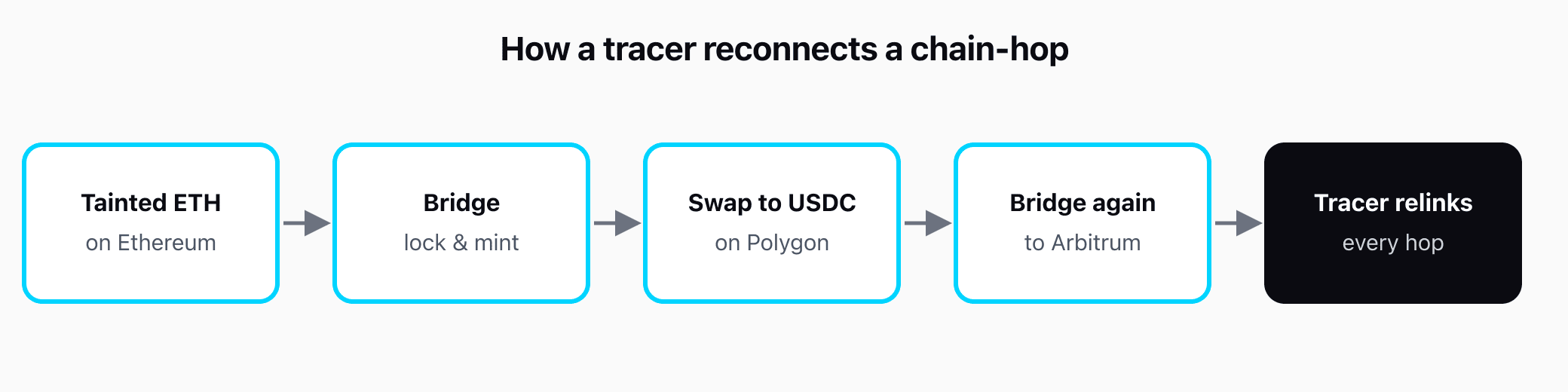
Chain-hopping is moving value across separate blockchains to make it harder to follow. Someone might send ETH through a bridge to Polygon, swap it for USDC, bridge again to Arbitrum, then withdraw to an exchange. Each hop changes the chain, the asset, or both. The hope is that an investigator following the Ethereum trail loses it the moment the funds leave for another network.
It is a favourite of large thefts. The groups behind major exchange and bridge hacks routinely scatter stolen funds across many chains and tokens before trying to cash out. The same pattern shows up in smaller scams and in ordinary attempts to obscure a source of funds. The mechanics are identical whether the amount is a hundred dollars or a hundred million.
Can exchanges really trace crypto across blockchains?
In most cases, yes. The reason is that the two ends of a hop are both recorded in the open. A bridge does not teleport your coins. It locks or burns the asset on the source chain and mints or releases an equivalent on the destination chain. Both events are public transactions with timestamps, amounts, and addresses. Match the lock on one side to the mint on the other, and the link is rebuilt.
Analytics vendors such as Chainalysis, TRM Labs, and Elliptic have built cross-chain tracing into their products precisely because chain-hopping became the default laundering move. When an exchange screens your deposit, it is usually running it through one of these tools, which already index dozens of chains and the main bridges between them. The deposit address may be new, but the funds feeding it are not.
How does cross-chain tracing actually work?
Tracers lean on a handful of signals that a bridge or swap cannot hide. The strongest is amount-and-time matching: a distinctive sum that leaves one chain and reappears on another within minutes is a confident link, even without reading the bridge contract. Bridge contracts themselves are also indexed, so the lock event and the corresponding release are paired directly. Decentralised exchange swaps stay on a single chain and are fully transparent, so converting a token mid-route changes the asset but not the readable trail.
Each hop changes the chain or the asset, but the matching amount and timing let a tracer reconnect the path end to end.
You can sample this yourself. After a bridge transfer, the lock transaction on the source chain and the mint on the destination chain are both visible on each chain's block explorer, such as Etherscan or Polygonscan, and the amounts usually line up to the token. Doing that by hand across several chains is slow and easy to get wrong. Screen the address with Plastron to see sanctions, mixer, and stolen-funds exposure across Ethereum and six other chains at once, with no wallet connection needed.
Does bridging or swapping clean the trail?
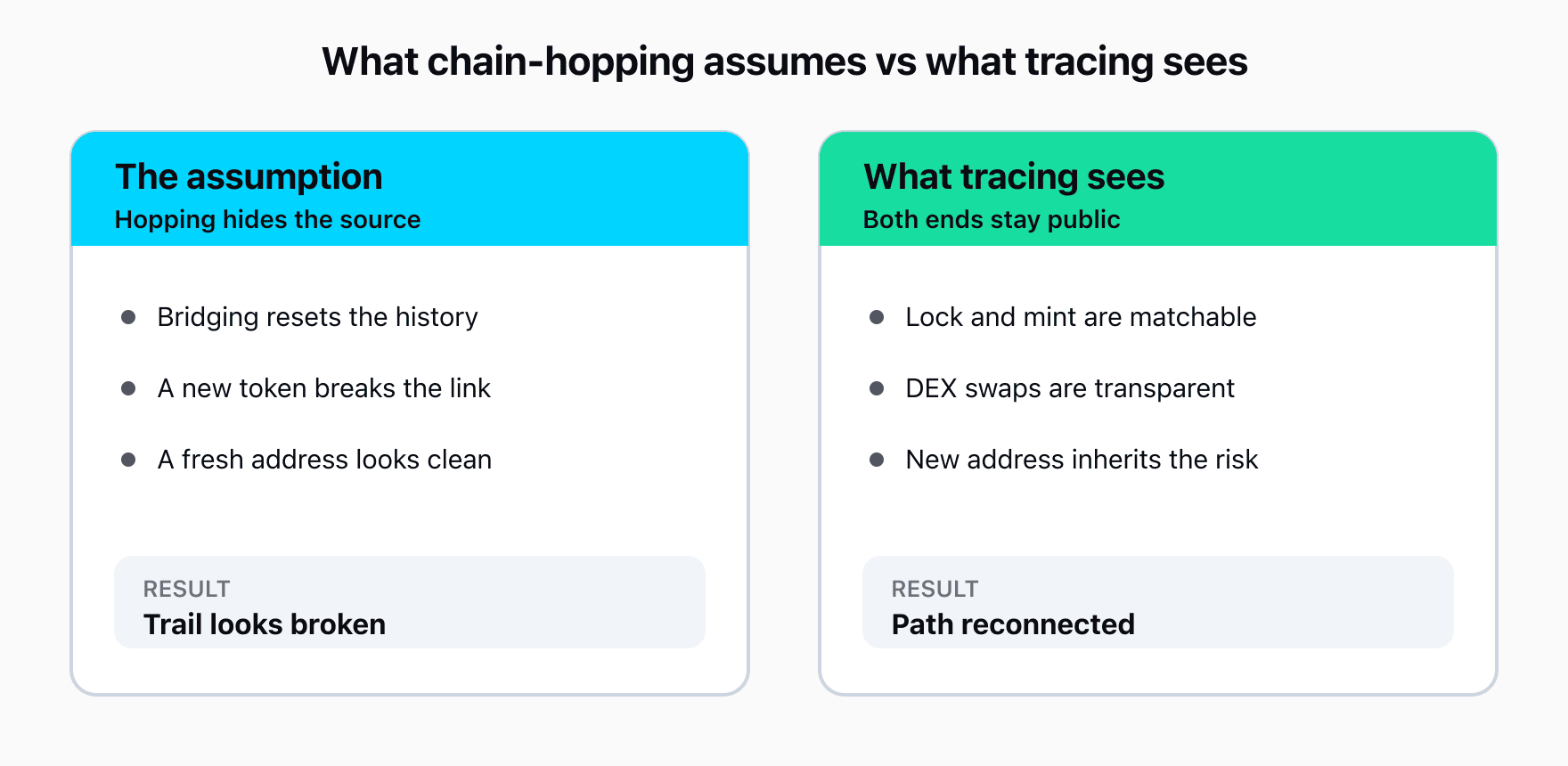
Generally, no. Bridging and swapping change the surface - a different chain, a different ticker - but they leave the link intact for anyone indexing both sides. The places where tracing genuinely weakens are narrower than people think. A centralised mixer can sever the on-chain link, though contact with one is itself a loud risk flag. A custodial swap service that takes funds in and pays different funds out can break the direct trail, but those services keep internal records and respond to law-enforcement requests. Privacy chains with shielded transactions are the real blind spot, and most screening tools treat any contact with them as high-risk by default.
What chain-hopping is assumed to do, against what cross-chain tracing actually reconstructs.
So an ordinary bridge-and-swap route does not launder anything. It mostly adds steps that a tool already built for cross-chain tracing will walk back. Worse, the act of routing funds through unusual hops can itself raise the risk weight on a deposit, because that behaviour matches known laundering patterns.
What does cross-chain exposure mean for your wallet?
The practical takeaway is that the chain you receive funds on tells you little about their risk. If you accept a payment on Arbitrum or Base, the relevant question is not which network it arrived on but where the value started several hops earlier. A wallet that looks pristine on one chain can sit two bridges away from a sanctioned address or a hacked protocol, and an exchange screening your later deposit will see that distance.
This is the case for checking funds before you move them onward, not after. Screen an incoming address against the chains it actually touched, trace the exposure back through any bridges, and you find out what a compliance desk would see before your deposit lands. The alternative is learning about a tainted origin from a frozen account and a source-of-funds request you were not expecting.
FAQ
Does using a bridge make my crypto untraceable?
No. A bridge records a public lock or burn on the source chain and a matching mint or release on the destination chain. Tracing tools pair those events by amount and timing, so the funds stay linked across the hop.
Can an exchange see that my funds came from a different blockchain?
Usually yes. Most exchanges screen deposits with analytics tools that index many chains and the bridges between them. A new deposit address does not hide the cross-chain history feeding it.
Which methods actually break a cross-chain trail?
Only a narrow set: centralised mixers, some custodial swap services, and shielded privacy-chain transactions. Each is treated as high-risk by screening tools, and the custodial options still keep records that can be subpoenaed.
How do I check my own cross-chain exposure?
Look up the address on each chain's block explorer, or run it through a multi-chain screening tool that traces exposure across networks at once. That shows the same risk picture an exchange sees before you deposit.
Disclaimer: This article is for educational and informational purposes only and is not legal, financial, tax, or compliance advice. Crypto carries risk; you act on this information at your own risk. Always do your own research and consult a qualified professional before making decisions. Views are the author's own and do not constitute financial, legal, or investment advice.
About Plastron
Plastron is a free, non-custodial wallet screening tool. It checks Ethereum and six EVM chains for AML and KYT risk — sanctions exposure, mixer contact, and stolen-funds proximity — and returns a risk report in seconds. It reads public on-chain data only: it never takes custody of funds and never asks for private keys.