TL;DR - Tainted or "dirty" crypto is any coin with a traceable link to theft, fraud, sanctions, or a mixer; receiving it is rarely a crime, but it can get your funds frozen or flagged by an exchange.
If someone has told you that the coins you just received are "tainted," or you found a sketchy address a few hops back in your transaction history, the worry is understandable. The fear is usually that the money is permanently marked and could be seized, or that simply holding it puts you at legal risk. The reality is more specific than the rumour, and most of the panic comes from mixing up two separate questions: is the coin itself poisoned, and will a business you deal with treat your wallet as risky?
What does it mean for crypto to be "tainted"?
"Tainted" and "dirty" are informal words for the same idea: a coin whose history includes a transaction tied to crime or to a sanctioned party. Nothing about the coin changes at the protocol level. A tainted ether is the same asset as any other ether, spends the same way, and carries no hidden flag in its code. The taint lives in the public record around the coin, not inside it.
That distinction matters, because it explains both why taint is hard to shake and why it is rarely the disaster people imagine. Blockchains keep every transaction forever, so a link to a hack or a darknet market never gets deleted. But the link is just data that an analyst can read, weigh, and act on. Whether it hurts you depends on who is looking and what rules they follow.
How do coins become tainted?
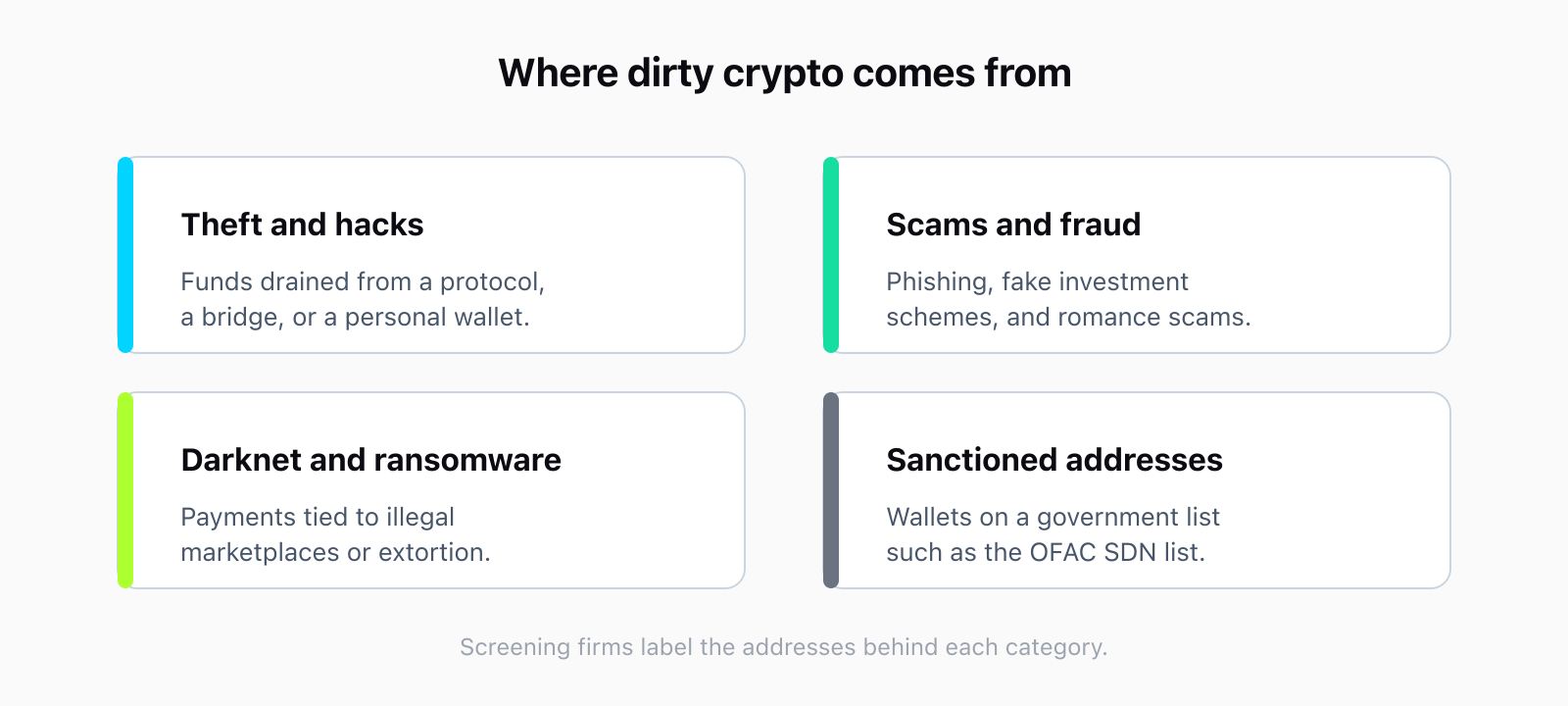
A coin picks up taint when it passes through, or sits close to, an address that screening firms have labelled as high risk. The common sources fall into a handful of categories.
Theft and hacks - funds drained from a protocol, a bridge, or a personal wallet.
Scams and fraud - proceeds from phishing, fake investment schemes, or romance scams.
Darknet and ransomware - payments tied to illegal marketplaces or extortion.
Sanctioned addresses - any wallet on a government list such as the OFAC SDN list.
Mixers and obfuscation - coins run through a tumbler or a long peel chain to hide their origin.
Analytics companies such as Chainalysis, TRM Labs, and Elliptic keep large databases of these addresses and trace how value flows out of them. A coin one transaction away from a labelled hack is treated very differently from one that is twenty ordinary hops removed. For the mechanics of how launderers stretch that distance on purpose, see how a peel chain works.
Coins pick up taint from four broad sources, and screening firms label the addresses behind each one.
Does taint really pass to me when I receive funds?
Here is where the model of the blockchain you are on changes the answer. On Bitcoin, every coin is a chain of unspent outputs, so analysts can follow a specific slice of value from address to address and argue that these exact coins came from a theft. On Ethereum and other account-based chains, there are no discrete coins to follow; a balance is just a number in an account. Screening tools handle this by measuring exposure - how close your wallet sits to a flagged source, and how much of your incoming value can be traced back to one.
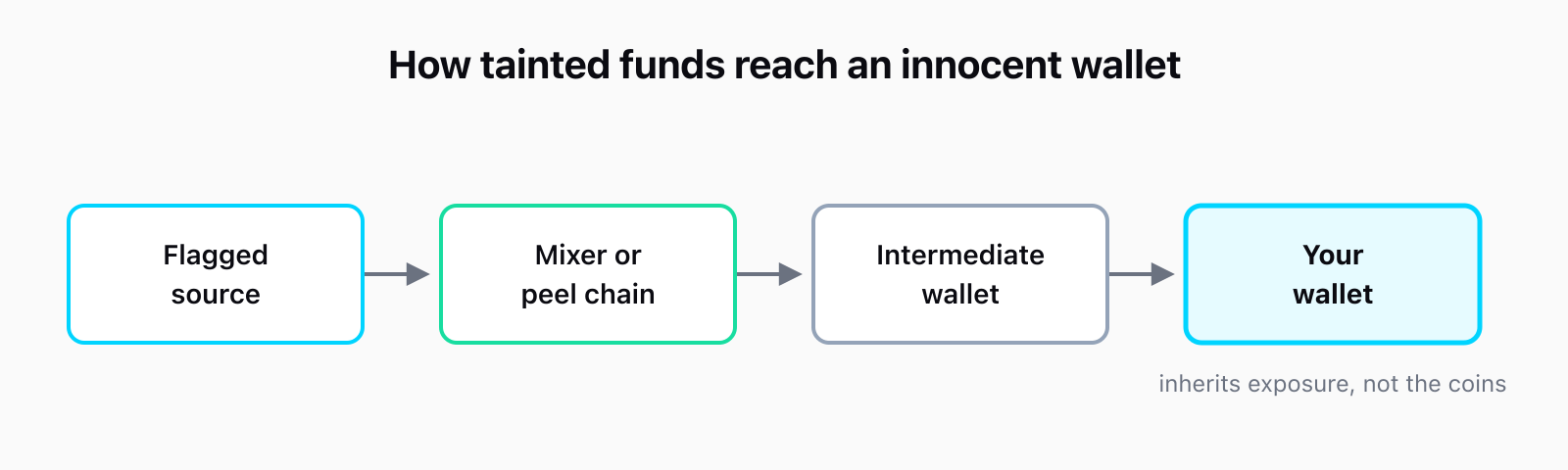
Either way, receiving tainted funds does not transfer guilt to you. It does create exposure on your address, and that exposure is what an exchange or a lender sees when they screen you. If a scammer sent you stablecoins, for instance, the token issuer or the exchange may act on it, which is the exact situation covered in what happens when you receive USDT from a scammer.
How can I check whether my crypto is tainted?
To check by hand, you would open a block explorer such as Etherscan, find the address that paid you, and trace its incoming transactions backward, hop by hop, watching for any address you recognise as a hack, a scam, or a sanctioned entity. This works for one or two hops, but it falls apart quickly: a single address can have thousands of transactions, and the risk labels that matter never appear on the explorer itself.
Rather than walking that trail one transaction at a time, screen the address with Plastron to see sanctions, mixer, and stolen-funds exposure across Ethereum and six other chains at once, with no wallet connection needed. Knowing where your incoming funds sit relative to a flagged source, before you forward them or send them to an exchange, is the difference between a clean cash-out and a surprise hold. For the wider picture of how a receiving business rebuilds your history, see how exchanges trace a deposit's origin.
Tainted value usually reaches an ordinary wallet through one or two hops, leaving exposure rather than a marked coin.
Can tainted crypto ever be "cleaned"?
Not in the way the word suggests. You cannot scrub the history off a coin, because the record is permanent and public. Sending it through another wallet only adds a hop; it does not erase the earlier ones, and a fresh string of self-transfers can itself look like laundering. Time and distance soften exposure - value that started at a flagged address and then changed hands through many independent, legitimate owners carries less weight than a direct transfer - but that is dilution, not deletion.
The practical move is the opposite of hiding. If you received funds you did not expect and cannot explain, keep a record of where they came from and why, and avoid mixing them with savings you may need to withdraw cleanly later. If an exchange asks, a clear account of the source is worth far more than a coin that has been bounced through a few extra wallets.
FAQ
Is it illegal to hold tainted crypto?
Holding it is not a crime on its own, and intent generally matters. The real risk is practical: if the funds trace to theft or a sanctioned source, an exchange can freeze them and ask you to prove how you got them, whether or not you knew their history.
Does taint ever expire?
The on-chain link never disappears, but its weight fades as value moves through many independent owners over time. A direct transfer from a hack reads as high risk; the same value twenty legitimate hops later barely registers.
Can one bad transaction taint my whole wallet?
A single flagged deposit raises exposure on that wallet, but screening looks at proportion and proximity, not a simple yes or no. Mixing a large flagged amount into a small wallet has more effect than a tiny dusting payment you never touched.
Are dirty coins worth less than clean ones?
In theory all coins are fungible and trade at the same price. In practice, coins with heavy exposure can be rejected by regulated exchanges, which makes them harder to cash out and, to that extent, less useful at the same market price.
Disclaimer: This article is for educational and informational purposes only and is not legal, financial, tax, or compliance advice. Crypto carries risk; you act on this information at your own risk. Always do your own research and consult a qualified professional before making decisions. Views are the author's own and do not constitute financial, legal, or investment advice.
About Plastron
Plastron is a free, non-custodial wallet screening tool. It checks Ethereum and six EVM chains for AML and KYT risk — sanctions exposure, mixer contact, and stolen-funds proximity — and returns a risk report in seconds. It reads public on-chain data only: it never takes custody of funds and never asks for private keys.