TL;DR - Monero hides transaction details on-chain, but converting it at a KYC exchange links your identity to the wallet on the other side, and that wallet's history is what an IRS audit actually uses.
Privacy coins don't buy audit immunity. They just move the paper trail one hop over, from the ledger itself to the exchange that touched it.
That distinction matters for anyone who holds Monero and eventually needs dollars out of it - freelancers paid in XMR, traders using it to break up a transaction history, or people who just value privacy on principle. Most guides to privacy-coin taxes stop at reporting obligations. Few explain what actually happens once your name gets attached to the exchange side of a Monero trade, or why that single link is enough to carry an entire audit.
Why Monero Draws IRS Attention
Monero's ring signatures and stealth addresses hide the sender, receiver, and amount of every transaction from anyone looking at the chain itself. That's the entire point of the coin, and it works. It also makes Monero the one major asset the IRS has openly paid to defeat.
In 2020, the IRS Criminal Investigation division awarded two $625,000 contracts - one to Chainalysis, one to the Texas firm Integra FEC - specifically to build tools that could trace Monero transactions. The agency picked two winners out of 22 proposals and gave each firm eight months to deliver a working prototype. Chainalysis later showed results on the Lightning Network side of that contract; what came of the Monero side was never confirmed publicly.
The message stuck anyway. An agency doesn't spend $1.25 million trying to crack an asset it doesn't think people are using to hide activity, and that reputation follows Monero into an audit even when nothing about your holding is illegal. An examiner who sees XMR on a return already has more reason to ask questions than they would for Bitcoin.
Can the IRS Actually Trace Monero?
Not directly, and that's still true in 2026. No public evidence shows the IRS or its contractors can de-anonymize a Monero transaction sitting entirely on-chain. What they can do is triangulate around it.
Monero's privacy stops at the two points where it touches the regulated financial system: the purchase and the cash-out. Buying XMR on a KYC exchange ties your Social Security number to that purchase before any privacy feature applies. Cashing out does the same thing in reverse - the exchange records the withdrawal address, reports the sale on Form 1099-DA starting with 2025 transactions, and the bank wire or deposit that follows shows up in your own statements. An examiner doesn't need to see inside the Monero transaction. They need your name, the fiat amounts on both ends, and the wallet address you withdrew to - three data points that already sit in exchange records and bank statements.
What the Wallet-By-Wallet Rule Changed
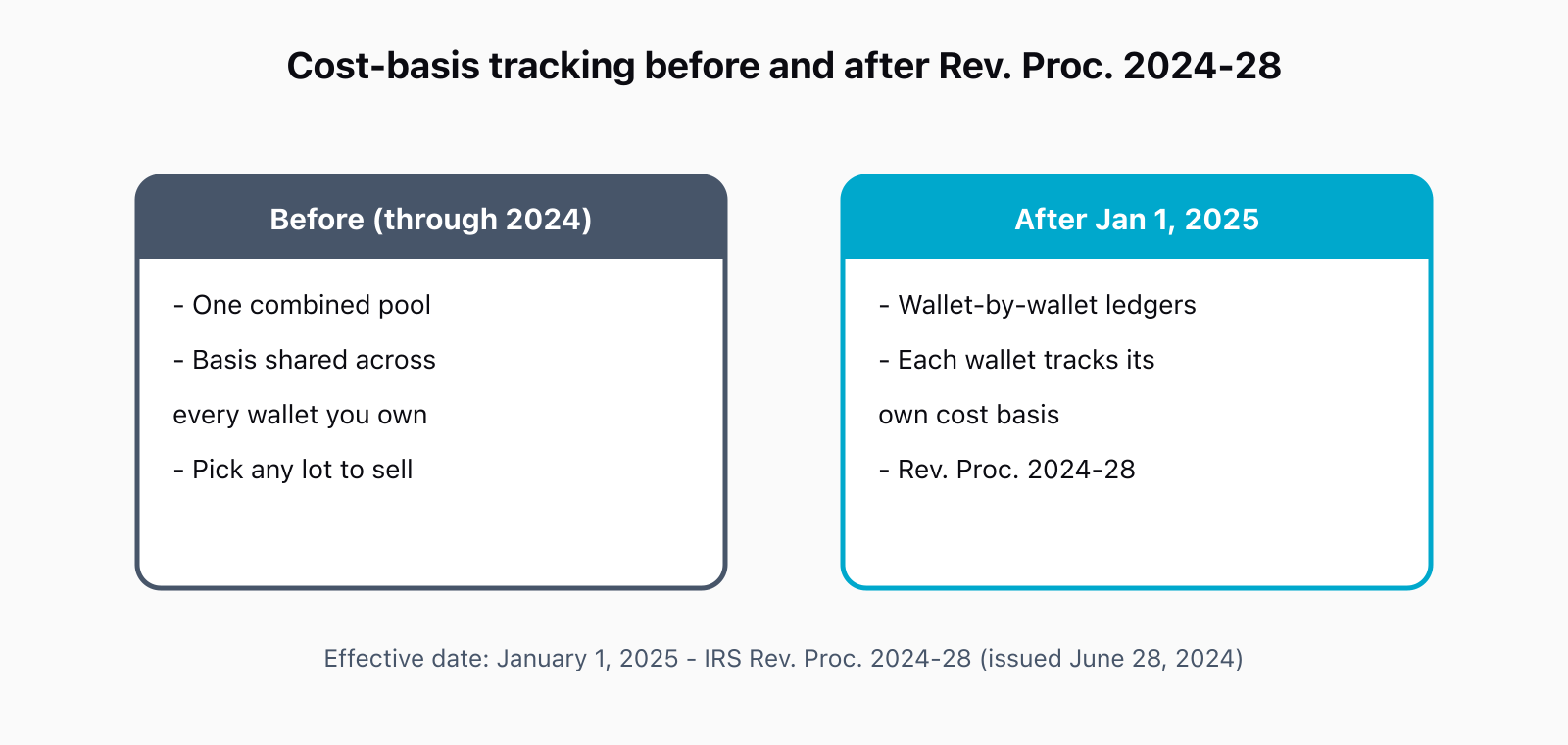
Before 2025, taxpayers could pool cost basis across every wallet they held and pick whichever lot made the math favorable when they sold. Revenue Procedure 2024-28, issued by the IRS on June 28, 2024, ended that. Starting January 1, 2025, every wallet or account is its own ledger, and basis has to be tracked wallet by wallet.
The pooled-basis method gave way to per-wallet tracking on January 1, 2025, so a Monero-to-exchange hop is now one more wallet an examiner can ask you to reconcile on its own.
The rule applies to every wallet, not just the ones that touched a privacy coin. But it lands hardest on anyone who moved funds through Monero, because each hop - the XMR wallet, the exchange account, the wallet it settled to - is now a separate ledger you're expected to reconcile on demand. Section 5 of Rev. Proc. 2024-28 offers a safe harbor that protects prior-year calculations if you followed the transition steps. It does not protect a return with unexplained gaps between wallets.
Does Cashing Out Monero Create a Paper Trail?
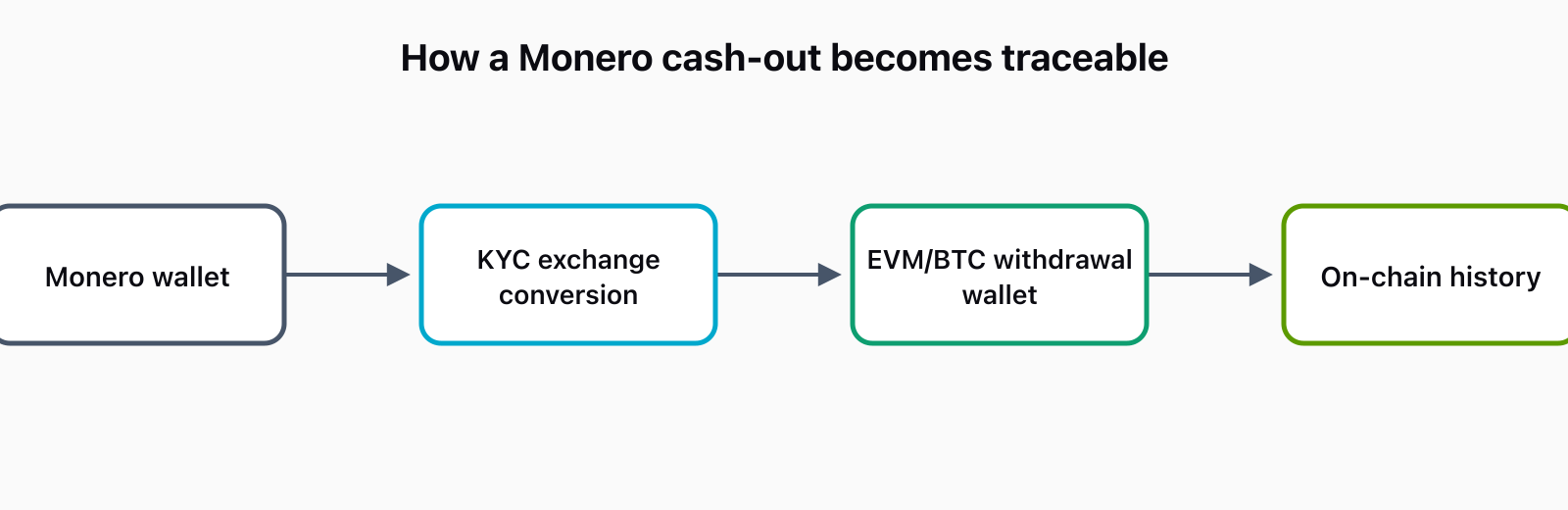
Yes, on the far side of the trade. Monero itself stays opaque, but the wallet that receives your converted funds - usually an Ethereum, Bitcoin, or exchange-custodied address - behaves like any other wallet on a public chain. Every deposit, withdrawal, and counterparty it touches afterward is visible to anyone who looks, examiner included.
Monero's privacy ends at the exchange: the wallet it converts into is fully public, and every hop after that is ordinary on-chain history.
You can look up that wallet's history yourself, one transaction at a time, on Etherscan or a similar block explorer. Screening the address with Plastron does the same check in one pass, matching it against more than 3,900 labeled high-risk addresses plus the OFACsanctions list, and returns sanctions exposure, mixer contact, and stolen-funds links across Ethereum and six other chains - roughly the picture an examiner is building by hand when they pull your wallet history.
This is where a privacy-coin audit actually diverges from an ordinary crypto audit. The IRS isn't trying to reconstruct what happened inside Monero. It's building a case from what happened immediately before and after: the exchange KYC record, the fiat rails, and the receiving wallet's own transaction history.
What Happens If You're Selected for a Crypto Audit?
An examiner requests records first - exchange statements, wallet addresses, and a reconciliation of gains and losses across every wallet you've disclosed. Using Monero doesn't change that ask. It changes the burden of proof once the numbers don't line up on their own.
CPA Laura Walter has said privacy coins raise the bar taxpayers have to clear to document their own holdings, precisely because the chain itself won't do that work for you. Without a public ledger to point to, the entire burden shifts to your own records: exchange statements, wallet exports, and a written reconciliation of each hop. A gap that would be a minor annoyance on a transparent chain becomes the central issue on an XMR-adjacent return.
Two things do not help the situation: refusing to produce wallet addresses, and arguing that Monero makes the transaction untraceable at the source. Both read to an examiner as an admission that you can't back up the number on the return.
The dollar exposure scales with how the gap looks on paper. A routine underpayment carries the section 6662 accuracy-related penalty: 20% on top of the tax owed. An examiner who decides the gap looks intentional - not sloppy, but deliberate - can move to the section 6663 civil fraud penalty instead, which is 75%. The two are mutually exclusive on any given dollar of underpayment, but which one applies is the examiner's call, built entirely from how well your records explain the wallet-to-wallet movement.
How to Lower Your Audit Exposure Before You File
The fix here is mechanical, not clever. Reconcile the trade before the IRS asks you to.
Three habits cut most of the exposure. Keep an export of every Monero wallet's transaction history, not just the exchange statements, since Rev. Proc. 2024-28 grades your basis wallet by wallet rather than account by account. Run an AML screening check on the wallet you cash out to before you send anything else through it, so a coincidental exposure to a sanctioned or high-risk address doesn't get layered on top of an already privacy-sensitive holding. And treat the safe-harbor election in section 5 as a paperwork deadline, not a formality - missing the transition steps forfeits the protection it offers.
None of this requires giving up Monero. It requires treating the two wallets on either side of it - the one that bought it, and the one that received the proceeds - as fully transparent. To an examiner, they already are.
Disclaimer: This article is for educational and informational purposes only and is not legal, financial, tax, or compliance advice. Crypto carries risk; you act on this information at your own risk. Always do your own research and consult a qualified professional before making decisions. Views are the author's own and do not constitute financial, legal, or investment advice.
About Plastron
Plastron is a free, non-custodial wallet screening tool. It checks Ethereum and six EVM chains for AML and KYT risk — sanctions exposure, mixer contact, and stolen-funds proximity — and returns a risk report in seconds. It reads public on-chain data only: it never takes custody of funds and never asks for private keys.