TL;DR - Attackers drained more than $40 million from Mercado Bitcoin on November 2, 2026, across ten blockchains, and Tether has frozen less than $5 million of it so far.
Ten blockchains carried the stolen funds out within hours, and a screening tool that only watches one of them would have missed most of the trail. Mercado Bitcoin is Brazil's oldest and largest crypto exchange, not a small no-name platform, and the breach didn't come from a bug in any of those ten chains. It came from inside the exchange's own wallet infrastructure. Most coverage stops at the headline number. It skips the part where the loss estimate has already moved three times and most of the money is still unaccounted for.
Mercado Bitcoin's November 2 breach, in one timeline
Attackers compromised a system tied to Mercado Bitcoin's wallet infrastructure on November 2, 2026, and moved funds out of exchange-associated wallets across multiple blockchains. The DefiLlama hack tracker classifies the incident as a "Protocol Logic" failure with the entry technique listed as unknown, which means the exchange hasn't disclosed how the attacker got in. Mercado Bitcoin suspended deposits and withdrawals while it investigated, and said customers would not absorb the loss and that no customer data was exposed.
The loss figure has moved three times since the first report. Hypernative's initial read, the one DefiLlama's feed carries, put the outflow at more than $40 million across ten chains. Arkham put it closer to $46 million. Chainalysis later estimated about $49 million moved across 17 blockchains, nearly double the chain count in the earliest report. None of these numbers has been confirmed by Mercado Bitcoin itself.
This wasn't some fly-by-night platform gambling with unaudited reserves. Tether put $20 million into Mercado Bitcoin in July 2026, back when the exchange said it served 4.5 million users.
Ten blockchains, one compromised wallet system
The ten chains DefiLlama lists are Bitcoin, Ethereum, Solana, TRON, Polygon, Arbitrum, Avalanche, BSC, Stellar, and XDC. None of those chains has a bug. What failed sits above all of them: the layer inside Mercado Bitcoin's own systems that decides which withdrawals get approved. Compromise that layer, and withdrawals can fire on every chain the exchange touches, all at once.
One compromise. Eight traceable chains.
Of the ten chains this hack crossed, Plastron screens eight directly: full multi-hop exposure tracing on Ethereum, Polygon, Arbitrum, Avalanche, and BSC, plus a same-day sanctions and stolen-funds read on Bitcoin, Solana, and Tron. Stellar and XDC aren't covered yet.
Mercado Bitcoin wasn't the only exchange facing this exact failure mode that week. Blockchain analytics firm Bitquery reported that an attacker withdrew $108.8 million in USDC from Kraken, Crypto.com, and OKX between November 1 and 2, using wallets that were already approved for withdrawal rather than exploiting any chain's code. Different exchange, different chains, same root cause: the authorization layer, not the blockchain underneath it.
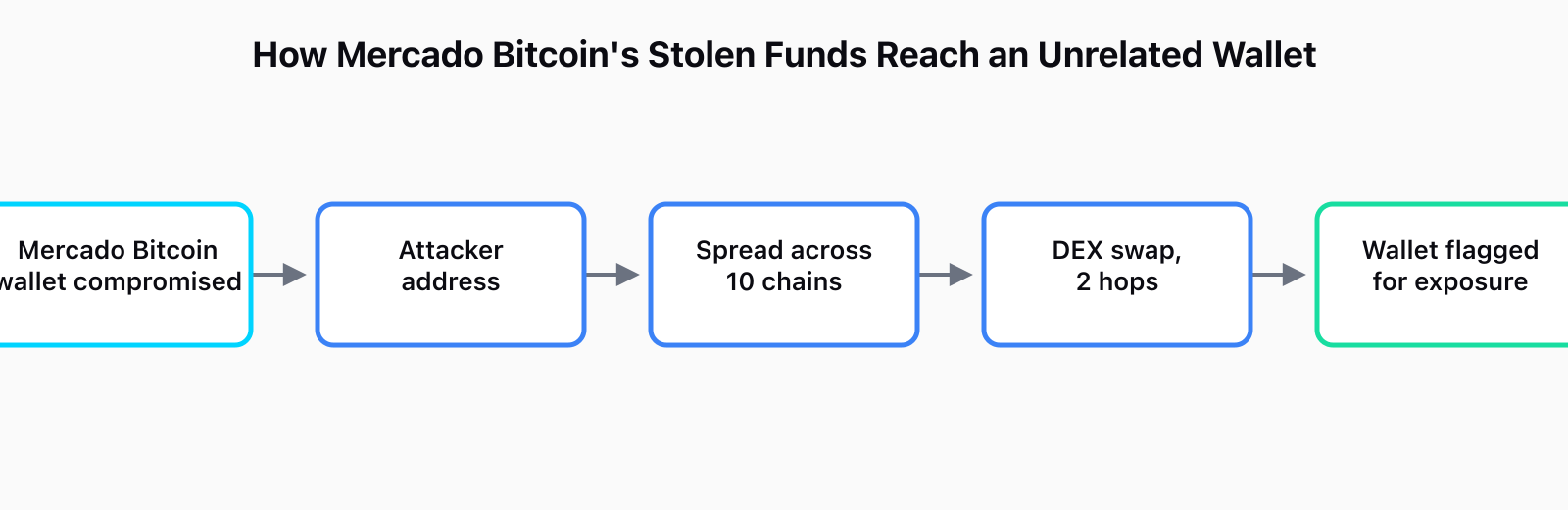
A wallet two hops from Mercado Bitcoin's attacker address never touched the breach directly, but it still inherits a share of the exposure score.
What does Tether's $4.5 million freeze actually cover?
Tether's CEO said on X that the company froze more than $4.5 million in USDT connected to the theft. Against even the lowest $40 million estimate, that's roughly one-ninth of what moved. Freezing isn't recovering: the statement didn't say whether those tokens go back to Mercado Bitcoin, sit frozen through an investigation, or something else entirely.
A freeze on one stablecoin doesn't clear the rest of the chain. Whatever Tether didn't catch, somewhere between $35 million and $44 million depending which estimate you use, is still moving through wallets that have nothing to do with the original breach.
How does stolen crypto from an exchange hack reach a wallet that never touched it?
A wallet doesn't have to receive funds directly from the attacker's address to inherit exposure. Plastron's corpus carries more than 100,000 labeled addresses, and 43,982 of them are tagged specifically for hack and exploit exposure, tracked apart from sanctions or mixer labels. A trader who swapped tokens on a decentralized exchange two or three hops downstream from the Mercado Bitcoin attacker's wallet can end up holding that exposure without ever knowing where it came from.
Tracing a ten-chain hack by hand means opening a Bitcoin block explorer, Etherscan, Solscan, and Tronscan separately and following each hop one at a time. Screen the address with Plastron instead and get a sanctions, mixer, and stolen-funds read across every chain it covers in one pass.
What should you do if a screening report flags Mercado Bitcoin exposure?
Start with the hop, not the flag. Find the specific transaction that connects your address to the stolen funds before you argue with an exchange's compliance team about it. Pull the transaction hash that triggered the review and send it to them directly, rather than waiting out a hold and hoping it clears on its own.
Receiving stolen crypto isn't a crime by itself in most jurisdictions. Holding it can still get a wallet delayed, frozen, or asked for a source-of-funds explanation, and that review can take days while an exchange waits on its own screening vendor to confirm how many hops separate your wallet from the attacker's address. The same pattern played out after Bitget lost $351 million in September, and most of that trail is still flagged more than two months later.
Screenshot the hold notice and save the transaction hash before you contact support, not after. Keep a plain record of where the funds in your wallet came from. A compliance team that gets a clear hop count and a transaction hash up front closes a review faster than one that has to chase you for both.
FAQ
How much did Mercado Bitcoin actually lose?
Estimates range from just over $40 million, the figure Hypernative reported and DefiLlama's tracker carries, to about $46 million from Arkham, to roughly $49 million across 17 chains from Chainalysis. Mercado Bitcoin hasn't confirmed a final figure.
Which blockchains were affected by the Mercado Bitcoin hack?
DefiLlama's tracker lists ten: Bitcoin, Ethereum, Solana, TRON, Polygon, Arbitrum, Avalanche, BSC, Stellar, and XDC. Chainalysis's later estimate puts the real count at 17.
Did Mercado Bitcoin customers lose money?
The exchange said customers would not absorb the loss and that no customer data was exposed. Neither statement has been independently verified.
Can Tether freeze the rest of the stolen USDT?
Only if the tokens are still sitting in a wallet Tether can identify. Once stolen funds move through a swap or a bridge into a different asset, a USDT freeze no longer reaches them.
Does this hack affect wallets that never used Mercado Bitcoin?
Yes. Once stolen funds spread across multiple hops and multiple chains, any wallet that receives even a fraction of them can inherit the exposure tag, regardless of whether it ever touched the exchange.
Disclaimer: This article is for educational and informational purposes only and is not legal, financial, tax, or compliance advice. Crypto carries risk; you act on this information at your own risk. Always do your own research and consult a qualified professional before making decisions. Views are the author's own and do not constitute financial, legal, or investment advice.
About Plastron
Plastron is a free, non-custodial wallet screening tool. It checks Ethereum and six EVM chains for AML and KYT risk — sanctions exposure, mixer contact, and stolen-funds proximity — and returns a risk report in seconds. It reads public on-chain data only: it never takes custody of funds and never asks for private keys.