When a crypto trading bot's API key or signing access gets stolen, the exchange and the bot platform almost always treat the drained wallet as the user's problem, not theirs.
In October 2026, attackers drained $953,000 from 48 wallets connected to the Solana trading bot Bloom in about 94 seconds, moving the funds with each wallet's own private key. Bitquery traced every transfer back to a properly signed transaction, which means the key itself, not a bug in Bloom's code, was the point of failure. Connect a bot to your wallet and you hand over exactly that kind of signing power, whether you notice it or not.
How Does a Bot Actually Get Access to Your Wallet?
There are three common setups, and they carry very different risk. An exchange API key, the kind 3Commas, Pionex, and Cornix use, can be scoped to trading only or to trading plus withdrawals. A trade-only key is safer, but plenty of users widen the scope by mistake or because an older bot requires it. A Telegram or Discord sniper bot is riskier by design: it generates a wallet for you inside the bot vendor's own infrastructure, so the private key never touches your device. You never had it to lose, because you never had it at all.
The third setup is a wallet-connect approval. You keep your own self-custody wallet, but you sign an allowance that lets the bot move tokens up to a limit without asking again each time. Revoke nothing, and that allowance sits open indefinitely, a standing invitation with no expiration date.
Four Bot Breaches, One Pattern
The mechanism keeps repeating across very different bots and chains.
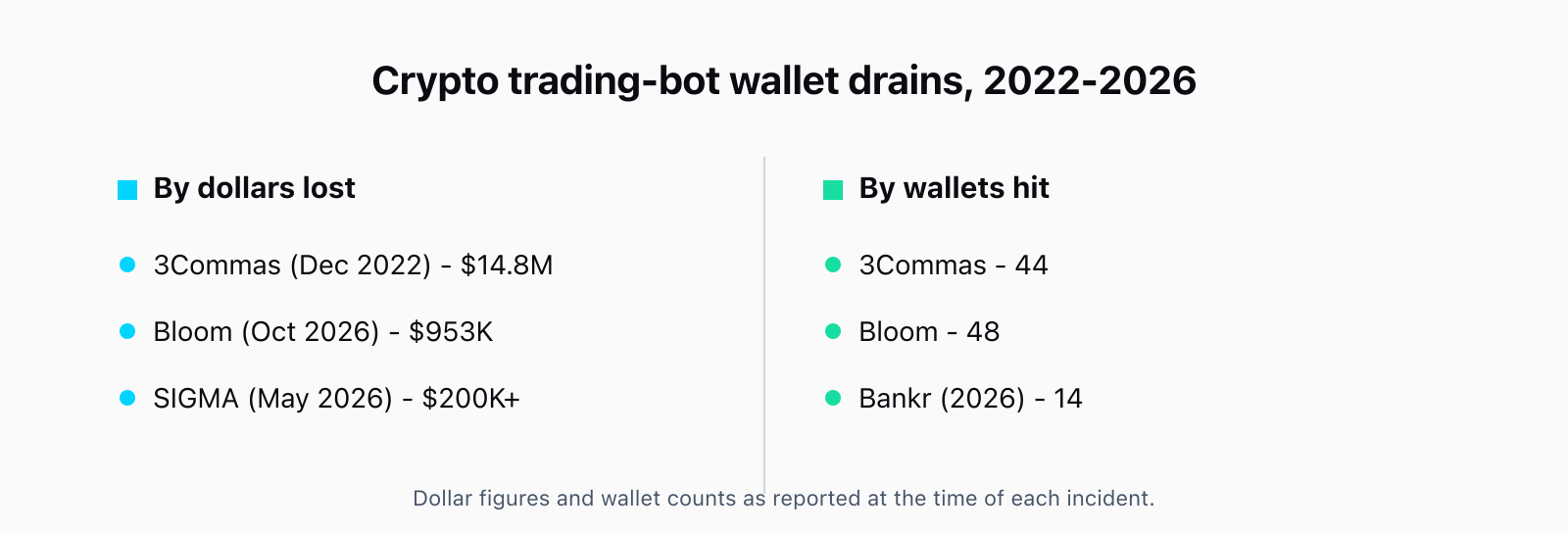
3Commas, December 2022. Leaked API keys led to roughly $14.8 million stolen from 44 accounts. Neither Binance nor 3Commas issued refunds, saying there was no way to prove the keys had been stolen rather than shared.
Bloom, October 2026. $953,000 moved out of 48 Solana wallets in about 94 seconds, each transfer signed with the wallet's own compromised key.
SIGMA, May 2026. A trader known as Unihax0r lost more than $200,000 across Ethereum, Base, and BSC after a private key tied to the Telegram bot's wallet-generation flow leaked.
Bankr, 2026. An AI trading assistant was breached through a combination of social engineering and its own automation, compromising 14 wallets.
Four incidents, one shared fact: in every case, the user did everything a bot asks of them and still lost the funds.
Four trading-bot breaches since 2022 share one mechanic: a leaked key moves funds as a validly signed transaction, not a flagged hack.
Why Won't the Exchange or Bot Platform Refund You?
Because the trade or transfer was authenticated. An exchange sees a valid API call or a validly signed transaction, not a hack, so its fraud systems don't flag it the way they'd flag a stolen password login. The 3Commas case set the template for how platforms respond: push the burden of proof onto the user, and since nobody can produce a server log from the attacker's side, the claim stalls. The FBI's 2025 Internet Crime Report put total crypto-related fraud losses at $11.37 billion for the year, and a bot-authenticated drain gets bucketed with every other kind of theft a victim is told, in practice, to absorb alone.
What to Do in the First Hour After a Drain
Revoke the API key at the exchange first. It stops every future authenticated call immediately, though it can't undo transfers already confirmed on-chain. If the bot ever held your actual private key or seed phrase, rather than a scoped key, don't bother rotating anything: treat the wallet as burned and move whatever's left to a brand-new one. A connected dapp wallet also needs an approval revoke, since the standing allowance survives even after you disconnect the bot.
Then pull the transaction hash and look at where the money went. A block explorer like Solscan or Etherscan shows the destination address, but not whether it's a known exchange cash-out point, a mixer, or an address already tied to a prior theft. You can screen that destination wallet with Plastron instead, free, to check it against sanctions lists, mixer exposure, and a stolen-funds corpus in one pass. Plastron's own committed corpus already carries 43,982 addresses tagged as hack or exploit proceeds out of more than 100,000 labeled entries total, which is roughly how stolen crypto tends to surface once it moves through a known cash-out point. That result is what turns a vague "I got hacked" report into something an exchange's security team, or the FBI's IC3, can actually act on. Solana wallets, like the ones Bloom drained, get the same sanctions and corpus check, even though the deeper counterparty tracing Plastron runs is still Ethereum-only.
FAQ
Does revoking my API key stop an in-progress bot drain?
It stops every new authenticated call from that key immediately. It does not reverse a transfer that's already broadcast and confirmed on-chain, so speed matters more than thoroughness in the first few minutes.
Are Telegram sniper bots riskier than exchange API bots?
Usually, yes. An exchange API key can at least be scoped to trade-only. A Telegram bot that generates your wallet inside its own servers holds the private key outright, so one breach of the vendor hits every connected wallet at once, not just yours.
Will my exchange refund a bot-caused loss?
Rarely. The 3Commas case is the reference point: after $14.8 million was stolen from 44 accounts via leaked keys in December 2022, both the exchange and the bot platform declined to refund anyone, citing the impossibility of proving the keys were stolen rather than misused.
Is a wallet-connect approval as risky as handing over an API key?
Functionally, yes. Approving a spending allowance gives a bot standing permission to move tokens up to that limit without a new signature each time, which is the same exposure as a scoped key until you revoke it.
Disclaimer: This article is for educational and informational purposes only and is not legal, financial, tax, or compliance advice. Crypto carries risk; you act on this information at your own risk. Always do your own research and consult a qualified professional before making decisions. Views are the author's own and do not constitute financial, legal, or investment advice.
About Plastron
Plastron is a free, non-custodial wallet screening tool. It checks Ethereum and six EVM chains for AML and KYT risk — sanctions exposure, mixer contact, and stolen-funds proximity — and returns a risk report in seconds. It reads public on-chain data only: it never takes custody of funds and never asks for private keys.