Plastron screens Solana addresses directly today against OFAC sanctions and a labeled scam corpus, but it still can't trace counterparty exposure the way it does on Ethereum.
A clean result on Solana doesn't mean what a clean result means on Ethereum. It means the address isn't on a sanctions list and isn't in a labeled scam set, nothing about who it has actually transacted with. Plastron shipped direct Solana screening on September 11, 2026, and the gap between what that check covers and what an Ethereum scan covers is the part most "Solana AML" writeups skip entirely.
What a Solana Scan Actually Checks Right Now
Paste in a base58 Solana address and Plastron runs two lookups against it: the OFAC SDN list and a labeled corpus of roughly 7,000 Solana scam wallets pulled from a public pump.fun rug-pull blacklist. Both checks run against the address itself, not against every wallet it has ever touched. Plastron also pulls live SOL balance and recent transaction activity straight from Solana RPC, so the report isn't just a static list lookup.
That's a real, useful check. Solana wallet drains are common enough that a sanctions-and-scam-list match catches a meaningful share of the worst addresses before you send anything. It's also a narrower check than the one Plastron runs on Ethereum, Arbitrum, Base, and the other five EVM chains it covers, and the difference matters more than most guides admit. The OFAC side of the check is the same underlying sanctions list across all fourteen chains Plastron watches; what changes chain to chain is how much beyond that list the scan can see.
Why Is a Clean Solana Result Weaker Than a Clean Ethereum One?
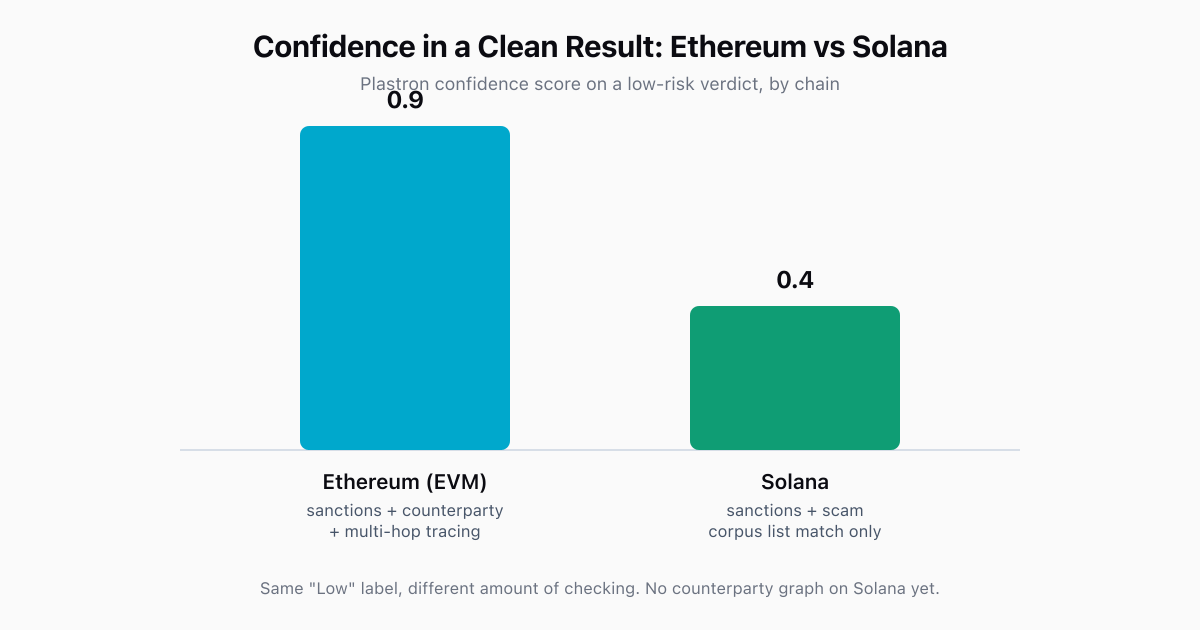
Confidence numbers make the gap concrete. A clean Ethereum scan reports 0.9 confidence in a low-risk verdict, built from direct exposure, one-hop counterparty links, and multi-hop tracing across known entities. A clean Solana scan reports 0.4. Same "Low" label, very different amount of checking behind it. Plastron flags every Solana result with a limited-scan notice for exactly this reason: a wallet can pass the sanctions and scam-list check clean while still having received funds one hop from a drained bridge or a sanctioned exchange, and today's Solana scan has no way to see that hop.
A clean Solana result today carries much less confidence than a clean Ethereum result, because it checks sanctions and scam lists only, not counterparty exposure.
Ethereum-side counterparty tracing exists because the corpus and the scoring engine were built for it first. Solana direct screening is the foundation, not the finished product; full counterparty and multi-hop analysis on Solana is planned next, not shipped yet. EVM chains have their own coverage gaps too, but they at least start from a counterparty graph. Solana starts from a list match.
What Solana Screening Still Can't See
No exposure percentage. No count of hops to a sanctioned address. No breakdown of which counterparties a wallet has interacted with. Those fields exist in an Ethereum report and stay blank or hidden on a Solana one, because building them requires transaction-graph data Plastron doesn't yet compute for Solana.
It also doesn't grade the tokens sitting in a wallet. Pump.fun's own token pool has an ugly track record, industry researchers at Solidus Labs put the share of Pump.fun tokens showing rug-pull or pump-and-dump traits near 98 percent, and a wallet holding a dozen of them is a token-quality problem, not a wallet-identity problem. Plastron screens the address. It doesn't audit the tokens that address is holding.
Picture the Ethereum equivalent of the gap. An address that received funds one hop from a sanctioned exchange shows up on an Ethereum report as indirect exposure, with a hop count and a confidence-weighted score attached. Send the same underlying pattern through a Solana wallet today and the scan has no counterparty graph to walk, so that hop stays completely invisible. The report just never mentions it.
Should You Trust a Low-Risk Score on a Solana Wallet?
Trust it for what it actually says: the address isn't sanctioned and isn't in the labeled scam set. Don't read more into it than that. A low-risk Solana result is a green light on sanctions exposure, not a green light on everything a counterparty check would catch on Ethereum.
This isn't a new problem invented by Solana. The August 2022 Slope wallet breach drained more than 9,000 Solana wallets in a single weekend, and every one of those addresses would have looked clean on a sanctions-only check run the day before. List-based screening was never designed to predict a breach. It was designed to catch known-bad addresses, and on Solana today, that's still the whole job.
How Do You Screen a Solana Address Right Now?
Keep the address exactly as given. Solana addresses are base58 and case-sensitive, so re-typing or lowercasing one before you check it can point the lookup at a different wallet entirely. Some people paste the address into a block explorer like Solscan and eyeball the transaction list for anything obviously wrong. Screen it with Plastron instead and you get the sanctions and scam-corpus match plus live balance and activity in one report, not a manual read of raw transaction rows.
Run the check before you send, not after. A Solana wallet check takes the same few seconds a manual explorer lookup does. It just checks against a maintained list instead of your own judgment of what looks suspicious.
Disclaimer: This article is for educational and informational purposes only and is not legal, financial, tax, or compliance advice. Crypto carries risk; you act on this information at your own risk. Always do your own research and consult a qualified professional before making decisions. Views are the author's own and do not constitute financial, legal, or investment advice.
About Plastron
Plastron is a free, non-custodial wallet screening tool. It checks Ethereum and six EVM chains for AML and KYT risk — sanctions exposure, mixer contact, and stolen-funds proximity — and returns a risk report in seconds. It reads public on-chain data only: it never takes custody of funds and never asks for private keys.