TL;DR - North Korea-linked hackers stole $351.6 million from Bitget's hot and warm wallets in September 2026, and the funds already show overlap with wallets that laundered last year's Bybit hack.
A wallet doesn't have to touch the hacker's address directly to end up flagged. Bitget's breach is the largest crypto exchange hack of 2026 so far, and the money it moved is already sitting in wallets that have nothing to do with the intrusion, three, four, five hops downstream. Most coverage of the hack stops at the $351.6 million headline. It skips the part where the trail runs through an exchange deposit that isn't Bitget's at all, and isn't even North Korea's.
What happened in the September 2026 Bitget hack?
Bitget disclosed on September 25, 2026 that attackers had compromised a critical backend system inside its wallet infrastructure the previous evening, at 18:31 UTC on September 24. CEO Gracy Chen said the intruders used that access to spoof transaction data and trigger the exchange's own authorization process, moving funds out of hot and warm wallets across seven chains: Ethereum, XRP Ledger, Arbitrum, Avalanche, Optimism, BSC, and Base. XRP was the single largest chain hit. ETH, BNB, AVAX, USDT, and USDC went with it.
The exchange suspended withdrawals within hours and brought them back online on September 28. Bitget's initial estimate of $351.6 million grew as the forensic count continued, and the figure now stands closer to $390 million in transferred assets. Bitget's own self-custodial wallet app runs on separate infrastructure and wasn't touched. Its User Protection Fund, which the exchange says holds 5,500 BTC (about $464 million), is covering the shortfall for Bitget's own customers. That fund pays back Bitget's users. It does nothing for the wallets that touch the stolen coins next.
Why do TRM Labs and Elliptic link the theft to North Korea?
Two blockchain analytics firms reached the same conclusion independently. TRM Labs found the stolen funds moving through wallet addresses that overlap with the laundering trail from the $1.5 billion Bybit hack in February 2025 and the AFX Bridge exploit, pointing to the group known as TraderTraitor. Elliptic separately traced the stolen XRP and ETH back to shared laundering infrastructure used in earlier DPRK-attributed thefts. Bitget brought in Mandiant and SlowMist for a third-party investigation, and Chen said the intrusion pattern matched behavior her team has tracked to North Korean state hackers before.
Bybit's hack already forced exchanges to treat a whole cluster of addresses as high-risk. Bitget's theft doesn't start a new cluster. It feeds the one that's already flagged.
How does stolen crypto reach a wallet that never touched the hack?
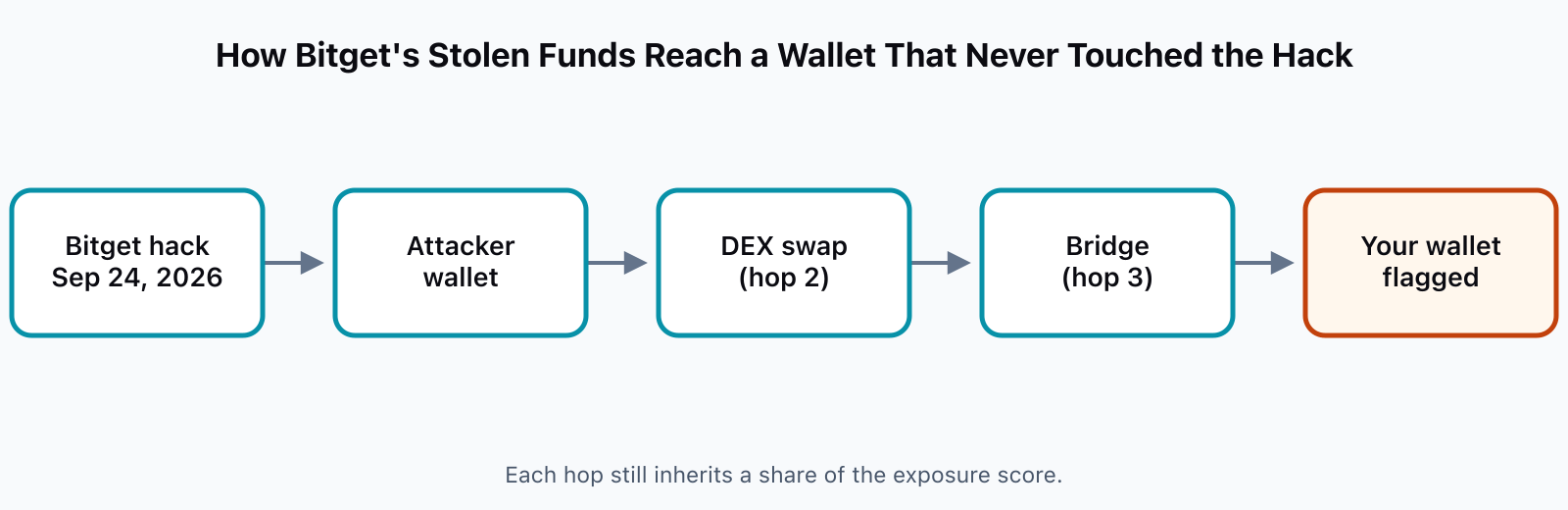
A wallet screening tool doesn't only watch the attacker's address. It tracks every hop the money takes afterward, and any wallet that receives a slice of it inherits a share of the exposure. Plastron's own corpus carries 3,901 labeled addresses, and 121 of them are tagged specifically for hack and exploit exposure, tracked apart from sanctions or mixer labels. A trader who swapped tokens on a decentralized exchange three hops downstream from Bitget's attacker can end up holding stolen funds exposure with no idea where it came from.
Distance from the hack doesn't erase the tag. What matters is how many hops separate your wallet from the attacker's address, and whether the case is still open.
A wallet three hops from Bitget's attacker never touched the hack directly, but it still inherits a share of the exposure score.
Does Bitget's $464 million protection fund change what gets flagged?
No. The User Protection Fund resolves Bitget's balance sheet, not the on-chain trail. It pays back the exchange's own customers for their losses; it doesn't touch the wallets that received a piece of the $390 million once the attacker started moving it. Every address downstream of that money keeps its flag until the case closes, funds get recovered, or a court or an exchange formally clears it.
Bybit's February 2025 theft is the precedent here. Most of that $1.5 billion was never recovered, and the wallets tied to it are still flagged more than a year later. There's no reason to expect Bitget's case to move faster. The exchange only resumed withdrawals on September 28, three days after the disclosure, and the investigation with Mandiant and SlowMist was still open at that point.
What should you do if a screening report flags exposure to the Bitget hack?
Start with the hop, not the flag. Find out which specific transaction connects your address to the stolen funds before you argue with an exchange about it. You can trace the attacker's wallet and its known downstream addresses by hand on Etherscan or Blockscan, following each transfer one at a time. Screen the wallet with Plastron instead and get the same hop-by-hop exposure path, plus sanctions and mixer checks across seven chains, in one pass.
If your own address is the one that got flagged, pull the transaction hash that triggered the review and send it straight to your exchange's compliance team. Don't wait out the hold hoping it clears on its own.
Receiving stolen crypto isn't a crime by itself in most jurisdictions. Holding it can still get a wallet frozen, delayed, or asked for a source-of-funds explanation, and that review can take days while an exchange waits on its own screening vendor to confirm the hop count. The faster you can show exactly where the funds entered your wallet, the faster that review closes.
Disclaimer: This article is for educational and informational purposes only and is not legal, financial, tax, or compliance advice. Crypto carries risk; you act on this information at your own risk. Always do your own research and consult a qualified professional before making decisions. Views are the author's own and do not constitute financial, legal, or investment advice.
About Plastron
Plastron is a free, non-custodial wallet screening tool. It checks Ethereum and six EVM chains for AML and KYT risk — sanctions exposure, mixer contact, and stolen-funds proximity — and returns a risk report in seconds. It reads public on-chain data only: it never takes custody of funds and never asks for private keys.