A Senate subcommittee report found 87% of 757 Iran-linked sanctioned wallets transacted mostly in USDT, because dollar-pegged stability beats Bitcoin's volatility for moving sanctioned money.
You check a wallet against the sanctions list, get a clean result, and move on - the list just didn't know the issuer had already frozen it. The Senate's Permanent Subcommittee on Investigations, under Democratic staff led by Sen. Richard Blumenthal, published a report on September 29, 2026 naming USDT as the preferred rail for Iran's sanctions-evasion network, and the gap between what gets frozen and what a public sanctions list shows is the whole story.
What Did the Senate Investigation Actually Find?
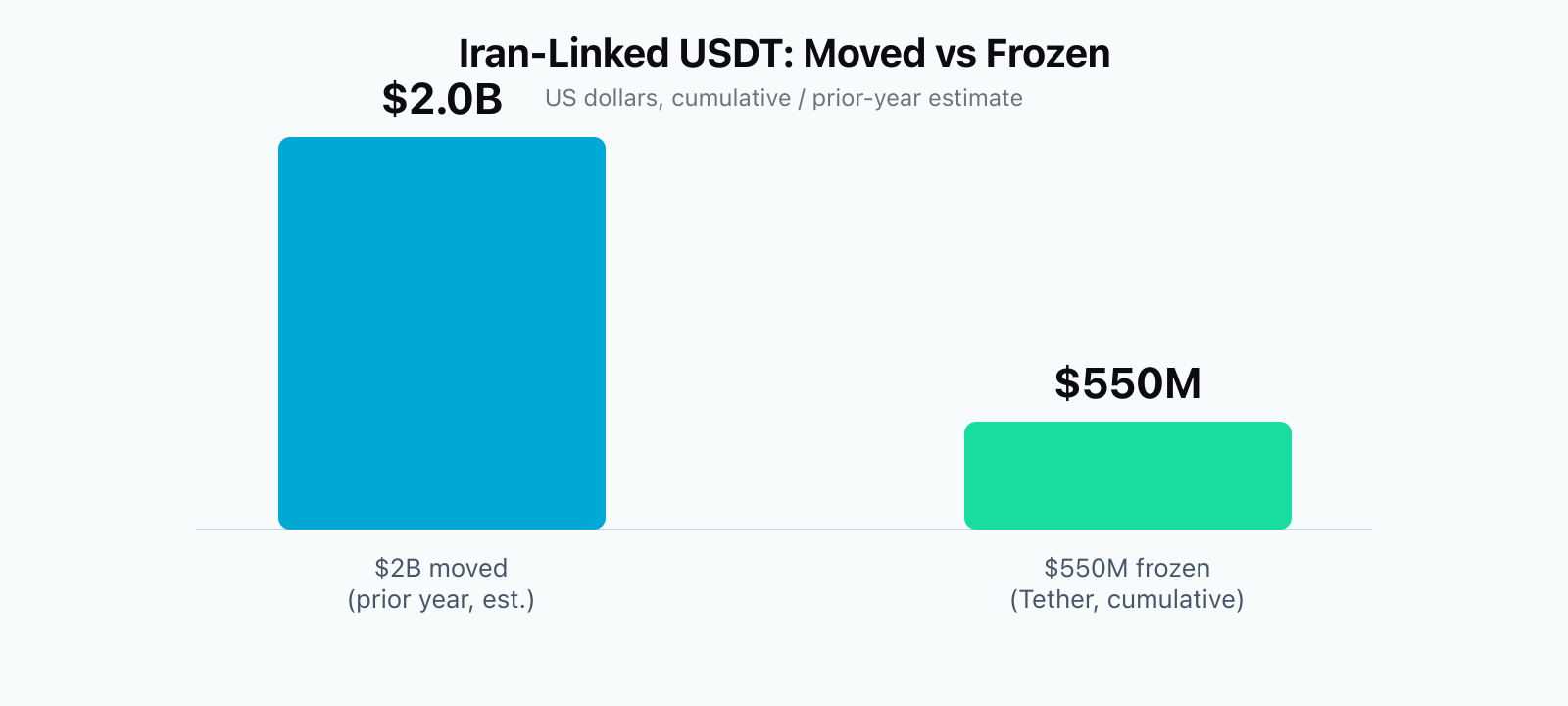
The report reviewed 846 crypto wallets tied to Iranian sanctions or blocking orders. 84% of them transacted mostly in USDT. Narrow the set to the 757 wallets flagged specifically for terrorism financing and the share climbs to 87%. The report puts Iran's government-linked USDT volume at roughly $2 billion over the prior year, moved through what it calls Iran's "cryptocurrency-based shadow banking network."
Tether disputes the framing but not the numbers. CEO Paolo Ardoino says the company has frozen close to $550 million in Iran-linked USDT. Do the subtraction: $550 million frozen against $2 billion moved. Most of it got through before anyone acted on it.
Tether's freeze total covers roughly a quarter of the USDT volume the Senate report ties to Iran's government over the same stretch.
Why Does USDT Beat Bitcoin for This?
Bitcoin's price swings are the whole reason a state actor settling a trade invoice won't touch it. A shipment priced in bitcoin today is worth a different number in bitcoin tomorrow. USDT removes that problem - one token still equals one dollar whether you hold it for an hour or a month. Iran's central bank leaned into this after easing restrictions on crypto for cross-border trade, reportedly accumulating upward of $500 million in USDT for settlement.
Here's the part most coverage skips. A dollar-pegged token isn't anonymous. Every USDT transfer sits on a public ledger, and the issuer can see exactly who's holding what. Cash can't be frozen from a server in the British Virgin Islands. USDT can. That's the trade a sanctioned network makes: give up secrecy, keep the one property a sanctions regime can't easily replicate for them - a currency that doesn't move against them overnight.
Does Freezing USDT Actually Stop the Money?
Not fast enough, the report argues. It states that prior to 2024, Tether "did not comprehensively and consistently freeze wallets designated" under US sanctions, and that freeze requests sometimes sat for weeks before action. Selective freezing without a full blacklist entry left a window open - long enough for funds to route onward through an exchange or a second wallet before the chain stopped moving.
Ardoino's response: "Tether has consistently demonstrated that USDT is not a haven for sanctioned actors, terrorist organizations or criminal networks." Both things can be true. The freeze mechanism works. It just works after the money has already moved once or twice, which is the gap a $42 million freeze without a warrant exposed from the other side - action without notice, not before the fact.
The report names a second problem beyond speed: selective freezing. A wallet gets its balance frozen for one designation while a related address, named in the same sanctions action, stays untouched for weeks. An OTC desk or an exchange relying on Tether's public blacklist alone inherits that lag - it's screening against a list that hasn't caught up yet.
How Does This Change Wallet Screening?
A wallet doesn't need to appear on OFAC's SDN list by name to be frozen. Tether and Circle each run their own blacklist, built from sanctions data plus their own compliance review, and it moves independently of any government designation. Checking only the published sanctions list misses that second, issuer-run layer entirely. A wallet can clear every OFAC check you run and still be frozen the next morning.
That split matters most for direct exposure - the wallet you're about to pay, not a counterparty three hops back. You can check a single address against Tether's blacklist state by hand, one lookup at a time, on a block explorer. Plastron screens the address instantly instead, reading the live USDT and USDC blacklist flag straight from the contract - not a cached snapshot - and scoring a confirmed freeze above anything the sanctions corpus alone would catch. That corpus currently carries 780 OFAC-listed addresses across 14 chains and 3,901 labeled high-risk wallets in total, refreshed daily. A live chain read beats all of it when the issuer moves first.
FAQ
Did the Senate report accuse Tether of breaking the law?
No. It criticized the speed and consistency of Tether's freeze process before 2024 and called for closer oversight. It didn't allege criminal conduct by Tether itself.
How much Iran-linked USDT has Tether frozen?
Close to $550 million, according to Tether's own figures cited in response to the report, against an estimated $2 billion in USDT volume tied to the Iranian government over the prior year.
Can a wallet be frozen without being on the OFAC SDN list?
Yes. Tether and Circle each maintain a blacklist built from their own compliance review, separate from the government's published sanctions list, and either one can freeze an address the SDN list has never named.
Does this mean Bitcoin is safer from sanctions than USDT?
Not really. Bitcoin can't be frozen by an issuer, but it also can't be reversed, refunded, or un-sent once it lands on a sanctioned address - and the transaction stays traceable on a public ledger forever.
Why did 84% and 87% both show up in the same report?
Different denominators. 84% is the share across all 846 Iran-linked sanctioned wallets reviewed. 87% is the narrower, higher share among the 757 wallets flagged specifically for terrorism financing.
Disclaimer: This article is for educational and informational purposes only and is not legal, financial, tax, or compliance advice. Crypto carries risk; you act on this information at your own risk. Always do your own research and consult a qualified professional before making decisions. Views are the author's own and do not constitute financial, legal, or investment advice.
About Plastron
Plastron is a free, non-custodial wallet screening tool. It checks Ethereum and six EVM chains for AML and KYT risk — sanctions exposure, mixer contact, and stolen-funds proximity — and returns a risk report in seconds. It reads public on-chain data only: it never takes custody of funds and never asks for private keys.