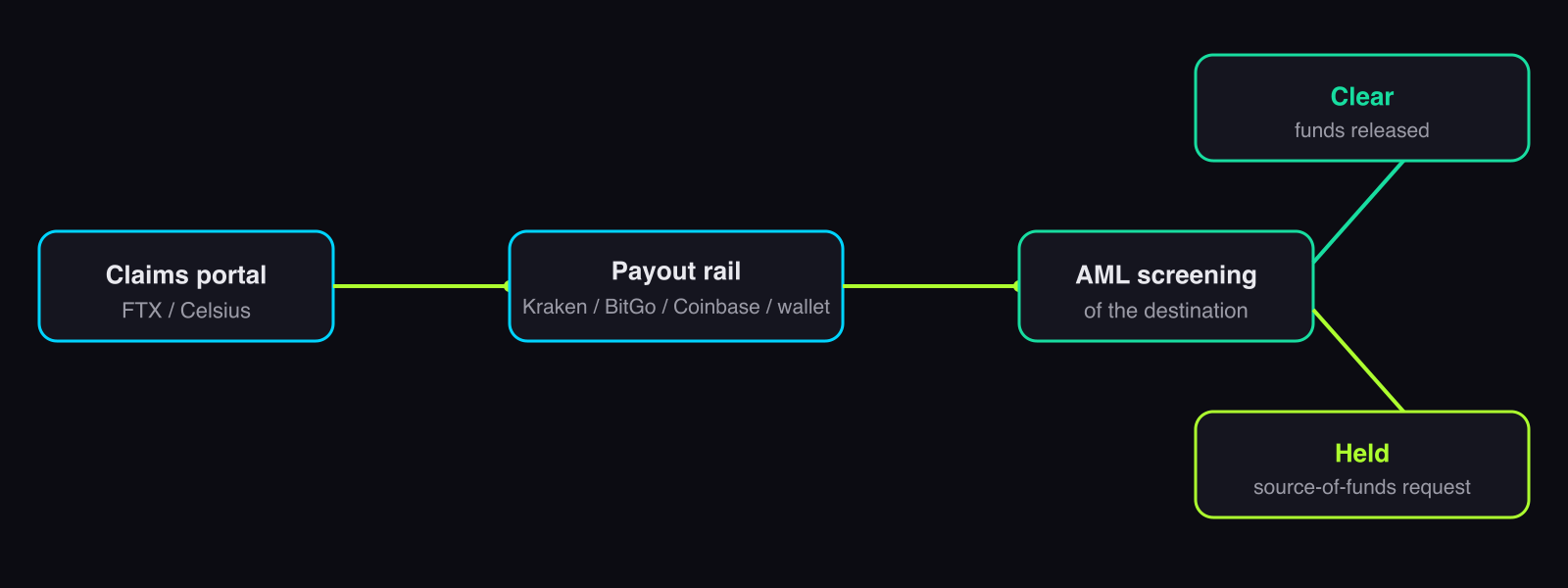
TL;DR - Run these eight checks before your FTX or Celsius payout lands, or the exchange receiving it can hold the funds for a source-of-funds review while your claim sits untouched.
A bankruptcy payout isn't free money with no strings attached. It still has to clear the same AML screening as any other deposit landing in your account.
FTX and Celsius are both still paying creditors in 2026, years after each collapsed, and a court order doesn't exempt the money from the rules the receiving exchange already runs on every other deposit.
Before You Start
FTX's fifth creditor distribution, about $900 million, began paying out on July 31, 2026, to claimants who hit the June 16 record date. Celsius creditors are further along, several distribution rounds deep through its own claims portal, and each round can still trigger a fresh identity check.
Both estates warn about the same thing before any money moves: a fake portal. The FTX Recovery Trust says outright it will never ask a creditor to connect an external wallet - a message that does is phishing, not a step in the real process.
Miss the paperwork and you miss the round, not the claim. FTX's own notice gives holders six months from the July 31, 2026 payout date to onboard with BitGo, Kraken, or Payoneer before losing access to that specific distribution.
What's Actually Landing in Your Wallet?
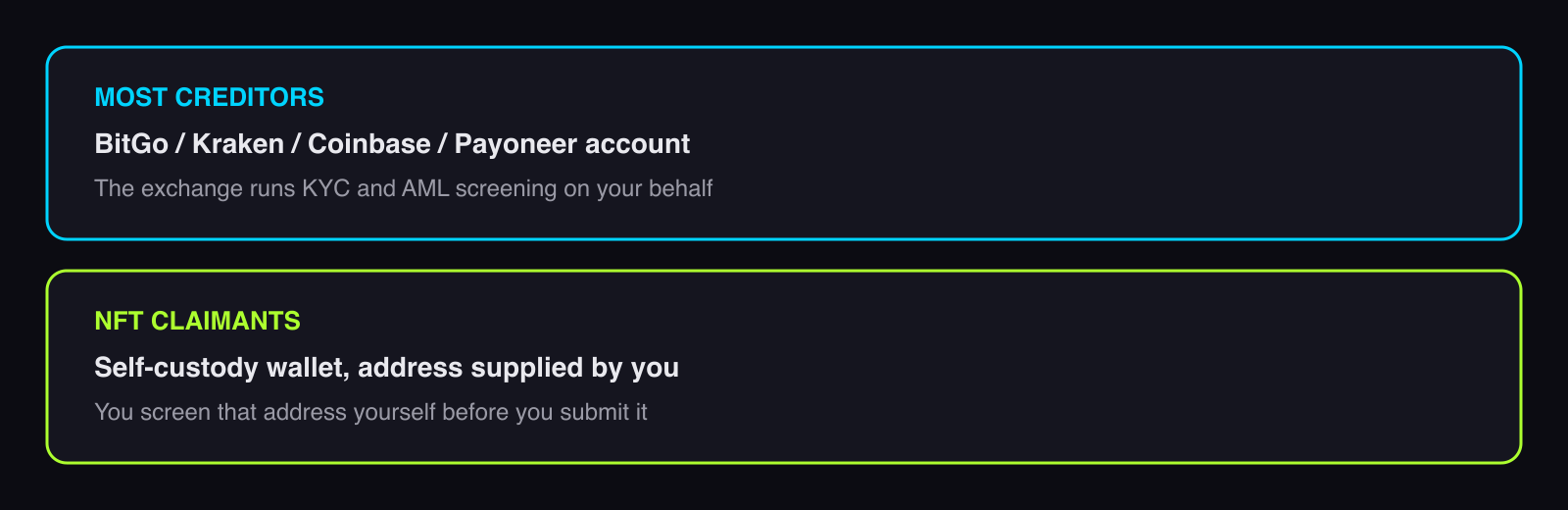
Most FTX and Celsius creditors aren't getting a raw wallet-to-wallet transfer. The money lands inside an account at BitGo, Kraken, Coinbase, or Payoneer, and that account already runs its own KYC and AML program underneath it.
Self-custody is the exception. FTX's NFT claimants are the one group asked to supply a destination wallet address directly through the official portal, which makes that address the one part of the whole process you actually control.
Celsius routes through Coinbase the same way. Your email, legal name, date of birth, and address all have to match exactly what Celsius has on file, or the payout stalls before it reaches a wallet at all.
Whoever controls the destination address is the one who ends up responsible for screening it.
The Checklist
Work through this before you register anything or click a single confirmation.
A payout clears the same AML screening as any other deposit, whether it lands at an exchange or a self-custody wallet.
Confirm you're on the real claims portal.
Type the URL yourself or use a link saved from the original court notice. Don't click through an email or a DM, even one that looks like it came from the right address.
Check which rail is paying you.
A payout through BitGo, Kraken, Coinbase, or Payoneer already carries its own compliance program on the receiving end. A self-custody NFT claim doesn't, which is where step five applies to you directly.
Match your KYC details exactly.
Name, date of birth, and address need to be identical to what the estate has on file. One mismatched middle initial is enough to stall a payout for weeks.
Never connect a wallet to anything that asks for one.
Both estates have said this outright. A prompt asking you to "verify" by connecting your wallet is the scam, not a step in the real process.
Screen the destination address before you submit it, if you're the one supplying it.
You can trace a single address by hand on Etherscan, reading its history one transaction at a time.
Instead, screen the wallet with Plastron for its sanctions, mixer, and stolen-funds exposure in one pass, built on a corpus of more than 100,000 labeled addresses, plus all 1,061 tied to OFAC sanctions.
Keep the portal confirmation and the transaction hash together.
Screenshot both. If the exchange on the receiving end later asks where the funds came from, that pairing is your answer.
Expect a source-of-funds question even on a clean payout.
A six-figure deposit landing from an address with no prior history looks unusual to a risk model, bankruptcy court order or not.
If the payout gets held, respond with documentation, not silence.
The claims-portal confirmation plus the transaction hash is a chain of custody a compliance team can actually verify.
Why Do Clean Payouts Still Get Held?
Size and timing trip risk models more than history does. A dormant exchange account that suddenly receives a six-figure deposit from an address it's never seen gets the same automated flag a stranger's wallet would, court order or not.
Plastron's own corpus carries more than 100,000 labeled wallet addresses, and 56,813 of them are tagged for scam activity rather than sanctions. A payout rail isn't only checking against a government list. It's checking against years of reported fraud, and a court-ordered distribution doesn't carry a pre-cleared stamp through that filter.
A legitimate source doesn't buy you a faster review. It just means the review eventually clears.
What If Your Payout Already Got Flagged?
Silence is the mistake here, not the hold itself.
Reply to whatever request comes in, usually a source-of-funds document, with the claims-portal confirmation and the transaction hash from step six. That pairing establishes where the money came from faster than any explanation you could write yourself.
Watch for a second scam layer too: fake "wallet checker" tools marketed at creditors who already got flagged once, promising to clear the hold for a fee. That's a drainer, not a fix.
FAQ
Will my FTX or Celsius payout get held automatically?
No. Most payouts clear without any manual review. A hold usually comes from a mismatch in your KYC details, an unusually large deposit against a dormant account, or a flagged destination address.
Do stablecoin payouts get screened differently than Bitcoin or Ethereum?
Not in kind. A USDC or USDT payout can also trigger the issuer's own freeze tools on top of the exchange's AML review, so a stablecoin distribution carries one more layer of possible scrutiny, not fewer.
Can I redirect my payout to a different wallet at the last minute?
Only through the official claims portal, and only before the record date for that round passes. Any message asking you to redirect a payout outside the portal is the scam both estates have warned about.
What happens if I miss a KYC or AML deadline for a distribution round?
You're excluded from that specific round, not from the claim itself. FTX's notices describe a missed record date as a deferral to a later round, provided you complete the outstanding requirement before the next one closes.
Disclaimer: This article is for educational and informational purposes only and is not legal, financial, tax, or compliance advice. Crypto carries risk; you act on this information at your own risk. Always do your own research and consult a qualified professional before making decisions. Views are the author's own and do not constitute financial, legal, or investment advice.
About Plastron
Plastron is a free, non-custodial wallet screening tool. It checks Ethereum and six EVM chains for AML and KYT risk — sanctions exposure, mixer contact, and stolen-funds proximity — and returns a risk report in seconds. It reads public on-chain data only: it never takes custody of funds and never asks for private keys.