TL;DR - A crypto deposit usually gets rejected because the sending wallet or exchange never passed the required Travel Rule information, not because the funds are dirty.
Most rejected deposits have nothing to do with the amount or the coin, and everything to do with a compliance message that never arrived.
This hits self-custody senders hardest: a cold wallet or a DeFi payout has no VASP on the other end to send that message, so the receiving exchange is left guessing about who sent the money.
Why Crypto Deposits Get Rejected and Returned
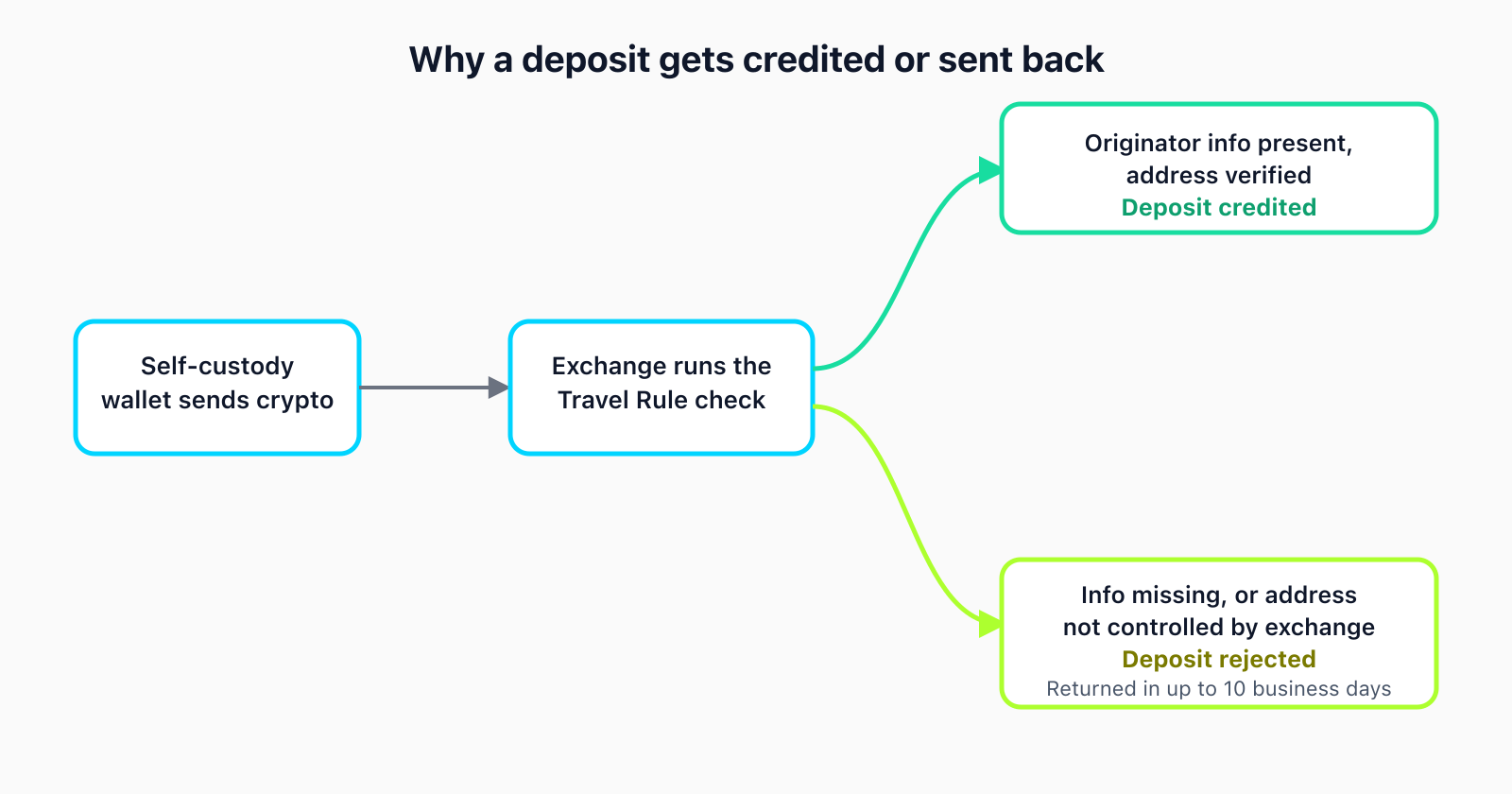
Exchanges don't inspect a deposit by eye. Most run every incoming transfer through a Travel Rule messaging network like Notabene before the coins ever show up as a spendable balance. That network checks three things: who sent the money, whether the receiving exchange actually controls the destination address, and whether either side is missing required paperwork.
A rejection usually means one of a short list of things. Notabene's own status codes spell it out: REJECTED means the receiving exchange doesn't control the address you sent to, and DECLINED means it looked at the transfer and refused it outright. Paxos flags a separate case with a NEEDS_INFO status, used when the sender's details - name, address, the originating platform - never arrived. And if the sending wallet, or any address in its recent history, is sanctioned or linked to a hack, that's an AML flag, not a paperwork gap. It won't clear on resubmission.
Bitvavo's own help center admits the quiet part: it says it often isn't told why Notabene blocked a deposit. The exchange just sees a hold or a return, same as you.
The same transfer splits into two outcomes at one checkpoint: whether originator data arrived and the exchange controls the destination address.
The Real Culprit Is the Travel Rule, Not a Mistake
The rule behind all of this is FATF Recommendation 16, which tells regulators to require an originator's name and account details on crypto transfers, the same way banks already do on wires. Jurisdictions set their own dollar line for when it kicks in, and the lines don't match. Circle's developer docs point to a $3,000 threshold under FinCEN guidance. Deribit applies its check above roughly AED 3,500, about $953. CoinSmart collects originator data above $1,000 CAD under Canadian rules.
The European Union skipped the threshold question entirely. Its Transfer of Funds Regulation took effect on December 30, 2024, and it requires full originator and beneficiary data on every crypto transfer an EU-licensed exchange handles, with no minimum amount. A sibling rule inside that same regulation adds a harder identity check above EUR 1,000 for self-hosted wallets specifically - worth reading if you send from your own wallet regularly.
The Checklist
None of this is random, which means most rejections are avoidable. Run through this before you send anything from a wallet the receiving exchange hasn't seen before, or use a pre-deposit check as a starting reference.
Confirm the exchange actually lists the exact token and network you're sending. An ERC-20 asset sent to a TRC-20 deposit address fails for a different reason than a compliance hold, but it looks identical from your side of the screen.
Send from a wallet whose transaction history you can explain, not one that picked up funds from an airdrop, a mixer, or an address you can't account for.
Screen your own wallet, and the address you're sending to where you can, before you move anything. Plastron's free scan checks an address against more than 3,900 labeled entries, including all 780 OFAC-designated crypto addresses, so you see the exposure before an exchange's compliance system does - screen a wallet with Plastron takes about as long as copying the address.
Expect a hold on your first large deposit through a new platform, even with clean funds. Size and novelty both raise the review odds on their own.
Keep the transaction hash, the sending address, the amount, and the date in one place the moment you send. You'll need all four if the exchange asks for source-of-funds documentation later.
Wait for the refund instead of resending through a different route if a deposit gets rejected. A second transfer from the same wallet while the first is still processing usually just opens a second compliance review.
Answer any "missing information" or NEEDS_INFO prompt immediately, with the originator details ready: your name, address, and the platform or wallet the funds came from.
What Happens to Your Funds After a Rejection?
They come back to the account that sent them, and nowhere else. Bitvavo is explicit that a refund can only go to the exact wallet address the funds came from, not a new address you provide and not a different exchange account. Revolut's policy reads the same way: once a return is processed, support can't redirect it.
That's also why a sanctioned or hack-linked address produces a different outcome than a paperwork gap. A REJECTED status from Notabene still gets the funds returned. An AML or sanctions flag can hold them pending a report instead, because at that point it isn't a messaging failure. It's a hit - the same underlying flag that gets a withdrawal rejected on the way out of an exchange, just caught on the way in instead.
How Long Does the Refund Actually Take?
BTC Markets' own troubleshooting guide puts a processed return at up to 10 business days. Some come back the same day; a handful sit longer when a compliance team needs a manual look. Exchanges rarely explain which bucket you're in, and as Bitvavo notes, that's often because they don't know themselves - the Travel Rule network doesn't always pass the specific reason back to the exchange holding your coins.
One short answer covers most of this: don't call support every few hours. A rejected deposit sits in a queue, not a conversation.
FAQ
Can an exchange reject a deposit without telling me why?
Yes. Several exchanges, including Bitvavo and BTC Markets, say they aren't always given the specific reason by the compliance network that made the call. You'll usually see a hold or a return, not a cause.
Will I lose my crypto if a deposit is rejected?
No, not from a Travel Rule rejection on its own. The funds are returned to the sending address, typically within 10 business days. A sanctions or AML freeze is a different, rarer outcome and can take longer to resolve.
What is the Travel Rule and why does it apply to a self-custody wallet?
It's FATF Recommendation 16, requiring originator and beneficiary information on crypto transfers above a jurisdiction's threshold, as low as zero under the EU's rule. A self-custody wallet has no institution to send that message, so the receiving exchange has to request it directly or reject the deposit.
Can I resend to a different exchange while the first deposit is pending?
Don't. The original transfer is still moving through review, and a second send from the same flagged wallet usually triggers its own hold rather than skipping the queue.
Does a rejected deposit hurt my account standing?
A single Travel Rule rejection, by itself, doesn't. Repeated rejections tied to the same wallet or pattern can prompt a broader account review, since exchanges weigh frequency along with the individual event.
Disclaimer: This article is for educational and informational purposes only and is not legal, financial, tax, or compliance advice. Crypto carries risk; you act on this information at your own risk. Always do your own research and consult a qualified professional before making decisions. Views are the author's own and do not constitute financial, legal, or investment advice.
About Plastron
Plastron is a free, non-custodial wallet screening tool. It checks Ethereum and six EVM chains for AML and KYT risk — sanctions exposure, mixer contact, and stolen-funds proximity — and returns a risk report in seconds. It reads public on-chain data only: it never takes custody of funds and never asks for private keys.