TL;DR - The EU's 2027 privacy-coin rule stops regulated exchanges from offering Monero or Zcash accounts; it does not touch self-custody wallets or peer-to-peer transfers.
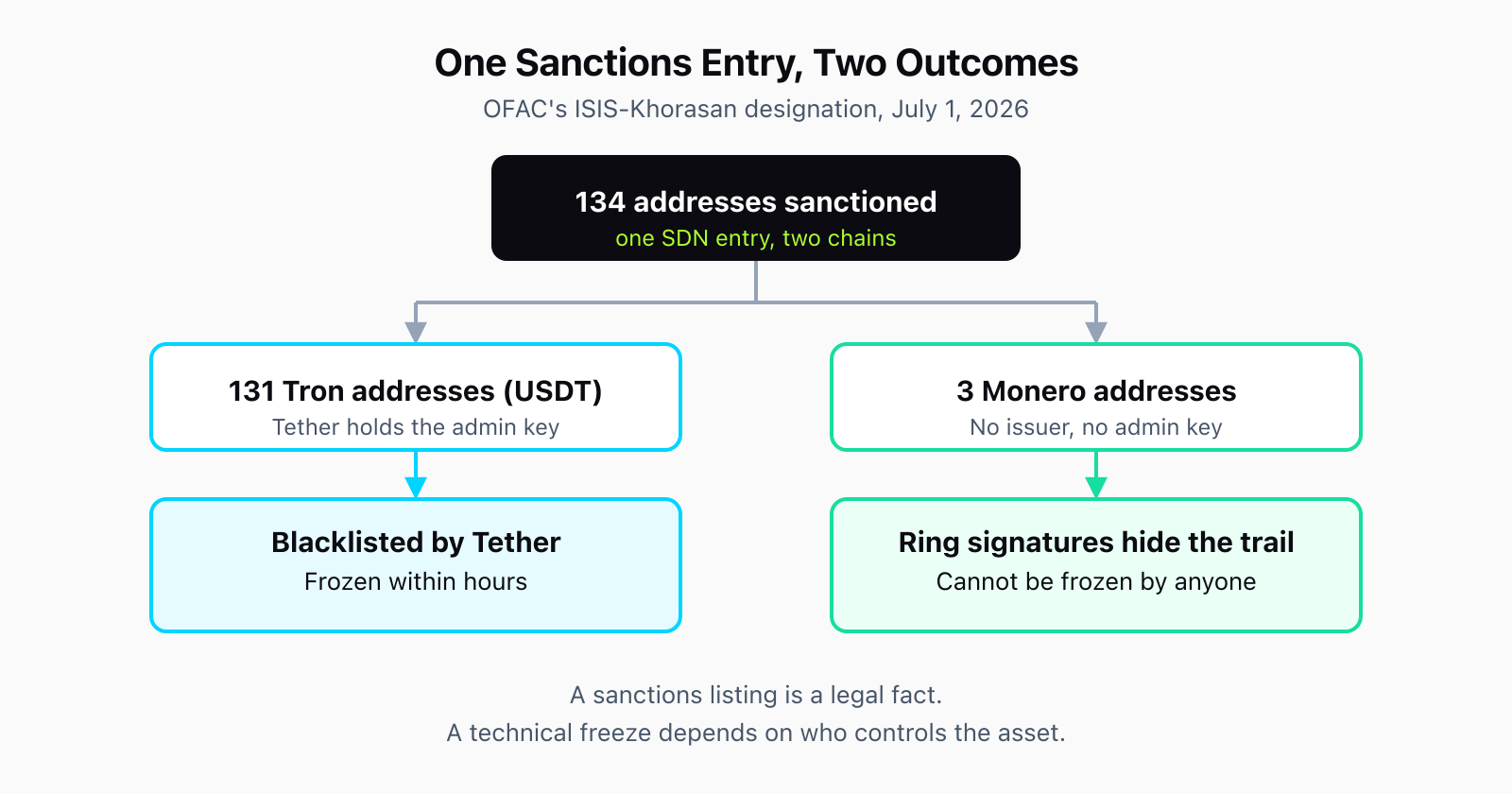
A government can sanction a privacy-coin address. It cannot freeze what sits inside it. OFAC proved that on July 1, 2026, when it added 134 crypto addresses to an ISIS-Khorasan sanctions entry and watched Tether freeze 131 Tron wallets within hours while the 3 Monero addresses on the same list stayed completely untouchable.
The EU's new Anti-Money Laundering Regulation reads that lesson correctly. Instead of trying to freeze an asset nobody can freeze, it cuts off the only choke point that actually exists: the regulated exchange.
One SDN entry produced two outcomes: Tether froze 131 Tron addresses within hours, but 3 Monero addresses on the same list stayed unfreezable by anyone.
What the EU's AMLR Actually Bans in 2027
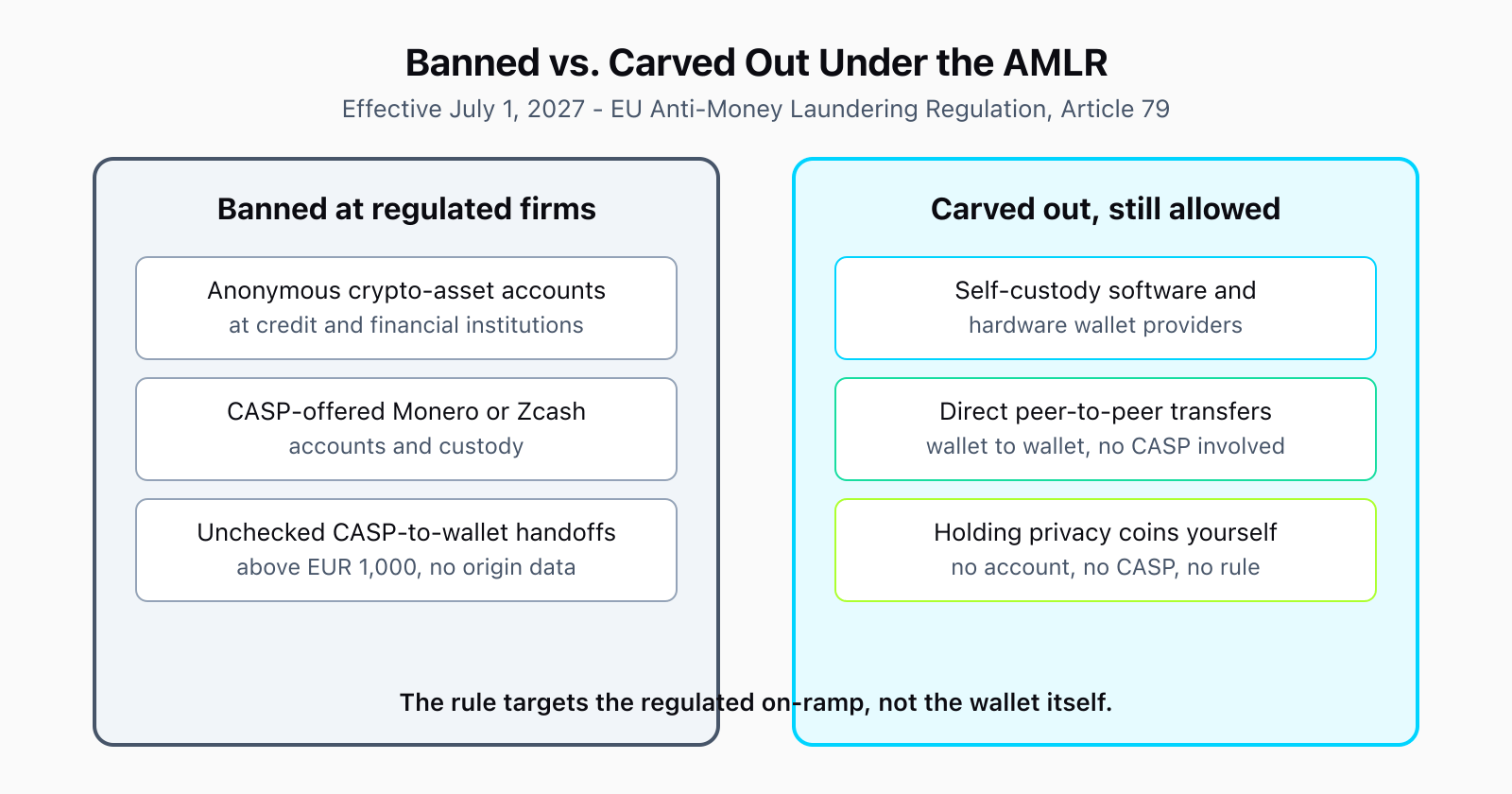
Article 79 of the EU's Anti-Money Laundering Regulation (AMLR, Regulation 2024/1624) bars credit institutions, financial institutions, and crypto-asset service providers from opening anonymous crypto accounts or handling coins designed to hide a transaction's sender, receiver, and amount. That description covers Monero and Zcash by name in most of the coverage around the rule. The ban takes effect July 1, 2027.
Mandatory customer due diligence already applies to crypto transactions above EUR 1,000 under the same package, so the privacy-coin rule lands on top of checks CASPs are supposed to be running already. None of it reaches a wallet a person holds outside a regulated platform. That part is where most of the panic coverage got the story wrong.
The rule isn't a first move either. MiCA, the EU's broader crypto licensing framework, already keeps assets with built-in anonymization features off regulated trading venues. The AMLR extends the same logic from trading pairs to account relationships: a CASP couldn't list Monero as a tradable asset before, and after July 2027 it can't hold one for a customer in any form.
Why Can't OFAC Freeze a Monero Wallet It Already Sanctioned?
USDT on Tron has an issuer. Tether holds an admin key that can blacklist an address at the contract level, and it used that key on all 131 Tron wallets the same day the ISIS-Khorasan designation went live. Read the full breakdown of that July 2026 split for how one SDN entry produced two completely different outcomes.
Monero has no issuer and no admin key. Ring signatures and stealth addresses hide the sender, receiver, and amount by design, and no company sits between a wallet and its coins the way Tether sits on top of USDT. There's no button to press, because there's no company that owns one.
The AMLR bans anonymous and privacy-coin accounts at regulated firms, but explicitly carves out self-custody wallets and direct peer-to-peer transfers.
Self-Custody and P2P Transfers Are Explicitly Carved Out
Patrick Hansen, Circle's EU policy chief, spent much of 2024 and 2025 correcting headlines that claimed the AMLR bans self-custody crypto outright. It doesn't. Software and hardware wallet providers that never hold or control a user's assets fall outside the regulation's scope, and so do direct peer-to-peer transfers between two wallets with no CASP in the middle.
What does tighten is the handoff. A transfer between a CASP and a self-custody wallet now needs risk-mitigating steps on the exchange's side, things like blockchain analytics or collecting origin and destination data before the funds move. Your wallet isn't banned. The exchange's ability to shrug at where your funds came from or where they're going is.
In practice that means an EU exchange asking for the destination address before releasing a large withdrawal, then running that address through a screening tool before clearing it. The same requirement already exists under the EU's travel rule for transfers above small thresholds. The AMLR just extends it to privacy coins specifically, where the exchange can verify the transparent ends of a swap even when it can't see what happened in the middle.
What Changes for Exchanges and CASPs Before July 2027?
The EU's new Anti-Money Laundering Authority (AMLA) is building a direct-supervision list of roughly 40 CASPs, with selection starting July 1, 2027 and at least one firm picked per member state. The materiality test for that list runs on scale: at least 20,000 customers in a single member state, or more than EUR 50 million in transaction volume there. Vyara Savova, senior policy lead at the European Crypto Initiative, has been tracking the rulemaking closely enough to publish a standalone handbook on it.
Monero and Zcash prices moved the opposite direction from what the headlines implied. Both rose a few percentage points in the days after the ban first made news, which reads less like "privacy coins are dying" and more like a market pricing in that an exchange losing a product line isn't the same as a protocol losing its users.
The European Banking Authority is still drafting the technical standards that will spell out exactly how a CASP checks the 20,000-customer and EUR 50 million thresholds, and those standards can still move before 2027. What won't move is the direction: every public draft since the AMLR passed keeps the anonymous-account ban and drops none of it in revision. An exchange betting on a late carve-out for privacy coins is reading a rulebook that doesn't exist yet in the hope it rescues one that does.
Ethereum, Bitcoin, and the Transparent-Chain Exception
None of this changes what happens the moment privacy-coin funds cross onto a transparent chain. A Monero-to-crypto swap still produces a visible Bitcoin or Ethereum leg on either side, a pattern covered in Plastron's look at how exchanges actually treat Monero and Zcash conversions. The murky leg stays murky. The transparent one doesn't.
Plastron's committed OFAC dataset tracks 1,061 sanctioned crypto addresses across 14 chains, part of a broader set of more than 100,000 labeled high-risk addresses, and none of that matching logic needs to see inside a Monero transaction to work. It only needs the wallet on the visible end of the swap. Look up that output address on a block explorer such as Etherscan and you'll see the counterparties on the transparent side, but not the exposure score behind them. Screen the address with Plastron instead, and it checks sanctions exposure, mixer and privacy-service contact, and stolen-funds proximity across Ethereum and six other chains in one pass, no wallet connection required.
FAQ
Does the EU's 2027 rule ban holding Monero or Zcash?
No. Holding a privacy coin in your own wallet carries no AMLR exposure. The rule restricts what credit institutions, financial institutions, and CASPs can offer as a regulated account product, not what an individual holds in self-custody.
Will EU exchanges delist Monero and Zcash before 2027?
Some already have, ahead of the deadline, since offering a privacy-coin account after July 1, 2027 would put a CASP's license at risk. Expect more EU-licensed platforms to drop support as the date gets closer rather than wait for an enforcement action.
Does this affect US exchanges or wallets?
Not directly. The AMLR is EU law and binds CASPs operating there. A US-based exchange still answers to FinCEN and OFAC rules, which is a separate set of obligations entirely.
Can I still send Monero peer-to-peer to someone in the EU?
Yes. A direct wallet-to-wallet transfer with no CASP involved sits outside the AMLR's scope, the same carve-out Circle's policy team has repeated since the rule was first drafted.
What happens if I cash out Monero through an EU exchange today?
The exchange already has to apply customer due diligence above EUR 1,000 and will likely ask for a source-of-funds explanation on the incoming leg. That screening only gets stricter as the 2027 deadline approaches.
Disclaimer: This article is for educational and informational purposes only and is not legal, financial, tax, or compliance advice. Crypto carries risk; you act on this information at your own risk. Always do your own research and consult a qualified professional before making decisions. Views are the author's own and do not constitute financial, legal, or investment advice.
About Plastron
Plastron is a free, non-custodial wallet screening tool. It checks Ethereum and six EVM chains for AML and KYT risk — sanctions exposure, mixer contact, and stolen-funds proximity — and returns a risk report in seconds. It reads public on-chain data only: it never takes custody of funds and never asks for private keys.