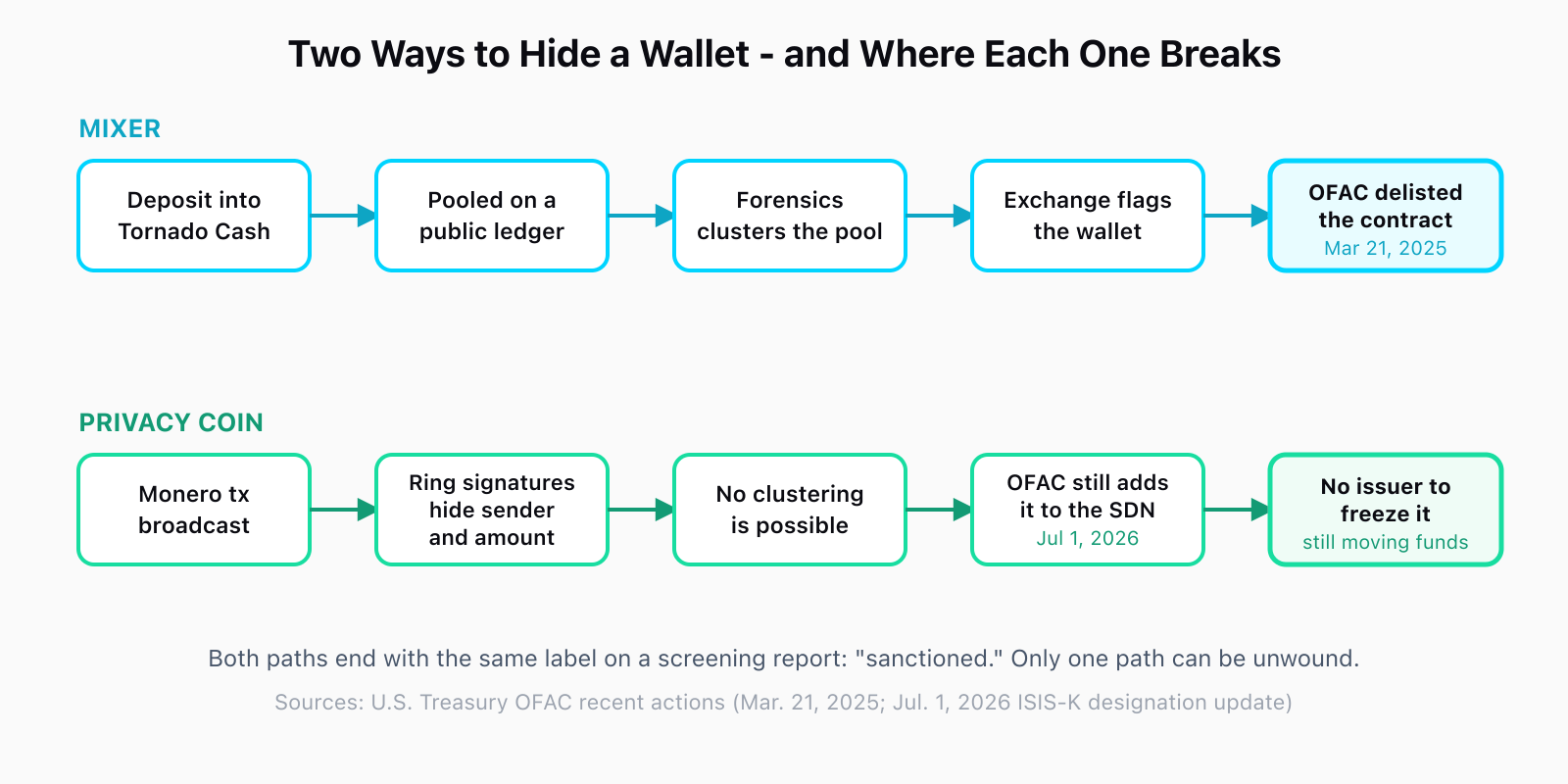
A mixer-tainted wallet can usually clear exchange review; a privacy-coin wallet usually can't even get a deposit address.
Anyone asking this question is in one of two spots: they already hold funds that touched a mixer or a privacy coin and want to know what happens next, or they're picking a privacy tool and want to know which one actually works. On July 1, 2026, Treasury added three Monero addresses to the OFACsanctions list as part of a 134-address update tied to ISIS-K. Tether froze the other 131 addresses, all on Tron, within hours. The three Monero wallets are still moving funds today. That gap is the whole story. Screening tools and sanctions lists treat "private" crypto as one category, and it isn't.
What's Actually Different Between a Mixer and a Privacy Coin?
A mixer is a tool bolted onto a transparent blockchain. Tornado Cash and Samourai's Whirlpool both run on Ethereum and Bitcoin, chains where every transaction is public by default. The mixer pools deposits from many users and pays them back out from a shared address, which breaks the direct sender-to-receiver link an investigator would otherwise read straight off the chain. The ledger itself never stops being public. Someone still has to go back and statistically re-link deposits to withdrawals, and that work is exactly what blockchain forensics firms sell.
A privacy coin skips the public ledger entirely. Monero uses ring signatures and stealth addresses on every single transaction, so the sender, the receiver, and the amount are hidden by default, not as an opt-in step. There's no pool to cluster because there's no visible flow to begin with. Plastron's own screening corpus lists more than 780 OFAC-sanctioned addresses spanning 14 chains, and not one of them comes with a usable exposure graph on Monero, because there's no graph to build.
One hides later. The other hides always.
Both paths end labeled "sanctioned" on a screening report, but only the mixer path can be reviewed, cleared, or unwound by anyone.
Which One Actually Gets Frozen or Seized?
This is where the two paths split hardest. A mixer deposit that's still sitting in USDT or USDC can be frozen the moment an issuer decides to act, mixer or no mixer, because Tether and Circle can blacklist any address on their own token contract. Tornado Cash itself was a different case: OFAC put it on the SDN list in 2022, a federal appeals court later ruled in Van Loon v. Treasury that sanctioning an immutable smart contract exceeded OFAC's authority under IEEPA, and Treasury delisted the contract on March 21, 2025. More than 3,400 of the addresses in Plastron's screening corpus still carry a "high" risk label, the same tier a wallet gets the moment it shows mixer exposure, delisting or not. The gap between "sanctioned" and "actually flagged by an exchange" is covered in detail here, and it hasn't closed.
Monero has no equivalent kill switch, sanctioned or not. When OFAC added those three Monero addresses to the ISIS-K entry in July 2026, nothing happened to the funds, because no issuer, no validator, and no smart contract controls the coin. The full breakdown of that case is here. A sanctioned mixer contract can be delisted. A sanctioned Monero address just keeps transacting.
Which One Gets a Wallet Flagged at an Exchange?
Mixer exposure produces a risk score, not an automatic ban. A compliance analyst can look at the exposure graph, see how many hops separate the deposit from the mixer, and decide the account is clean enough to clear. Plastron runs that exact check on an Ethereum or EVM address: screen the address with Plastron to see sanctions, mixer, and stolen-funds exposure across seven chains before you send anything to an exchange.
Monero deposits don't go through that process, because most major exchanges don't accept them at all. Binance delisted XMR on February 20, 2024, and OKX, Bittrex, and Huobi had already dropped it in earlier rounds, each one citing the same evolving-regulatory-standards language. Kraken, KuCoin, and Bitfinex still list it in some jurisdictions. When an exchange can't build a risk graph for an asset, the easiest compliance decision is to not list it, which is a blunter outcome than a flagged wallet but a far more common one.
That difference shows up again the moment a wallet changes hands. A mixer-exposed EVM address keeps a visible history: every hop from the mixer to the current holder is still on the chain, so a new counterparty can run their own check and see exactly how many hops separate them from the flagged activity. Buy or receive funds from a Monero wallet, and there's nothing to inherit except the seller's word for where the coins came from. Due diligence on one side is a graph. Due diligence on the other is a conversation.
Head-to-head
Lay the two side by side on the criteria that actually change what happens to a wallet, and the pattern holds across every row.
Criterion
Mixers (e.g. Tornado Cash)
Privacy coins (e.g. Monero)
Traceability
Public ledger, obfuscated by pooling
Hidden by protocol default, no public graph
Can be frozen by an issuer
Yes, if funds sit in USDT or USDC
No issuer exists
Can be put on the OFAC SDN list
Yes (contract delisted March 21, 2025)
Yes (3 addresses added July 1, 2026)
Effect of a sanctions listing
Contract or developers targeted; funds can still be frozen by issuers
Address listed, funds keep moving
Typical exchange response
Risk score, often clearable with review
Outright delisting of the asset
Developer legal exposure
Criminal charges possible (Samourai founders, 2024)
No comparable U.S. case against Monero developers
Verdict
If the threat you're worried about is a government freeze, Monero wins outright. No kill switch exists for it, not even for an address OFAC has directly named. If the threat is getting a deposit past a compliance team, a mixer-tainted EVM wallet wins, because a human being can actually review the exposure graph and clear it. Neither path makes a wallet invisible to everyone. One makes it reviewable. The other makes it unwelcome.
Most people asking this question aren't choosing a privacy tool for its own sake. They're trying to figure out why a deposit is stuck or whether an old transaction is going to come back on them. For that question, the mixer side of the table matters more, because it's the side with a review process attached. Check the wallet first, before an exchange's own system does it for you and freezes the deposit while someone reads the report manually.
FAQ
Does Tornado Cash's 2025 delisting mean mixer-tainted funds are clean now?
No. OFAC lifted sanctions on the contract on March 21, 2025, but exchange risk engines still score mixer exposure as high risk on their own criteria, independent of the SDN list. A delisted contract and a clean wallet are two different things.
Can an exchange legally accept a Monero deposit?
In most jurisdictions, yes, but very few major exchanges still try. Binance, OKX, Bittrex, and Huobi all delisted XMR between 2021 and 2024 rather than build screening for a coin with no visible transaction graph. Kraken, KuCoin, and Bitfinex are among the exchanges that still support it in some regions.
If I hold Monero, will OFAC ever sanction my specific address?
Almost certainly not, unless that address is tied to a group already under sanction, the way the three ISIS-K-linked Monero addresses were named in July 2026. Most Monero holders never appear on any list.
Can any wallet screening tool read a Monero address?
No. Every screening tool, Plastron included, needs a public transaction graph to work from, and Monero doesn't produce one. Mixer exposure across Ethereum and six other EVM chains, plus direct, single-address screening on Solana, Tron, and Bitcoin, is a different story.
Is using a crypto mixer illegal?
Using Tornado Cash is not illegal in the U.S. after the 2025 delisting. Building and operating one can be a different question. Two Samourai Wallet developers were charged in 2024 over the service's Whirlpool and Whirlpool-adjacent features, a case about the operators, not the users.
Disclaimer: This article is for educational and informational purposes only and is not legal, financial, tax, or compliance advice. Crypto carries risk; you act on this information at your own risk. Always do your own research and consult a qualified professional before making decisions. Views are the author's own and do not constitute financial, legal, or investment advice.
About Plastron
Plastron is a free, non-custodial wallet screening tool. It checks Ethereum and six EVM chains for AML and KYT risk — sanctions exposure, mixer contact, and stolen-funds proximity — and returns a risk report in seconds. It reads public on-chain data only: it never takes custody of funds and never asks for private keys.