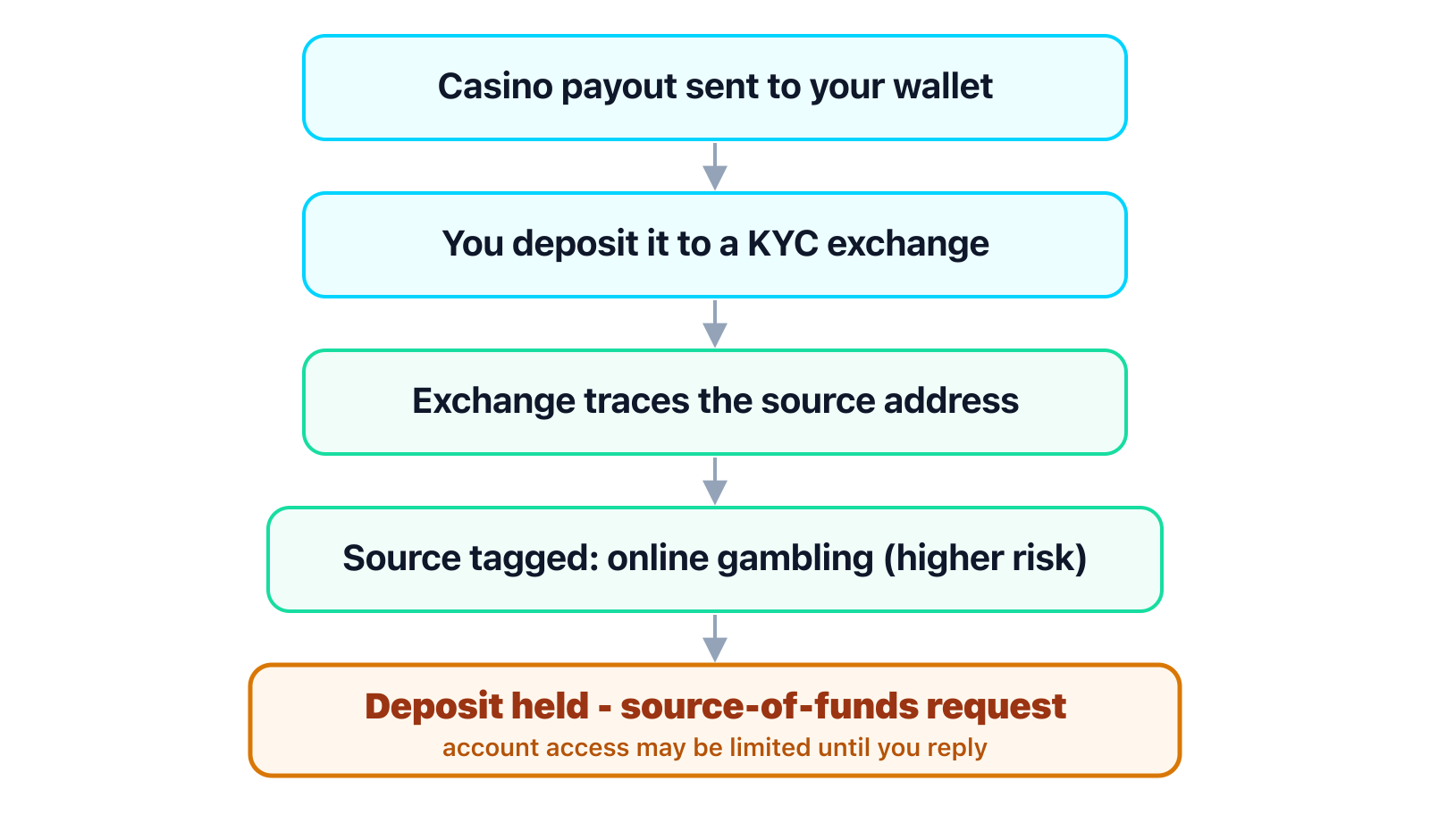
TL;DR - Exchanges flag casino deposits because blockchain analytics tags many gambling sites as higher-risk sources, so the funds get held while compliance asks where the money came from.
You cashed out a win from an online casino, sent the crypto to your exchange account, and instead of a clean balance you got a hold and a request for documents. This catches people off guard because the payout felt legitimate to you - you won it fairly. The exchange is not judging your luck. It is reacting to where the coins sat before they reached you, and gambling addresses carry a risk label that has nothing to do with whether your particular win was honest.
Why does an exchange flag a deposit that came from a casino?
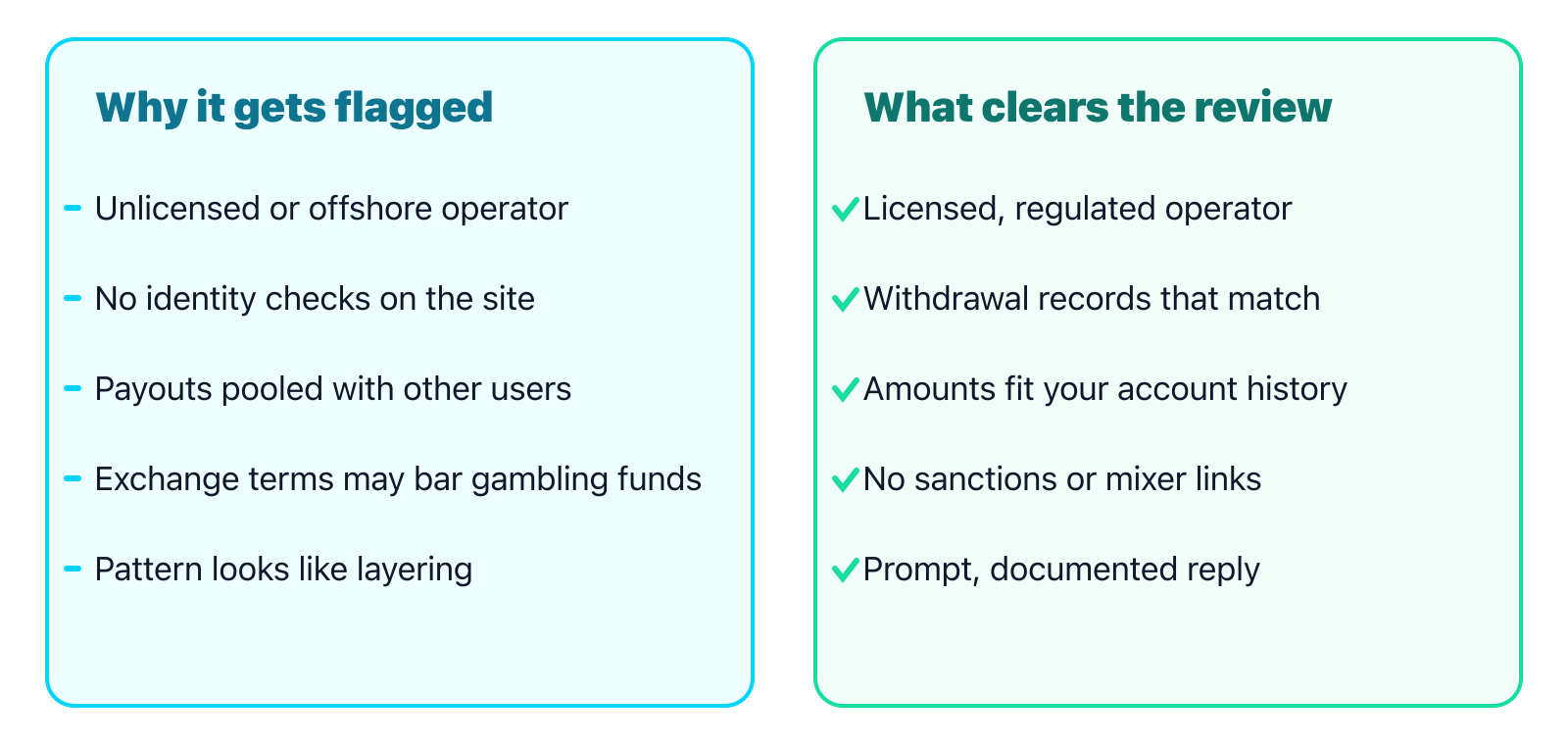
Regulated exchanges run every incoming deposit through automated screening before they credit it. That check looks at the address that sent you the funds and the addresses behind it, then assigns a risk category. Online gambling is one of the categories compliance teams watch, alongside mixers, darknet markets, and sanctioned entities. The reason is not that gambling is always illegal. It is that gambling platforms, especially unlicensed offshore ones, are a known channel for moving illicit money, so funds arriving straight from one get extra scrutiny.
There is also a contractual angle. Many exchanges name gambling in their terms of service, either restricting it outright or requiring extra checks. So even a payout from a site you consider reputable can trip a rule you never read. The flag is a precaution, not an accusation, but it still freezes your access until someone reviews it.
How does the exchange know the funds came from gambling?
The blockchain is public, so the exchange does not need to ask the casino anything. Analytics firms such as Chainalysis, TRM Labs, and Elliptic spend years attributing addresses to real-world services. When a casino pays out from the same wallets thousands of times, those wallets get clustered and labelled as that operator. Your deposit inherits the label of whatever paid you.
Your deposit inherits the risk label of the address that paid you, and a gambling tag routes it into manual review.
This is why the amount rarely matters. A small win from a flagged operator can draw the same hold as a large one, because the trigger is the source label, not the size. You can see the immediate sending address yourself on a block explorer such as Etherscan, but a raw explorer will not tell you that the address belongs to a gambling service or how risky it is. Rather than guessing from a list of transactions, screen the address with Plastron to see sanctions, mixer, and stolen-funds exposure across Ethereum and six other chains at once, with no wallet connection needed. Checking before you deposit is the difference between a clean credit and a surprise hold.
Is gambling crypto actually illegal, or just risky?
In most places, winning crypto at a licensed casino and cashing it out is legal. The problem is practical, not criminal. The exchange cannot tell your honest win apart from money that someone ran through a casino to launder it, so it treats the whole gambling category as elevated risk and asks you to close the gap with evidence. Whether the funds clear depends less on the law and more on what you can show.
The same deposit can clear or stall depending on the operator's licensing and how well your records line up.
The licensing of the operator matters most. A payout from a regulated, named casino that keeps records is far easier to defend than one from an anonymous site with no identity checks. If the funds also passed through a mixer or touched a sanctioned address on their way to you, the gambling label is the least of your worries, and the review will take longer.
What should I do if my casino deposit is on hold?
Start by reading the exchange message carefully, because it usually names exactly what it wants. Most reviews end with a source-of-funds request, which means proof of where the money came from. Gather your casino account statement, the specific withdrawal confirmation, and anything that ties the payout to you, such as a transaction ID or an email receipt. Submit it promptly and keep your answers factual.
Do not try to move the funds elsewhere mid-review or open a second account, since both make you look evasive and can escalate a routine hold into a closure. If you trade peer-to-peer or accept payments often, screen incoming addresses before you deposit, so you learn about a gambling or mixer label while you can still choose a different route. For the document side, our guide on how to write a source of funds letter walks through what to include, and getting an account unfrozen after an AML review covers what to expect next. To understand the broader idea of why some coins carry risk, see what dirty coins really mean.
FAQ
Will every exchange flag a casino withdrawal?
No. It depends on the exchange's risk settings and the operator behind the payout. A licensed casino that the analytics firms label as low risk may pass without comment, while an offshore site with no checks is far more likely to trigger a hold. The same deposit can sail through one exchange and stall at another.
Can the exchange keep my gambling winnings permanently?
An exchange can freeze funds during a review and, in rare cases, refuse to return them if it concludes they are linked to crime or a sanctions breach. For an ordinary win you can document, the usual outcome is a delay, not a loss. Responding quickly with clear records is the fastest way to release the hold.
Should I just withdraw to a personal wallet instead of an exchange?
Holding the funds in your own wallet avoids the immediate hold, but it does not erase the history. The gambling label stays attached to the coins, so the same flag can appear later when you eventually deposit to any regulated service. Screening the funds first tells you what you are holding before it becomes a problem.
Does using a licensed casino make a difference?
Yes. A regulated operator that performs identity checks and keeps records gives you a paper trail the exchange can verify, which makes a hold far easier to resolve. Anonymous sites leave you with on-chain coins and no way to prove the win was clean, which is the harder position to defend.
Disclaimer: This article is for educational and informational purposes only and is not legal, financial, tax, or compliance advice. Crypto carries risk; you act on this information at your own risk. Always do your own research and consult a qualified professional before making decisions. Views are the author's own and do not constitute financial, legal, or investment advice.
About Plastron
Plastron is a free, non-custodial wallet screening tool. It checks Ethereum and six EVM chains for AML and KYT risk — sanctions exposure, mixer contact, and stolen-funds proximity — and returns a risk report in seconds. It reads public on-chain data only: it never takes custody of funds and never asks for private keys.