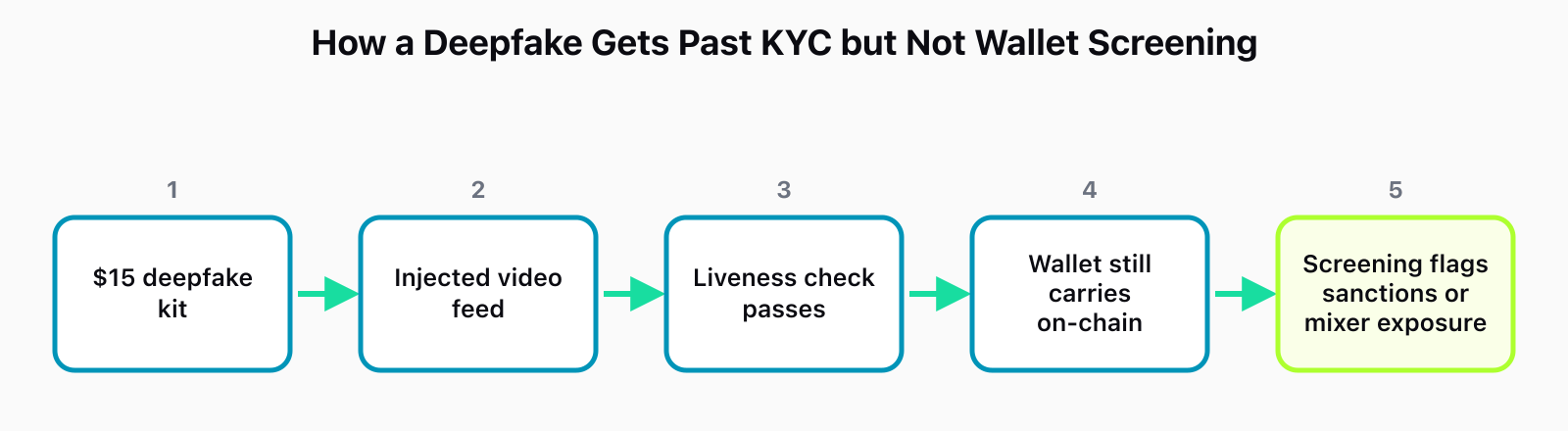
A deepfake kit now costs about $15 and can beat the facial liveness check at major crypto exchanges, while an address's on-chain history still gives it away.
You hold your phone up, blink on command, and the exchange's camera confirms it is really you. That confirmation is getting easier to fake, and most exchanges built their onboarding around the assumption that it can't be.
The $15 Kit Beating Facial KYC Checks
A darknet tool called JINKUSU CAM surfaced in early April 2026, built to inject a fabricated video feed straight into a browser or mobile verification flow instead of a live camera. Crypto-industry researchers who tracked the kit said it was aimed at the KYC flows of Binance, Coinbase, Kraken, and OKX specifically. One report pegged the going rate at around $15 per attempt, cheaper than the application fee on most of the accounts it gets used to open.
Injection attacks like this do not trick a human reviewer. They trick the software that replaced one.
The face check only runs once at onboarding. The wallet's transaction history stays checkable after it passes.
How Bad Has the Deepfake-KYC Problem Gotten?
Bad enough that iProov's Threat Intelligence Report 2026 flagged a sharp rise in biometric injection attempts, including on Apple devices that used to be considered a safer bet. Separately, researchers at Sensity said they bypassed automated liveness checks with AI-generated faces and found 9 of the 10 leading identity-verification vendors highly vulnerable to the technique - a vendor's own test, not an independent audit, but a result that lines up with the rest of this year's reporting.
The tools are not hard to find, either. Biometric Update reported active Telegram channels built around selling ready-made KYC-bypass kits to anyone willing to pay. No coding required. Buy the kit, point it at the exchange's upload flow, and the camera does the rest of the work for you.
Passing KYC Doesn't Mean the Wallet Is Clean
An identity check and a wallet risk check answer two different questions. One asks whether the face on camera belonged to the account holder. The other asks whether that account holder's wallet has ever touched a sanctioned address, a mixer, or a cluster of known scam activity - and a deepfake does nothing to change that second answer.
Plastron's own screening corpus holds more than 100,000 labeled wallet addresses, plus all 1,061 entries on the OFAC Sanctions List, built independently of any identity document anyone submitted. A spoofed selfie does not erase a wallet's on-chain history. It just gets a fake face past the camera checking it.
Can Wallet Screening Catch What a Deepfake Gets Past?
Yes, because it is not checking the same thing a camera checks. Wallet screening reads the blockchain itself, every address that wallet has sent to or received from, instead of a face on a webcam. A liveness check runs once, at onboarding. A wallet carries its transaction history permanently, and that history does not change no matter whose face got past the camera that opened the account.
You can trace a single hop by hand on Etherscan, but that only shows the last transaction, not the cluster of addresses behind it. Screen the wallet with Plastron instead and get its sanctions, mixer, and stolen-funds exposure across Ethereum and six other chains in one scan, regardless of whose face the exchange's camera approved.
What Should Exchanges and Users Actually Do Differently?
Exchanges are leaning on capture-source validation, confirming a video frame actually came from a live camera rather than an injected file, and scoring a whole verification session instead of a single frame. iProov's own report recommends exactly that layered approach, though it is also the vendor selling it.
For users, the fix has nothing to do with your own face. If you are about to accept a payment, hire a contractor, or approve an OTC trade with someone whose KYC you cannot personally verify, screen their wallet instead of their selfie. The cost asymmetry favors the attacker right now: a $15 kit against a verification stack that can cost an exchange tens of dollars per check. Wallet screening does not shift that economics for the exchange, but it gives the counterparty on the other side of the trade a check that a fake face cannot pass. Check the difference between KYC and KYT first if you are not sure which check actually answers your question.
A deepfake can get a fake identity through the door. It cannot give a dirty wallet a clean transaction history, and that is still the check that catches the money.
Disclaimer: This article is for educational and informational purposes only and is not legal, financial, tax, or compliance advice. Crypto carries risk; you act on this information at your own risk. Always do your own research and consult a qualified professional before making decisions. Views are the author's own and do not constitute financial, legal, or investment advice.
About Plastron
Plastron is a free, non-custodial wallet screening tool. It checks Ethereum and six EVM chains for AML and KYT risk — sanctions exposure, mixer contact, and stolen-funds proximity — and returns a risk report in seconds. It reads public on-chain data only: it never takes custody of funds and never asks for private keys.