TL;DR - A KYC mule is someone who passes identity verification honestly, then hands account control to someone else, so a "verified" account's wallet can still move dirty money.
Someone messages you on Telegram offering $300 to "borrow" your verified Binance or OKX account for a few weeks. No crime mentioned, just verification you already did and apparently don't need right now. That pitch is the funding mechanism law enforcement is now tracing back through more than 336 million euros in laundered crypto, one real passport at a time.
What is a KYC mule, exactly?
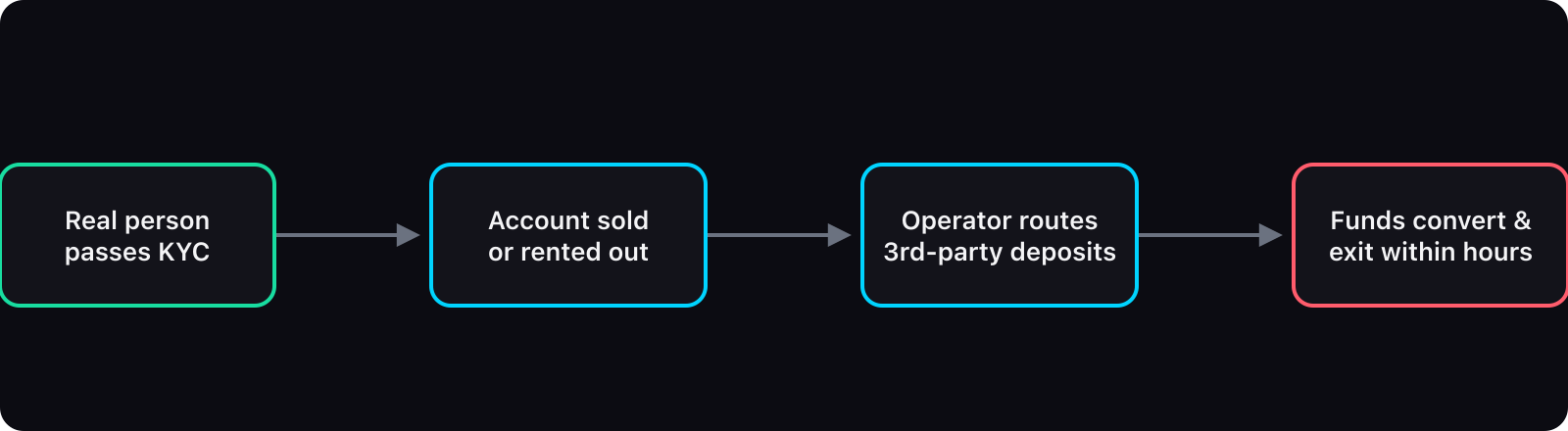
A KYC mule is a verified real person whose identity, not their money, is the product being sold. Unlike a classic money mule who receives and forwards stolen funds themselves, a KYC mule passes onboarding with a genuine passport and a matching selfie, then transfers operational control of the account to someone else in exchange for a fee, a commission, or a flat payment. The verification was real. The hands on the keyboard aren't the same hands anymore.
This isn't a fringe problem. A 2025 Times and ICIJ investigation traced roughly $28 billion tied to illicit activity into major crypto exchanges, and a meaningful share of it moved through accounts that had already cleared identity checks. India's Operation Chakra-V found more than 850,000 mule accounts spread across over 700 bank branches in a single sweep in June 2025. The ID is real. The person deciding what the account does next usually isn't.
How does a verified account end up controlled by someone else?
The pattern is consistent across cases. A customer completes legitimate KYC and the account behaves unremarkably for several weeks: a small deposit, a couple of ordinary trades, nothing that would draw attention. Then the activity shifts. Deposits start arriving from multiple unrelated third parties, convert to stablecoins or another asset almost immediately, and exit to a specific destination wallet within hours. The person who opened the account may be getting paid a cut, may have been told it's for "arbitrage," or may genuinely not grasp what's moving through their name.
OKX lived through a version of this directly. A user known as "Captain Bunny" admitted to purchasing KYC-verified accounts from other regions, and OKX froze roughly $40,000 in stablecoins tied to the activity, with the exchange's leadership publicly defending the freeze as a straightforward rules violation. Checking a destination wallet's own transaction history on a block explorer will show you that it received funds from several "different" accounts, but it won't tell you those accounts are all paying out to the same cash-out address this month. Screening the wallet itself for shared counterparties and risk exposure does, and you can screen a wallet for that exposure with Plastron before you treat an incoming deposit as routine.
Why doesn't identity verification catch this?
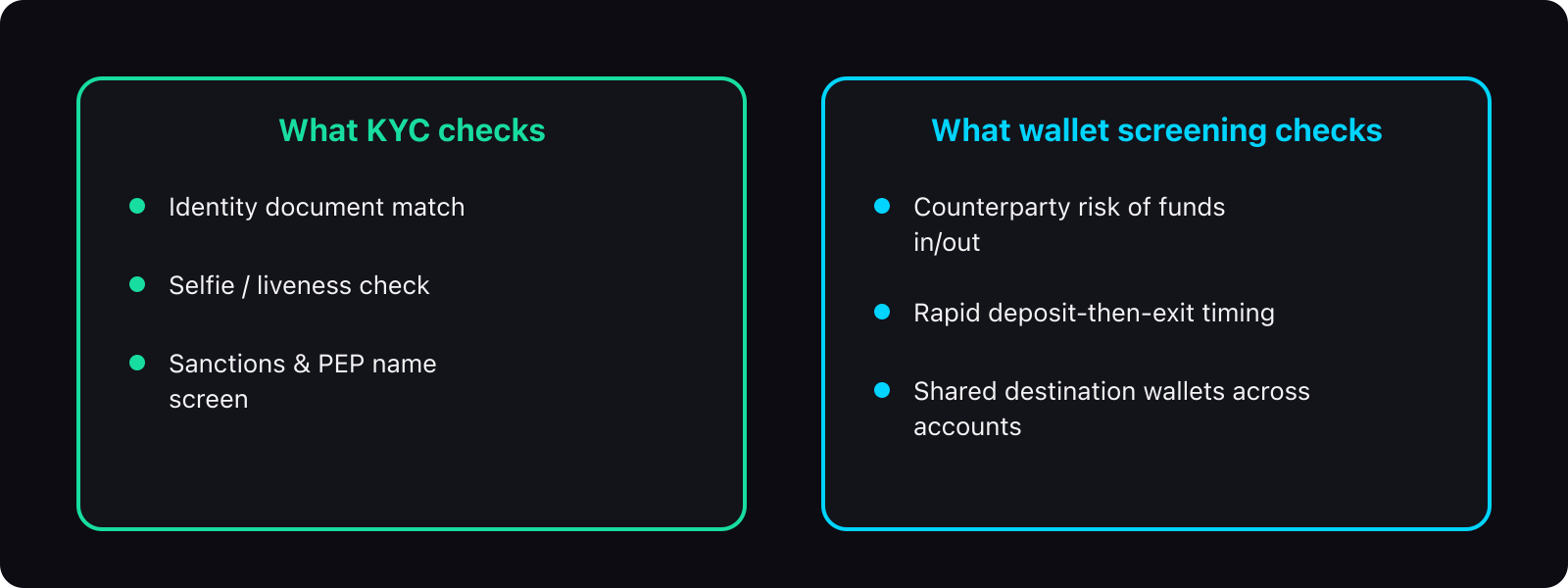
KYC answers one question: who opened this account. It checks a document, matches a face, and screens a name against sanctions and PEP lists at onboarding. None of that tells a platform who is deciding what the account does six weeks later. As one compliance write-up on the pattern puts it, the platform verified who opened the account; it never established who decides what the account does now. That gap is structural, not a bug someone forgot to patch.
Wallet and transaction screening covers the part KYC was never built for: what the money actually does once it's moving. That means counterparty exposure on incoming and outgoing funds, deposit-then-exit timing measured in hours instead of weeks, and whether several supposedly unrelated accounts keep sending value to the same destination wallet. Plastron's own labeled dataset carries 3,902 flagged addresses across scam, fraud, mixer, and exchange-risk categories, plus the full OFACsanctions list, and a shared cash-out wallet behind a rented account is exactly the kind of address that pattern is built to catch.
KYC proves who opened the account once. Wallet screening watches what the account's funds actually do afterward, which is where a rented account shows up.
What did the AudiA6 takedown actually show?
On June 10, 2026, a coordinated operation supported by Eurojust and Europol, running across the United States, France, Poland, Georgia, and Iceland, shut down a crypto laundering service known as AudiA6. Investigators say the service processed more than 336 million euros in criminal proceeds between 2022 and 2025, charging commissions of 3 to 10 percent and returning "cleaned" funds to customers within about an hour of deposit. Two alleged administrators were arrested in Georgia, with a co-perpetrator already arrested in Poland back in September 2025. Authorities seized more than 80 vehicles, multiple properties, and took down 25 domains and over 30 servers.
The detail that matters here: investigators identified more than 6,000 KYC records linked to money mule accounts feeding the service. Six thousand passed verification. Zero of those verifications told anyone who was actually running the accounts by the time the money moved.
Every step up to the sale is clean on paper. The laundering happens in the step compliance teams can't see from an onboarding form.
What happens if you already rented out or sold your account?
Stop moving anything through it immediately, and don't forward whatever balance is left back to whoever paid you. Exchanges that catch the pattern freeze first and ask questions later, the way OKX did with its $40,000 freeze, and an unexplained frozen account with a plausible laundering trail behind it is a far worse position than a cooperative disclosure. Keep every message from the person who recruited you. That record is what separates a deceived account holder from a willing participant when an exchange or an investigator starts asking why the activity changed.
This isn't a grey-area side hustle. Europol's ninth European Money Mule Action identified 10,759 money mules and 474 recruiters in a single coordinated sweep, resulting in 1,013 arrests. Law enforcement already treats "renting out your verified identity" as a tracked, prosecutable laundering channel, not a victimless shortcut. Selling the account doesn't just risk a freeze. It puts your name on the trail of someone else's crime, permanently, whether you understood the job or not.
Disclaimer: This article is for educational and informational purposes only and is not legal, financial, tax, or compliance advice. Crypto carries risk; you act on this information at your own risk. Always do your own research and consult a qualified professional before making decisions. Views are the author's own and do not constitute financial, legal, or investment advice.
About Plastron
Plastron is a free, non-custodial wallet screening tool. It checks Ethereum and six EVM chains for AML and KYT risk — sanctions exposure, mixer contact, and stolen-funds proximity — and returns a risk report in seconds. It reads public on-chain data only: it never takes custody of funds and never asks for private keys.