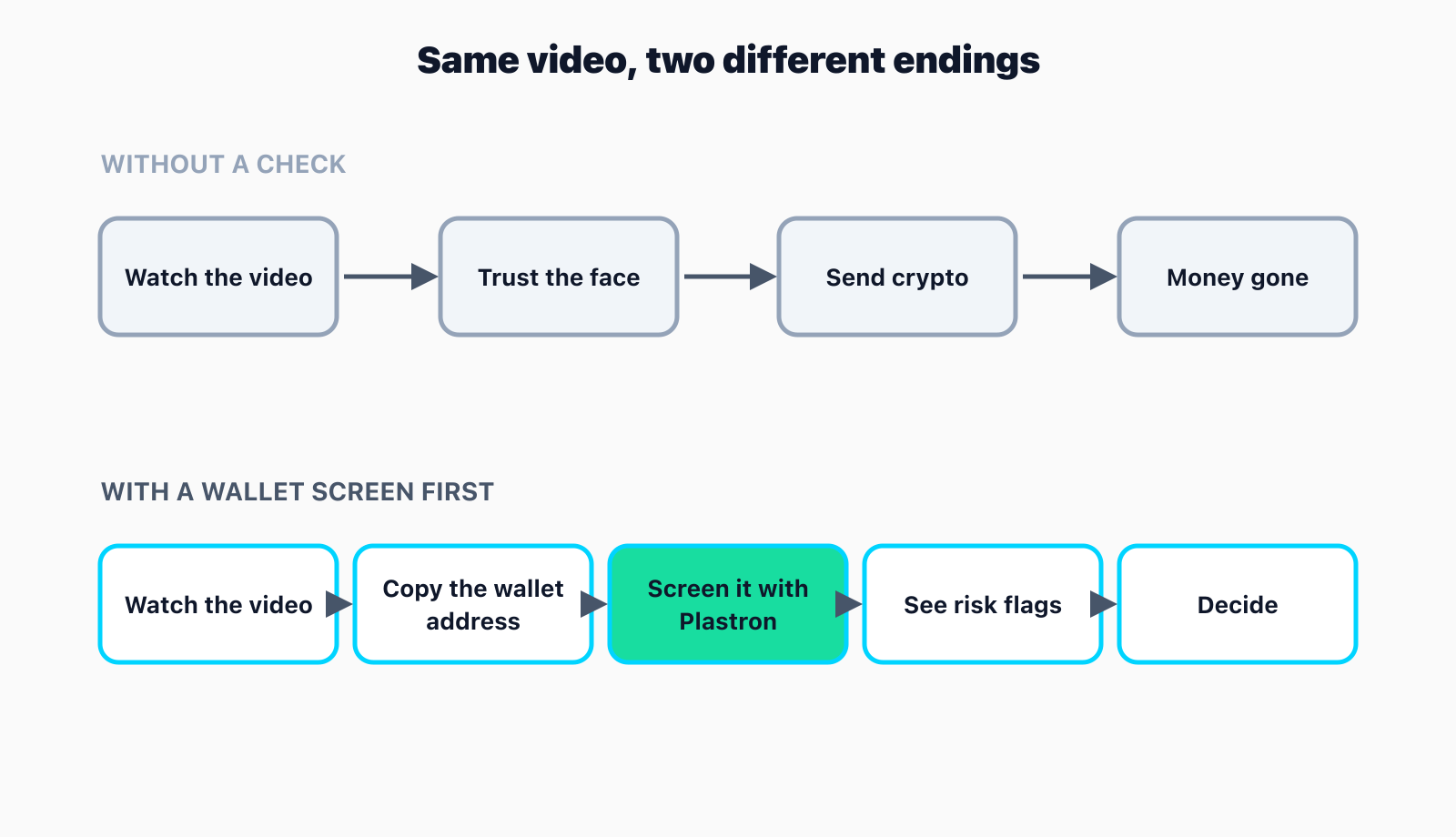
TL;DR - A celebrity endorsement video proves nothing about a crypto platform, and screening the wallet it asks you to send to takes under a minute and catches most of these scams before the money moves.
A deepfake of Elon Musk or a sitting prime minister doesn't make a trading platform real. It just makes the ask harder to refuse. These videos cost real victims real money in 2026, and the tell isn't in the footage - it's in the wallet address the video points you toward.
Why Are Deepfake Investment Videos Working So Well Right Now?
The clips are cheap to make and expensive to spot. A few minutes of public speech footage is enough to clone a voice, and the lip-sync tools sold on Telegram now run in real time during a live stream chat. Scammers don't need the deepfake to be perfect. They need it to be good enough to survive a scroll past on Facebook or YouTube before a viewer closes the tab.
Trust does the rest. A familiar face saying "I only use this platform" short-circuits the questions a stranger's pitch would trigger. In June 2026, a senior in Ontario wired $900,000 into a platform built on a deepfake video of Prime Minister Mark Carney, according to CTV News. Doug and Victoria Lloyd, a couple in Ottawa, lost $177,000 the same way, chasing a deepfake of Musk promising guaranteed returns. Neither household would have sent a cent to a stranger cold-calling them. The video made it feel like a referral.
The ad placement matters as much as the footage. These clips run as paid promotions on mainstream platforms, next to real financial news, which lends them a borrowed credibility no cold email ever gets. Takedowns happen, but a new upload with a slightly different thumbnail is live again within hours. Chasing the video is a losing game. Chasing the wallet behind it isn't.
What Do These Scam Platforms Actually Look Like Up Close?
Almost every case follows the same shape: a short video ad, a landing page with a countdown timer, and a deposit screen that only takes crypto. There's no customer support number that connects to a person, and the "live chat" widget is scripted. A victim in Northern Ireland lost 250,000 pounds this way; police there called the operation "sophisticated," which mostly means the website looked like a real brokerage and the video looked like a real endorsement.
Scale is the part people underestimate. Australia's corporate regulator, ASIC, tracked AUD 7.4 million in losses tied to AI-cloned voices of the country's prime minister and nine other public figures in the 2025-26 financial year alone. One video template, swapped onto a new face, works across borders with no translation needed beyond subtitles.
How Do You Check the Platform's Wallet Before You Send Anything?
Ignore the video entirely and go straight to the deposit address. Every one of these platforms eventually shows you a wallet address or a QR code and asks for crypto first. Copy that address before you send anything, not after.
A manual lookup on a block explorer like Etherscan will show you transaction history, but it won't hand you a verdict - you have to read the raw flow of funds yourself and know what you're looking at. Screen the same address with Plastron instead, and it returns sanctions, mixer, and stolen-funds exposure across Ethereum and six other chains in one pass, free, with no account needed. If the address has already received deposits from other reported scams, that shows up in seconds instead of after your money is gone.
Do this even when the platform looks polished. A real exchange or broker never asks for an upfront crypto transfer to "activate" an account, and a real one is also happy to wait while you check. Pressure to send immediately, before you've had time to look anything up, is itself a red flag worth treating as a verdict on its own.
The video is identical in both paths. The only difference between losing the money and keeping it is one screening step, done before you send.
Does a Clean Screening Result Mean the Platform Is Trustworthy?
No, and this is the gap these scams exploit. Plastron's own labeled dataset tags 3,354 of its 3,901 flagged addresses as outright scams, built from reports filed after money was already lost. A wallet that was generated last week for this exact campaign hasn't been reported yet, so it won't carry a flag the first day it's used.
A clean result on a brand-new address means "nothing bad is recorded here yet," not "this is safe." Treat it as one data point, not a green light. Separately, Plastron also tracks 780 OFAC-sanctioned crypto addresses, and a hit against that list is the one result that should end the conversation immediately, no further questions asked.
What Should You Do If You Already Sent Crypto to One of These Videos?
Move fast, and skip the parts that waste time. Here's the order that actually helps:
Stop sending more. A platform that claims your withdrawal needs a "tax" or "unlock fee" before it releases funds is running the second half of the same scam.
Screen the receiving wallet so you have a record of the exposure, timestamped, before the address gets reused or relabeled by someone else's report.
File a report with your national fraud reporting center and your local police, and keep the transaction hash and screenshots of the video and landing page.
Expect to be contacted by a "recovery agent" within days. That follow-up pitch is almost always a second scam built on the first one, the same con covered in Plastron's recovery scam breakdown.
Full recovery is rare once funds have moved through a few hops. A documented, screened wallet trail is still worth having for any later investigation, and it's the same exposure check used in Plastron's pig-butchering wallet guide for a different flavor of the same long-con playbook.
Disclaimer: This article is for educational and informational purposes only and is not legal, financial, tax, or compliance advice. Crypto carries risk; you act on this information at your own risk. Always do your own research and consult a qualified professional before making decisions. Views are the author's own and do not constitute financial, legal, or investment advice.
About Plastron
Plastron is a free, non-custodial wallet screening tool. It checks Ethereum and six EVM chains for AML and KYT risk — sanctions exposure, mixer contact, and stolen-funds proximity — and returns a risk report in seconds. It reads public on-chain data only: it never takes custody of funds and never asks for private keys.