TL;DR - No - a Suspicious Activity Report is confidential by law, an exchange is legally barred from telling you one was filed, and you are never notified, so the only signs you see are indirect, like a frozen account.
If you have searched for whether a crypto exchange filed a Suspicious Activity Report, or SAR, on you, the honest answer is the one nobody wants: you cannot find out, and the exchange cannot tell you even if you ask. The rule that makes SARs useful to investigators is the same rule that keeps you in the dark. What you can do is understand what triggers one, read the indirect signs, and check your own wallet for the exposure that draws scrutiny in the first place.
What is a Suspicious Activity Report (SAR)?
A SAR is a confidential report that a regulated financial institution files with a government financial-intelligence unit when it spots activity that looks suspicious. In the United States, crypto exchanges and other virtual asset service providers file SARs with FinCEN under the Bank Secrecy Act. In Australia, the equivalent reports go to AUSTRAC, which publishes its own indicators of suspicious activity for the crypto sector, and the global baseline for all of this comes from the FATF standards that most countries now follow.
The single most important thing to understand is what a SAR is not. It is not a criminal charge, a conviction, or even an accusation of guilt. It is a flag that says activity deserves a closer look. Plenty of SARs are filed on people who did nothing wrong, and most never lead anywhere. The report goes into a secure database and may sit there unused.
Will an exchange tell you if it filed a SAR on you?
No, and this is the part that surprises people. Telling a customer that a SAR has been filed, or even hinting at it, is called tipping off, and it is illegal in most jurisdictions that follow the FATF framework. A compliance officer who confirms a SAR exists can expose the company and themselves to penalties. So when you email support asking why your account is under review, the silence you get back is not evasiveness. It is the law working as intended.
That confidentiality is deliberate. If subjects of reports could see them, anyone laundering money would simply file a support ticket, learn they had been flagged, and move their funds before investigators acted. The secrecy is the whole point, which is also why no freedom-of-information request or account-data export will ever surface a SAR filed about you.
What triggers a SAR on a crypto account?
Exchanges run automated monitoring that scores every account against known risk patterns. A SAR is usually filed when one or more of those patterns crosses an internal threshold. The triggers are not secret in principle, even if any specific filing is.
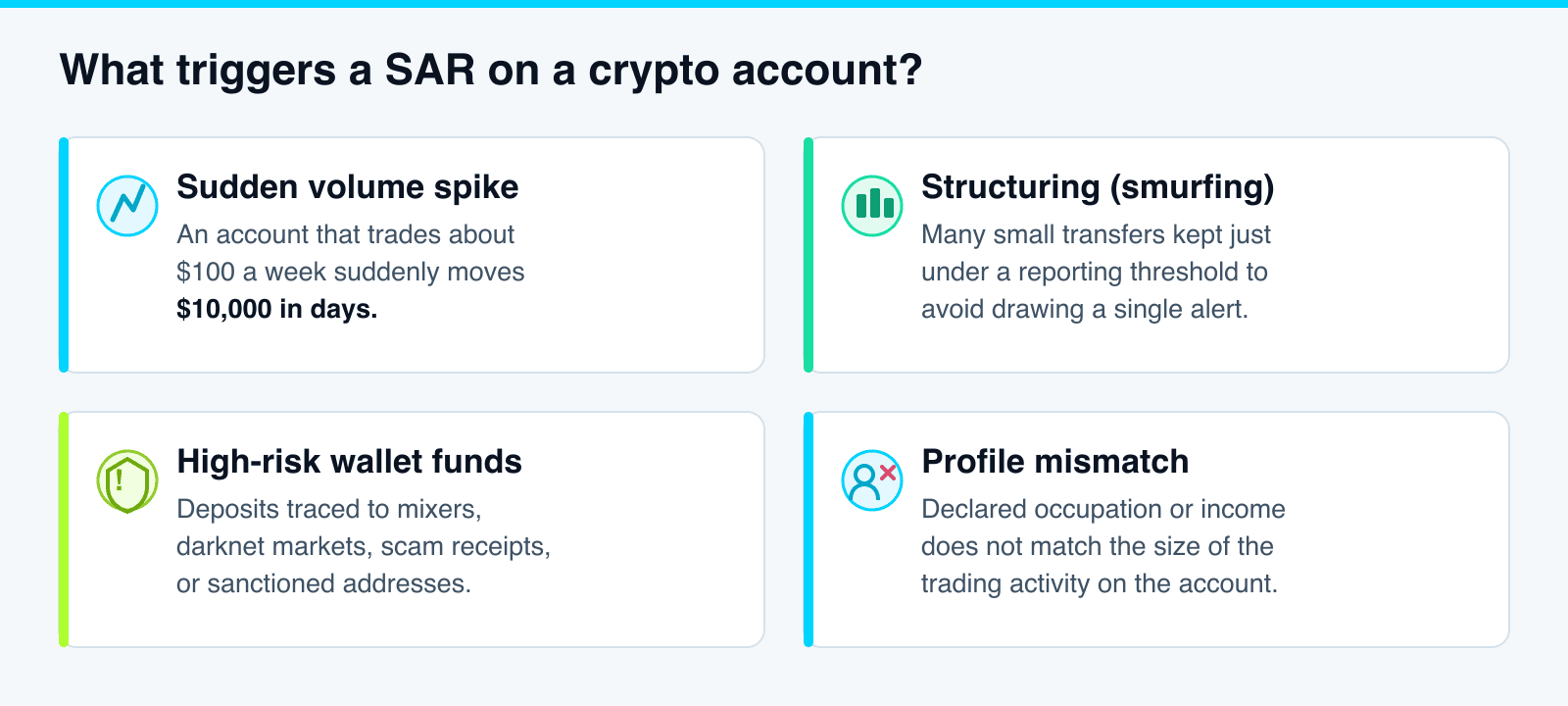
The four patterns that most often push an account over an exchange's internal reporting threshold.
The most common triggers are easy to describe. A sudden volume spike stands out, such as an account that normally trades around 100 dollars a week and abruptly moves 10,000 dollars in a few days. Structuring, sometimes called smurfing, means breaking a large sum into many small transfers kept just under a reporting threshold, which monitoring systems are specifically built to catch. Funds arriving from wallets with high or extreme risk exposure are another big one: deposits traced to mixers, darknet markets, ransomware payments, scam receipts, or sanctioned addresses. Finally, a mismatch between your declared profile and your behaviour, like an account registered to a part-time student moving six figures, invites a manual review that can end in a filing.
What are the signs a SAR may have been filed?
Because you cannot see the report itself, you are left reading indirect signals. None of them confirms a SAR, but together they suggest your activity has drawn compliance attention.
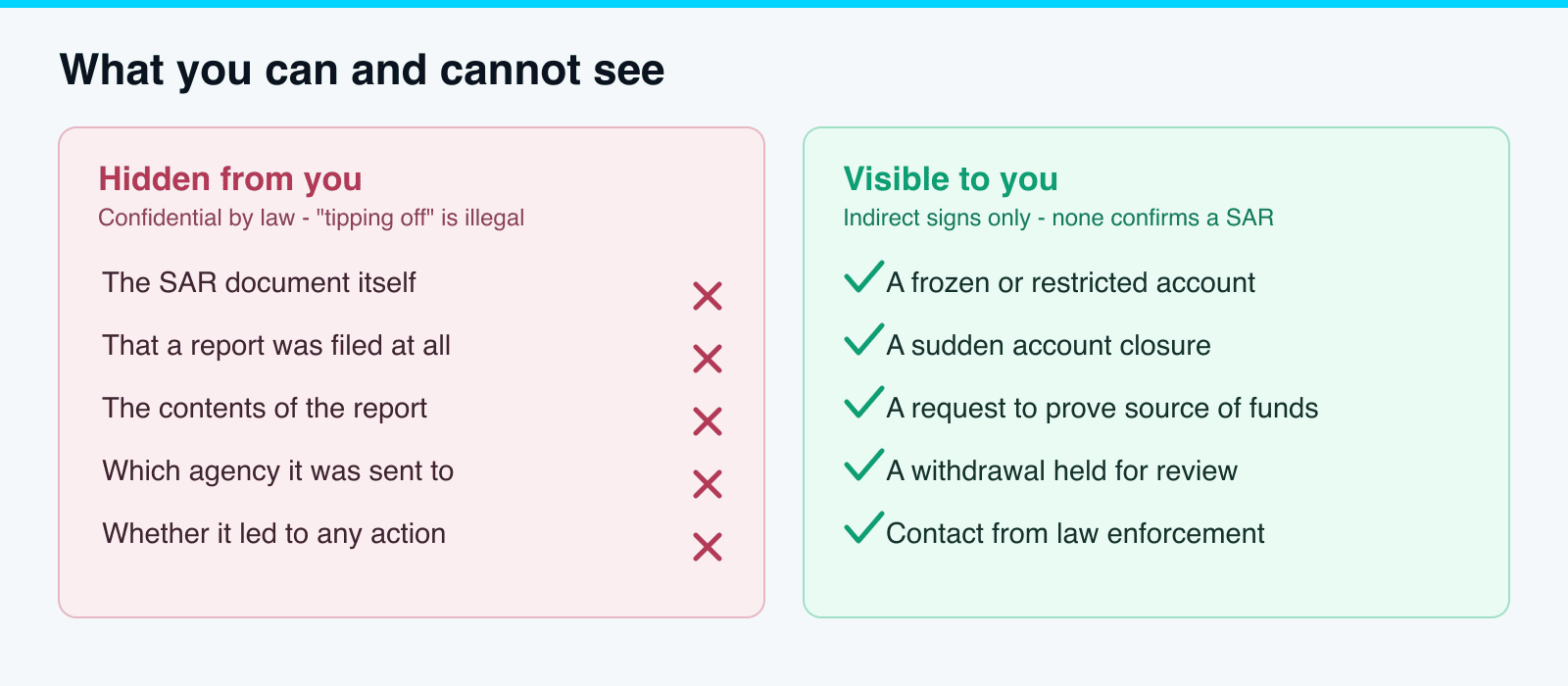
You never see the SAR itself, only the downstream effects: a hold, a closure, a source-of-funds request, or law-enforcement contact.
The clearest sign is an account freeze or restriction that arrives without a detailed explanation. A sudden account closure, a request to prove your source of funds, or a withdrawal held for extended review all point the same way. In rarer cases, contact from law enforcement is the first concrete signal. It is worth repeating that a frozen account does not prove a SAR exists, and many holds resolve once a compliance team finishes a routine check. If your withdrawal is stuck in review, the mechanics of that process are covered in why a crypto withdrawal gets flagged for review.
What can you actually do about it?
You cannot un-file a SAR or appeal one you cannot see, so the useful moves are all preventive. Keep clean records of where your funds came from, respond promptly and honestly to any source-of-funds request, and avoid the deposit patterns above that read as structuring. The single most effective habit is knowing the risk profile of funds before they touch your exchange account, because a deposit traced to a mixer or a sanctioned address is what tips many accounts into review.
Checking that by hand means tracing an incoming address backward through a block explorer such as Etherscan, hop by hop, looking for links to flagged sources, which is slow and easy to get wrong. Instead, screen the address with Plastron to see sanctions, mixer, and stolen-funds exposure across Ethereum and six other chains in one pass, with no wallet connection required. If a freeze has already happened, the realistic timelines are laid out in how long a crypto exchange AML review takes.
FAQ
Can I request a copy of a SAR filed about me?
No. SARs are exempt from disclosure laws like the Freedom of Information Act, and the filing institution is legally prohibited from confirming or denying that one exists. There is no process for a customer to obtain or even verify a SAR.
Does a SAR mean I am being investigated?
Not necessarily. A SAR is a report of suspicious activity, not evidence of a crime. Many filings are reviewed and closed without action, and the institution that filed it usually never learns the outcome.
How long does a SAR stay on record?
Financial-intelligence units typically retain SAR data for years, and US institutions must keep their own copies for five years after filing. The report does not expire from your perspective because you were never told it existed in the first place.
Can a SAR get my account frozen?
A SAR itself does not freeze funds; it is a report, not an order. But the same suspicious activity that prompts a filing often prompts a separate compliance hold or closure, which is why the two so often appear together.
Disclaimer: This article is for educational and informational purposes only and is not legal, financial, tax, or compliance advice. Crypto carries risk; you act on this information at your own risk. Always do your own research and consult a qualified professional before making decisions. Views are the author's own and do not constitute financial, legal, or investment advice.
About Plastron
Plastron is a free, non-custodial wallet screening tool. It checks Ethereum and six EVM chains for AML and KYT risk — sanctions exposure, mixer contact, and stolen-funds proximity — and returns a risk report in seconds. It reads public on-chain data only: it never takes custody of funds and never asks for private keys.