TL;DR - Paxos can freeze and permanently wipe any wallet's PYUSD balance through a single on-chain role, the same kill switch built into USDT and USDC, and you can read that flag yourself before you accept a transfer.
You just received a PYUSD payment, the balance shows up fine in your wallet, and now you're wondering if Paxos can take it back. Most posts about stablecoin freezes only cover Tether and Circle and skip PYUSD entirely, even though Paxos ships the same override plus one extra power the other two don't equally share.
Can PayPal freeze PYUSD in your wallet?
Yes. Paxos Trust Company, which issues PYUSD under contract with PayPal, holds a smart-contract role that can freeze the PYUSD balance of any Ethereum address, yours included, with no signature from you required. The token is an ERC-20 sitting at 0x6c3ea9036406852006290770bedfcaba0e23a0e8 on Ethereum mainnet, and every administrative function in that contract is visible on-chain to anyone who looks.
Paxos has said it expects to use the power rarely and won't do so on its own judgment. PYUSD's contract still gives Paxos the same override Tether and Circle already carry. None of the three stablecoins run entirely on your consent.
How does the freeze and wipe mechanism actually work?
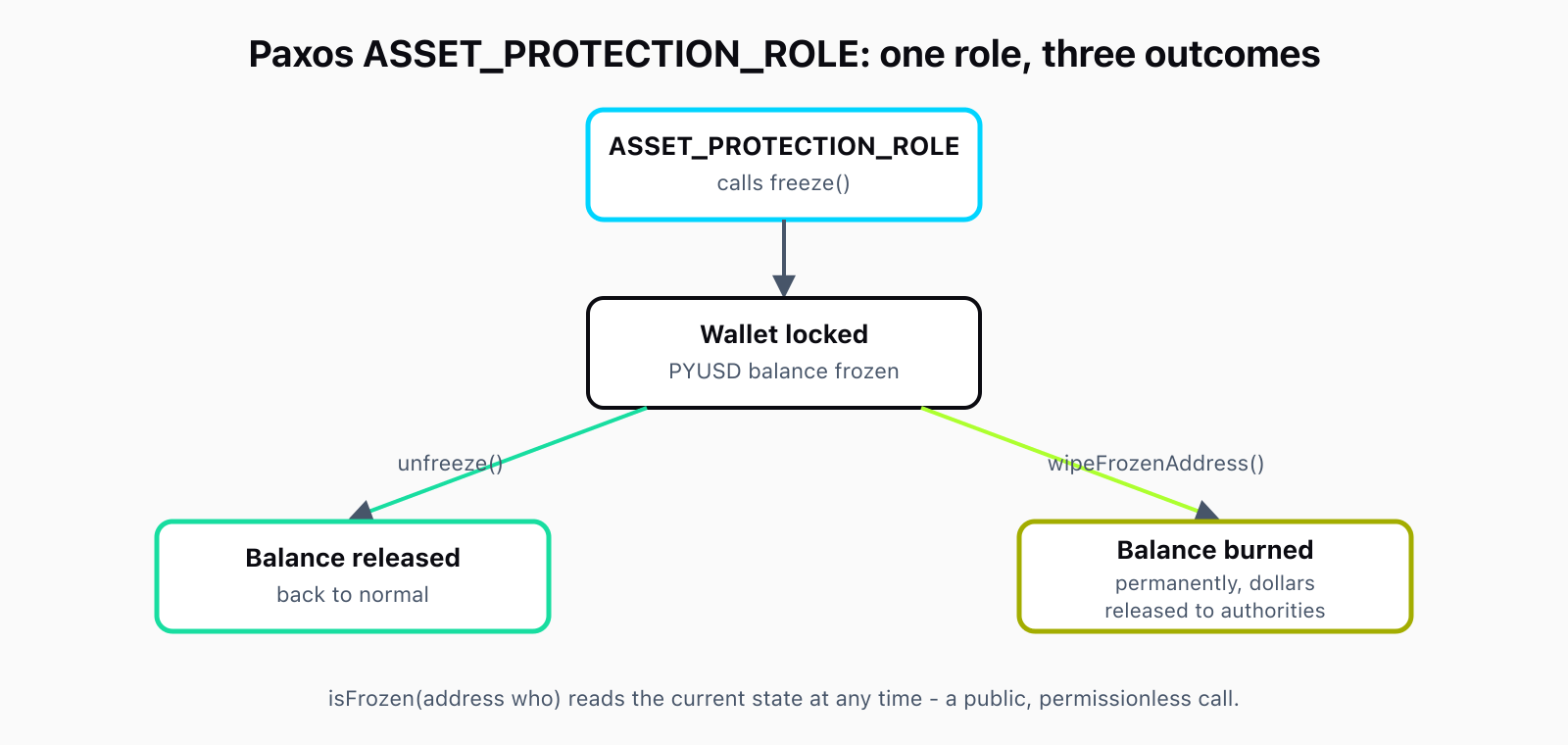
The freeze runs on a single smart-contract role called ASSET_PROTECTION_ROLE, documented in Paxos's own pyusd-contract repository on GitHub. Whoever holds that role can call freeze() on any address to lock its PYUSD in place, then call unfreeze() to release it later.
Freezing alone doesn't destroy anything; it just stops the balance from moving. The harder power sits in wipeFrozenAddress(), which burns the PYUSD sitting in an already-frozen wallet outright, clearing the way for Paxos to release the backing dollars to whichever authority ordered the seizure. Anyone can check current status with the public isFrozen(address who) function, no permission needed. The code doesn't care what Paxos expects. It runs the moment someone holding the role calls it.
One role controls three outcomes for a flagged wallet: an active freeze, a reversal, or a permanent burn of the frozen balance.
How does PYUSD's freeze power compare to USDT and USDC?
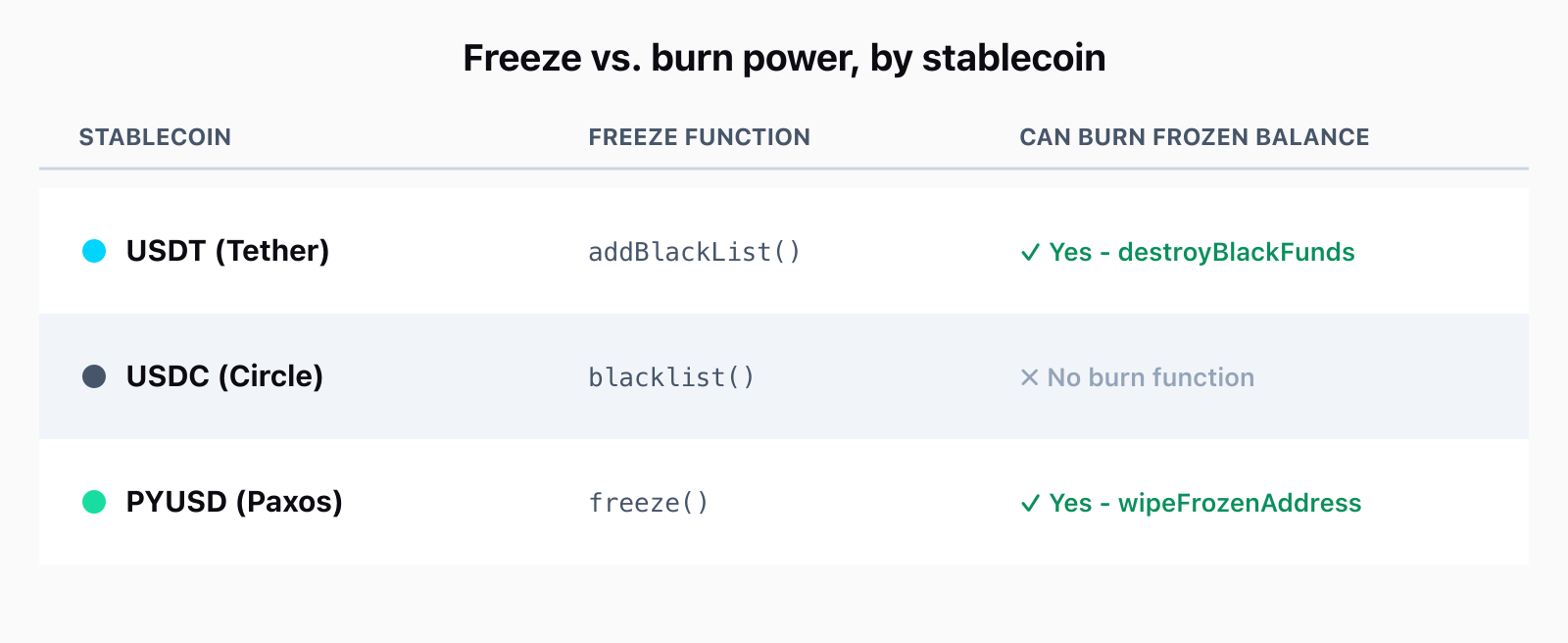
All three major dollar stablecoins carry an issuer kill switch, but the switch isn't identical. USDT uses addBlackList and can permanently burn a flagged balance with destroyBlackFunds. USDC uses blacklist and stops there, with no built-in burn function at all. PYUSD sits between the two in name but lands closer to USDT in power, since wipeFrozenAddress gives Paxos the same destroy capability Tether has.
Dimension
USDT (Tether)
USDC (Circle)
PYUSD (Paxos)
Freeze function
addBlackList
blacklist
freeze
Check function
isBlackListed
isBlacklisted
isFrozen
Can burn balance
Yes, via destroyBlackFunds
No burn function
Yes, via wipeFrozenAddress
Circle can lock a wallet, but it has no on-chain way to torch what's inside it. Tether and Paxos both do. That single difference is the same logic covered in how Circle and Tether freeze stablecoin addresses, and it's worth reading if a counterparty holds a mix of stablecoins rather than PYUSD alone.
USDT and PYUSD both let the issuer burn a frozen balance outright; USDC's blacklist stops at freezing and goes no further.
What happened when Paxos accidentally minted $300 trillion PYUSD?
On October 15, 2025, Paxos minted 300 trillion PYUSD by mistake, a fat-finger entry that turned an intended 300 million into 300 trillion, and burned the entire batch about 22 minutes later by sending it to an inaccessible address. No customer lost a cent, and Paxos said the root cause behind the entry error had been fixed.
Aave still paused PYUSD deposits on its protocol while the incident played out, purely as a precaution. That's the real lesson here: a temporary anomaly at the issuer can freeze your practical access to the token before Paxos ever looks at your specific wallet.
How do you check if a PYUSD address is frozen?
Open the PYUSD contract at 0x6c3ea9036406852006290770bedfcaba0e23a0e8 on Etherscan, go to Read Contract, and call isFrozen with the address you want to check. A result of true means Paxos has locked that address already; false means it hasn't, at least not yet.
That one call only answers the PYUSD freeze question. It says nothing about sanctions exposure, mixer contact, or stolen-funds history sitting on the same address. Screen the address with Plastron instead, and the freeze-adjacent risk comes back in one pass, checked against sanctions lists plus known scam, mixer, and stolen-funds activity across Ethereum and six other chains. The same reasoning behind wallet screening in general applies here: a clean freeze status is necessary, not sufficient.
What should you do if your PYUSD gets frozen or a counterparty looks risky?
Act before the funds move again, not after. A few rules cover most situations.
Don't pay anyone offering to unfreeze your wallet for a fee, because Paxos never charges to lift a freeze and the offer is always a scam.
Screen a counterparty's address before you accept a large PYUSD payment, since catching exposure before the funds land beats catching it after.
Keep the transaction hash and the sender's address on record in case you need to dispute a freeze with Paxos support later.
Move remaining balances off an exposed but not-yet-frozen address early, because the freeze flag can flip with no warning.
The playbook barely changes from Circle's own no-warning USDC freezes: document everything, and appeal through the issuer directly rather than a third party promising a shortcut.
Paxos Trust Company holds the ASSET_PROTECTION_ROLE and executes any freeze. PayPal markets and distributes the token but doesn't hold the freezing key itself.
Can a frozen PYUSD wallet still hold other tokens?
Yes. A freeze only touches the PYUSD balance in that address; ETH and other tokens in the same wallet stay movable unless a separate action targets them too.
Is calling isFrozen on Etherscan safe?
Yes. isFrozen is a public view function, so checking it on Etherscan's Read Contract tab costs nothing, needs no wallet connection, and can't trigger a transaction.
Can Paxos reverse a PYUSD freeze?
Yes. The same ASSET_PROTECTION_ROLE that freezes an address can call unfreeze to release it, typically only after the legal or security issue behind the freeze gets resolved.
What's the difference between freezing and wiping a PYUSD address?
Freezing just stops the balance from moving and can be reversed with unfreeze. Wiping is separate and permanent: wipeFrozenAddress burns the PYUSD in an already-frozen wallet so Paxos can release the backing dollars to whoever the law says should get them.
Disclaimer: This article is for educational and informational purposes only and is not legal, financial, tax, or compliance advice. Crypto carries risk; you act on this information at your own risk. Always do your own research and consult a qualified professional before making decisions. Views are the author's own and do not constitute financial, legal, or investment advice.
About Plastron
Plastron is a free, non-custodial wallet screening tool. It checks Ethereum and six EVM chains for AML and KYT risk — sanctions exposure, mixer contact, and stolen-funds proximity — and returns a risk report in seconds. It reads public on-chain data only: it never takes custody of funds and never asks for private keys.