TL;DR - XRP Ledger's Deep Freeze can lock a sanctioned account out of an issuer's token entirely, but it can't touch XRP itself, and only one XRP address has ever landed on OFAC's sanctions list.
On November 8, 2021, Treasury's OFAC sanctioned the exchange Chatex and 57 linked crypto addresses in one sweep for laundering ransomware proceeds. One of those 57 runs on the XRP Ledger, and it's been sitting there, untouched, for more than four years. Most sanctions-screening guides treat the XRP Ledger as an afterthought next to the chains that can freeze a wallet without an exchange. That's a gap - XRPL has its own freeze tools, and in 2025 Ripple shipped a sharper one.
What Is XRP Ledger's Deep Freeze?
Deep Freeze is XLS-0077, an amendment the XRP Ledger enabled on May 4, 2025. It lets the issuer of a token - not Ripple, whoever created that specific asset - lock a flagged account out of both sides of that token's trust line. Before Deep Freeze, a regular freeze only stopped the account from sending the token. It could still receive more of it, including through a decentralized exchange order that filled automatically in the background.
Deep Freeze closes that gap. Once an issuer applies it to an account, that account can't send or receive the frozen token at all. The rule only touches issued currencies - IOUs, in XRPL terms, things like a stablecoin or a tokenized asset - not the native XRP that pays the ledger's own transaction fees.
One XRP Address Has Sat on the OFAC List Since 2021
Plastron's own sanctions corpus carries all 780 OFAC-designated crypto addresses tracked across 14 chains, and exactly one of them runs on the XRP Ledger: rnXyVQzgxZe7TR1EPzTkGj2jxH4LMJYh66, tied to Chatex under Treasury's CYBER2 cyber-sanctions program. Chatex never got frozen by Deep Freeze - the feature didn't exist in 2021. OFAC simply added the address to its own list, the same way it's added Bitcoin and Ethereum addresses for years.
That's the distinction worth holding onto. An OFAC listing and an XRPL freeze are two separate things. Treasury can sanction an address whether or not any issuer ever touches it. The issuer's own freeze tool is what decides whether a sanctioned wallet can still move tokens on the ledger itself.
Checking one of those 780 addresses against the Treasury list by hand means pulling the SDN file and searching it yourself. Screen a wallet with Plastron instead for an instant read on sanctions, mixer, and stolen-funds exposure - it covers Ethereum and six other chains today, though not yet the XRP Ledger.
Deep Freeze Closes a Gap the Original Freeze Left Open
XRPL issuers could already freeze non-XRP balances years before Deep Freeze shipped. That tool lets an issuer lock one counterparty, lock every counterparty at once, or permanently give up the power to freeze at all. What it never did was stop a frozen account from receiving more of the token - a frozen account could still sit on one side of a trust line and collect transfers it never asked for.
Deep Freeze is account-level and symmetric. Send and receive both stop. An issuer can also set and clear it through the API, so a Deep Freeze can double as a temporary hold rather than a permanent block. Not everyone at Ripple is sold on the name, either. CTO Emeritus David Schwartz has said on X that he's skeptical of calling it "deeper" - in some of the edge cases it touches, he argues, an account the regular freeze would have blocked anyway ends up not frozen under the new rule. The mechanism is narrower than the marketing.
Can Your Native XRP Be Frozen?
No. Freeze and Deep Freeze both work through trust lines, and XRP doesn't use one. It's the ledger's native asset, not an IOU issued by anyone. Ripple's own documentation is blunt about it: no one can freeze XRP. If every token on an address is native XRP, neither freeze tool reaches it. Full stop.
The exposure shows up the moment you hold an issued currency instead - RLUSD, a tokenized bond, a wrapped asset, anything moving over a trust line to an issuer that can apply a freeze.
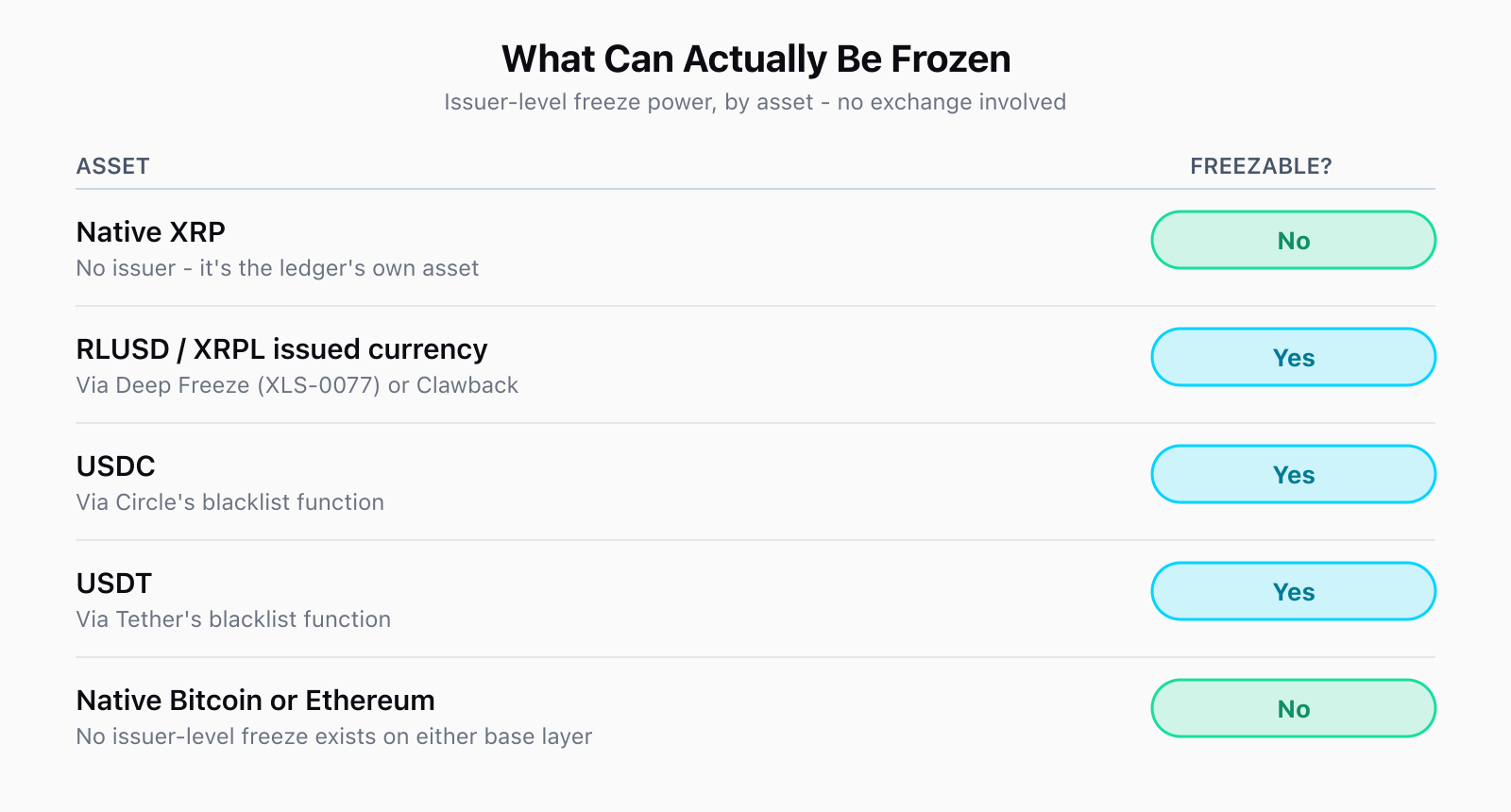
Freeze power sits with the issuer, not the chain - native XRP, Bitcoin, and Ethereum have none, while RLUSD, USDC, and USDT all answer to one.
Does This Make RLUSD Less Decentralized?
RLUSD can be frozen, and under a separate Clawback amendment, reclaimed outright. Ripple has said it will use that power if a court orders it to. That's not unusual among dollar stablecoins. Circle and Tether freeze USDC and USDT addresses under the same kind of legal pressure, routinely, and have for years.
A U.Today headline called the 2025 wave of XRPL amendments evidence the community was "outraged." Read past the headline and the actual complaint is fatigue over an unpredictable rollout schedule, not the freeze power itself. The sharper, older complaint predates Deep Freeze. After a February 2025 network halt, critics pointed out that Ripple can restart all 35 of its validator nodes at once. A freeze an issuer can apply and clear through an API is a smaller version of the same concern - centralized control sitting on top of a ledger marketed as decentralized.
FAQ
Can my XRP be frozen?
No. Freeze and Deep Freeze apply only to issued currencies on a trust line. Native XRP can't be frozen by anyone, including Ripple.
What is XRP Ledger Deep Freeze?
It's XLS-0077, an amendment enabled on May 4, 2025, that lets a token issuer block a flagged account from sending or receiving that issuer's token at all.
Can RLUSD be frozen or clawed back?
Yes. Ripple, as the issuer, can freeze an RLUSD-holding account under Deep Freeze or reclaim the tokens outright under the separate Clawback amendment, typically in response to a court order.
Does the XRP Ledger have its own sanctions blacklist?
No. The ledger has no built-in sanctions list - freezing is a per-issuer decision. OFAC's SDN list is separate, and it currently names one XRP Ledger address.
Disclaimer: This article is for educational and informational purposes only and is not legal, financial, tax, or compliance advice. Crypto carries risk; you act on this information at your own risk. Always do your own research and consult a qualified professional before making decisions. Views are the author's own and do not constitute financial, legal, or investment advice.
About Plastron
Plastron is a free, non-custodial wallet screening tool. It checks Ethereum and six EVM chains for AML and KYT risk — sanctions exposure, mixer contact, and stolen-funds proximity — and returns a risk report in seconds. It reads public on-chain data only: it never takes custody of funds and never asks for private keys.