TL;DR - A PEP (politically exposed person) is someone in a prominent public role, and crypto platforms give them extra scrutiny for corruption risk - separate from whether their wallet address itself is flagged for on-chain exposure.
On October 14, 2026, the Treasury's Office of Foreign Assets Control pulled five entries off its Specially Designated Nationals list in a single Venezuela-related designation removal - all name variants for one person. OFAC's Venezuela sanctions programs, built on a stack of executive orders starting with EO 13692 in 2015, exist almost entirely to designate current and former government officials and the people around them. In compliance shorthand, that's a PEP program at work.
What Does "Politically Exposed Person" Actually Mean?
A politically exposed person, PEP for short, is someone who holds, or has held, a prominent public role: a head of state, a senior politician, a judge, a general, or an executive at a state-owned company. The Financial Action Task Force wrote the definition into its guidance on Recommendations 12 and 22, and most exchange compliance policies copy it almost word for word.
The label reaches past the official. FATF's guidance covers immediate family and close associates too, so a PEP's spouse, adult child, or long-time business partner can inherit the same scrutiny, even without ever holding a public job themselves. The category splits three ways: domestic PEPs, foreign PEPs, and people tied to international organizations such as the UN or the IMF.
Why Do Crypto Platforms Screen for PEPs?
Crypto platforms screen for PEPs because of what the role exposes someone to, not because of anything they have done. Access to public budgets, procurement contracts, and state assets creates a bribery and corruption risk that a retail customer buying ETH on a Tuesday doesn't carry. Robinhood's own support page says PEPs, their family members, and close associates must disclose that status when they open a Robinhood Crypto account. Crypto.com runs the same self-declaration, then layers automated database checks behind it.
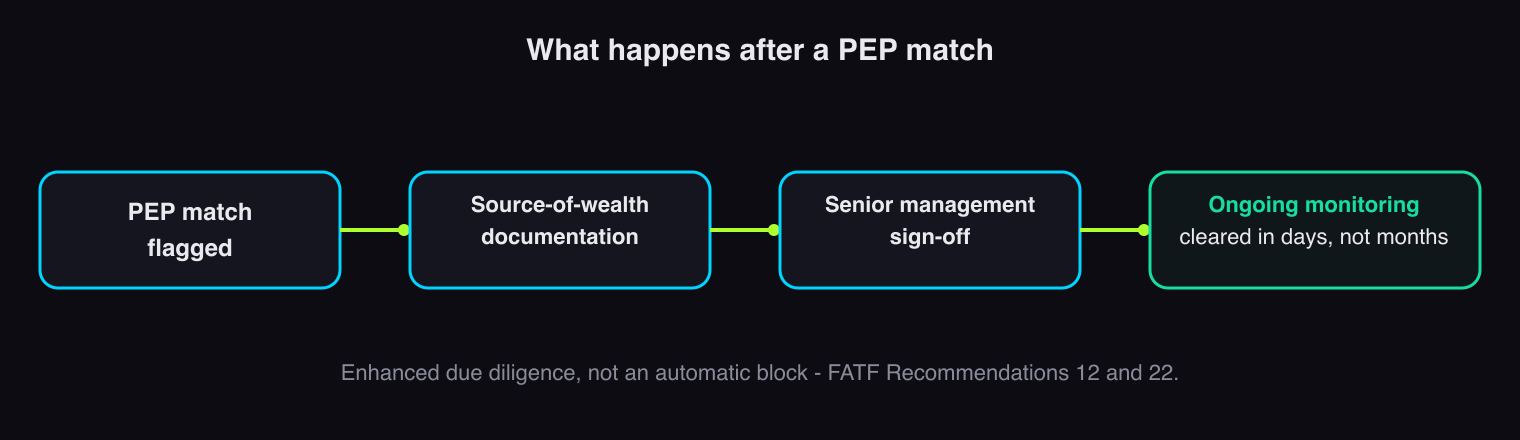
A PEP match is not an accusation. It's a trigger for enhanced due diligence: a deeper look at source of wealth, tighter transaction limits until that review clears, and sign-off from someone more senior than a front-line analyst. The checks continue after onboarding too, since a customer can rise into a prominent role - or fall under investigation - years into the relationship.
A PEP Label and a Flagged Wallet Are Not the Same Thing
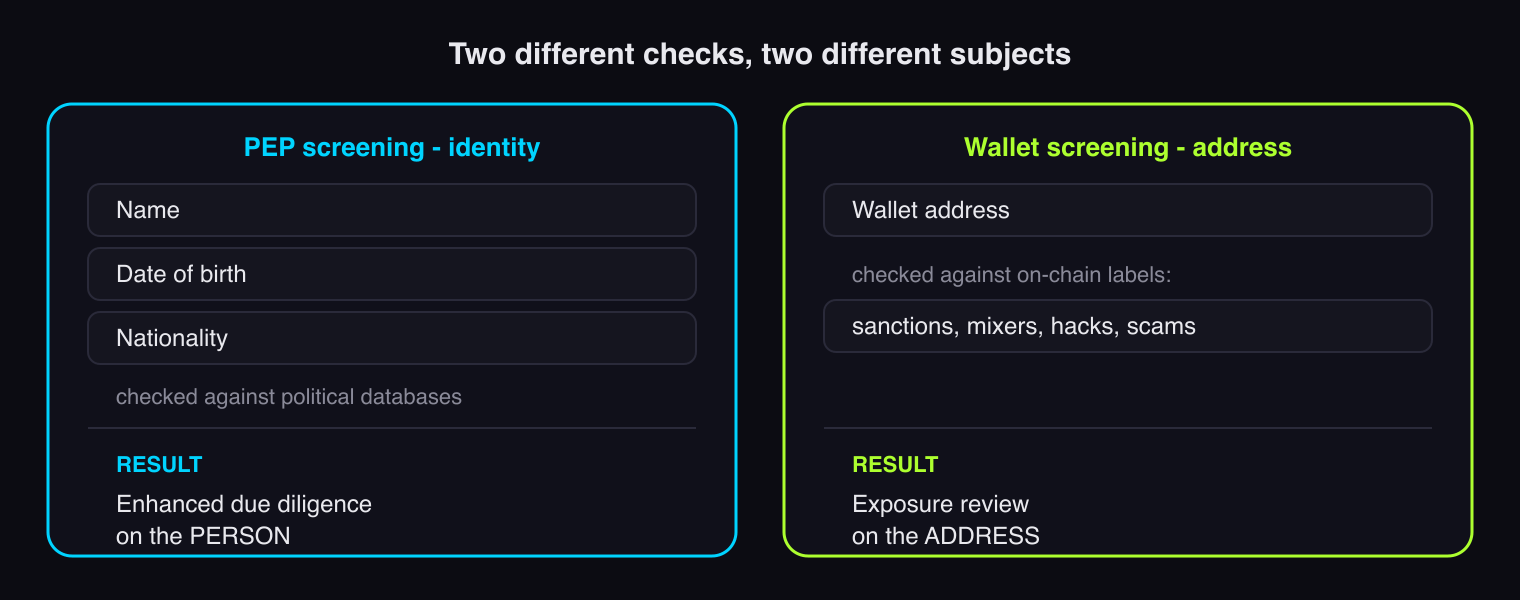
This is where most explanations blur two separate checks into one. PEP screening is identity screening: it runs a name, a date of birth, a nationality against political databases. Wallet screening is address screening: it runs the blockchain address itself against a dataset of labeled risk, things like sanctions, mixers, hacks, and scam clusters. A person can be a PEP with a completely clean wallet. A wallet can carry heavy sanctions exposure for an owner who has never held public office in their life.
Different question, different answer. A PEP database tells you who someone is. It tells you nothing about whether a specific address received funds from a mixer three hops back, or sits one hop from an OFAC-listed cluster. Wallet screening runs the other direction, starting from the address and tracing its on-chain history no matter who holds the keys.
A PEP check verifies who someone is; wallet screening verifies what an address has touched. They answer different questions.
Plastron runs that second check for free. Screen any wallet address with Plastron for sanctions, mixer, and stolen-funds exposure across Ethereum and six more EVM chains - no name, date of birth, or identity document required. The underlying corpus carries 3,907 labeled addresses plus the full 780-entry OFAC SDN crypto list, refreshed as new designations land.
What Happens After You're Flagged?
Getting matched against a PEP list doesn't freeze an account by itself. FATF's guidance calls for enhanced due diligence, not an automatic block, and most exchanges run the same playbook: senior management approves the relationship, the customer documents source of wealth and source of funds, transaction limits tighten until that documentation clears, and ongoing monitoring replaces the one-time check every other customer gets. A cooperative PEP who answers the request promptly can clear review in days, not months.
The wallet-side version of that review looks different in practice. What triggers enhanced due diligence on an address is its own exposure history, not the owner's resume, so the same source-of-funds request ends up aimed at the coins instead of a job title.
Enhanced due diligence is a sequence, not a verdict - a flagged PEP moves through documentation and sign-off instead of getting an automatic block.
PEP Status Isn't Permanent
Labels move in both directions. The same October 14 notice that removed five SDN entries for one Venezuelan national landed eight months after FATF's February 13, 2026 plenary added Kuwait and Papua New Guinea to its grey list for AML gaps - a reminder that political and jurisdictional risk gets reassessed on a schedule, not set once and left alone.
Wallet labels work the same way, and it's the detail most PEP explainers skip. A screening corpus gets rebuilt, not just appended to, as sanctions lists update and new scam clusters get identified. An address clean today can pick up exposure next month if it touches something newly listed. A direct sanctions hit outranks a PEP match every time, too: identity risk fades with documentation, while on-chain exposure to a sanctioned cluster generally doesn't. Review the person on one clock. Review the address on another.
FAQ
Is being a PEP illegal?
No. PEP status is a risk factor, not a finding of wrongdoing. It reflects access and influence that could be abused, which is why platforms apply closer scrutiny instead of an outright block.
Does wallet screening tell you if someone is a PEP?
No. Tools like Plastron screen the address itself for sanctions, mixer, and stolen-funds exposure - they don't identify or screen people. PEP status is a separate, identity-based check that exchanges run during onboarding.
Can a PEP use a crypto exchange normally?
Yes, once enhanced due diligence clears. Most PEPs pass onboarding with documentation of their source of wealth; the review takes longer than a standard account, but it isn't a ban.
Do a PEP's family members get flagged too?
Often, yes. FATF's guidance extends the category to immediate family and close associates, since funds and influence can move through those relationships as easily as through the PEP directly.
Disclaimer: This article is for educational and informational purposes only and is not legal, financial, tax, or compliance advice. Crypto carries risk; you act on this information at your own risk. Always do your own research and consult a qualified professional before making decisions. Views are the author's own and do not constitute financial, legal, or investment advice.
About Plastron
Plastron is a free, non-custodial wallet screening tool. It checks Ethereum and six EVM chains for AML and KYT risk — sanctions exposure, mixer contact, and stolen-funds proximity — and returns a risk report in seconds. It reads public on-chain data only: it never takes custody of funds and never asks for private keys.