What Should I Do If My Wallet Address Was Reported on Chainabuse?

By Alexandr Kerya · · 6 min read

TL;DR - If your wallet shows up on Chainabuse, someone filed a public scam report about it that exchanges and screening tools can see, but you can flag a false report for review and have it removed.

Finding your own address listed as a scammer on a public abuse database is unsettling, and it happens to honest users more often than you would think. A report can land on the wrong wallet through mistaken identity, a poisoned lookalike address, or a refund you sent that a stranger later disputed. The report itself is just a claim, not a conviction, but it sits in a public record that compliance teams read. Knowing what the listing actually does, and how to challenge it, is the difference between a quick fix and a lingering risk flag.

What does it mean if my wallet is on Chainabuse?

Chainabuse is a free, public crypto-scam reporting platform run by TRM Labs together with a network of security partners. Anyone can submit a report naming an address, a transaction hash, or a website, and the report becomes part of a searchable public database. Victims use it to warn others; investigators and exchanges use it as an open-source signal when they assess a wallet.

A listing does not mean a court, a regulator, or a blockchain analytics firm has confirmed wrongdoing. Reports carry a confidence score and one of three badges: Trusted Contributor for vetted security partners, Checked Report for entries a moderator verified with supporting evidence, and Unverified Report for everything else that has not been flagged as spam. Most user submissions start unverified. That distinction matters, because an unverified single report carries far less weight than a checked one from a trusted source.

How did my address end up reported when I did nothing wrong?

False or mistaken reports are common, and they usually trace to a handful of patterns. Address poisoning is one: a scammer sends you a tiny transaction from a wallet whose first and last characters mimic yours, hoping you copy the wrong address later. A victim reviewing their history can mistake your real address for the attacker's lookalike and report it.

Refunds and reversals cause others. If you returned funds to someone who turned out to be running a scam, or you bought goods that never arrived and the seller reported you out of spite, your address can be named. Shared infrastructure adds more: pooled exchange wallets, payment processors, and OTC desks all touch thousands of users, so a report aimed at one customer can implicate an address that simply passed funds through. And plain malice exists too, where someone files a retaliatory report with no basis.
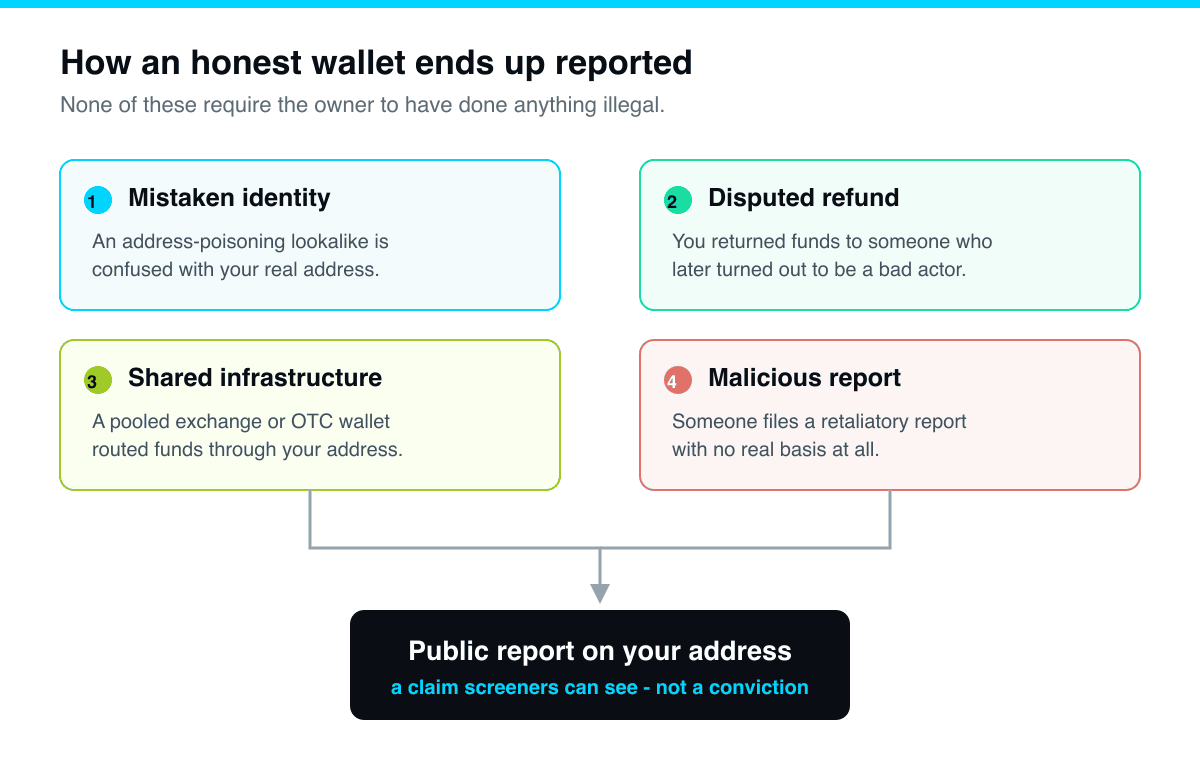
A taxonomy diagram showing four common pathways by which an innocent wallet ends up on a public scam-report database. The four branches are: mistaken identity from an address-poisoning lookalike; a disputed refund or reversal sent to a bad actor; shared infrastructure such as a pooled exchange or OTC wallet that routed funds; and a malicious or retaliatory false report. Each branch points to the same outcome box, a public report on the address.
Most wrongful listings trace to one of four patterns - none of which require the wallet owner to have done anything illegal.

Does a Chainabuse report mean exchanges will freeze my wallet?

Not on its own. A public report is one input among many, and it is not the same as an OFAC sanctions listing, which is a legal designation that compels every regulated business to block the address. A scam report has no such force. What it can do is raise your risk score inside the screening tools that exchanges run on deposits and withdrawals, which may trigger a manual review, a source-of-funds request, or a temporary hold rather than an automatic ban.

The weight a report carries depends on its badge and confidence score, how many independent reports name the same address, and whether your wallet has other exposure, such as funds traced back to a mixer or a hack. A lone unverified report against an otherwise clean address rarely sticks. Several checked reports, or a report combined with real high-risk exposure, is what turns a flag into a frozen account. If you are already dealing with that, our guide on how to dispute a high-risk false positive covers the exchange side.

How do I get a false Chainabuse report removed?

Chainabuse lets users flag a report as inaccurate or spam. Flagged entries are reviewed by TRM's Global Investigations team, which includes former agents from the FBI, U.S. Secret Service, and IRS Criminal Investigation. Spam is removed and repeat abusers are banned, so a genuinely false report has a real path to deletion.

To give your flag the best chance, document your case before you submit it. Gather the transaction hashes that show the legitimate context, note the exact address being confused with yours if poisoning is involved, and write a short, factual explanation of why the report is wrong. Keep it specific and unemotional. If the report stems from a payment dispute, include proof of the goods, the refund, or the agreement. The review team is weighing evidence, so the clearer your record, the faster the resolution.
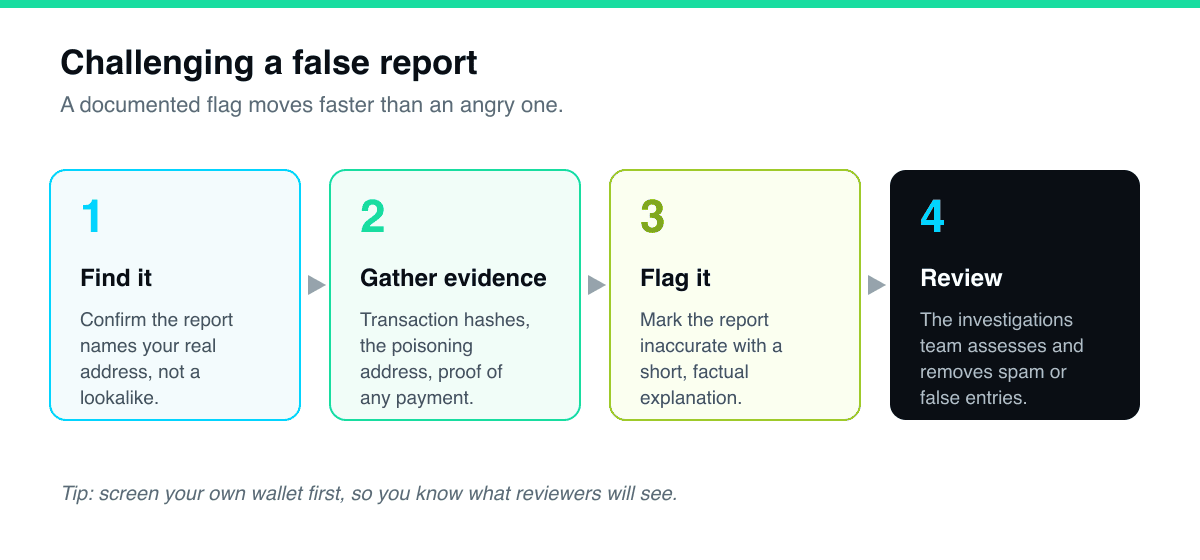
A four-step horizontal flow for challenging a false scam report. Step one, find the report and confirm it names your real address rather than a lookalike. Step two, gather evidence: transaction hashes, the poisoning address if relevant, and proof of any disputed payment. Step three, flag the report through the platform as inaccurate or spam with a short factual explanation. Step four, the investigations team reviews the flag and removes spam or false entries. A footnote notes that screening your own wallet first shows what reviewers will see.
A documented flag - hashes, context, and a clear explanation - moves faster than an angry one.

How do I check what others see about my wallet?

Before you flag anything, find out what a compliance team actually sees when they look at your address, because the report may not be your only issue. You can read your transaction history by hand on a public explorer such as Etherscan, tracing each counterparty backward, but that view stops at the first hop and never tells you whether a sender was tied to a sanctioned entity, a mixer, or stolen funds. Rather than piecing it together manually, screen your wallet with Plastron to see your sanctions, mixer, and stolen-funds exposure across Ethereum and six other chains in one pass, with no wallet connection required.

Doing that first tells you whether the Chainabuse listing is an isolated false report or a symptom of real exposure you need to address. If the wallet is clean apart from the bad report, you can flag it with confidence. If the screen surfaces something more, you will want to understand it before an exchange does - our explainer on how to check an address before you send is a useful companion.

FAQ

Can anyone report my wallet on Chainabuse without proof?

Yes. Chainabuse is open to public submissions, so a report can be filed without verified evidence. Those entries start as unverified and carry a low confidence score until a moderator or trusted partner reviews them. You can flag a report you believe is false for the investigations team to assess.

Is a Chainabuse report the same as being sanctioned?

No. A scam report is a community claim with no legal force. An OFAC sanctions listing is a government designation that legally requires regulated businesses to block the address. A Chainabuse entry may raise your risk score during screening, but it does not compel anyone to freeze your funds.

How long does it take to get a false report removed?

There is no published service window, and timing depends on the queue and the strength of your evidence. A well-documented flag with transaction hashes and a clear explanation gives the review team what it needs to act, so a thorough submission tends to resolve faster than a vague one.

Will the report disappear from exchanges once Chainabuse removes it?

Removal stops the report from appearing in future lookups, but some firms cache or copy data, so a flag may persist in a third party's records for a while. Screening your own wallet afterward confirms whether the listing still shows up where it counts.

Disclaimer: This article is for educational and informational purposes only and is not legal, financial, tax, or compliance advice. Crypto carries risk; you act on this information at your own risk. Always do your own research and consult a qualified professional before making decisions. Views are the author's own and do not constitute financial, legal, or investment advice.

About Plastron

Plastron is a free, non-custodial wallet screening tool. It checks Ethereum and six EVM chains for AML and KYT risk — sanctions exposure, mixer contact, and stolen-funds proximity — and returns a risk report in seconds. It reads public on-chain data only: it never takes custody of funds and never asks for private keys.

How Plastron works and who runs it →

Keep reading

Wallet Flagged as High-Risk? How to Dispute a False PositiveHow to Check if a Crypto Address Is a Scam Before You SendIs My Crypto Tainted? What Dirty Coins Really MeanPrivacy Pools vs Tornado Cash: Which Flags Your Exchange Deposit?