A public wallet address can't let anyone touch your funds, but it permanently exposes every transaction, balance, and counterparty you've ever had.
Posting an address on a donation page, an invoice, or a Discord bio feels like handing out a locker number with no key attached. It isn't. Anyone who pastes that string into a block explorer gets a complete, permanent ledger of what the wallet owns, who it's paid, and who it's paid it - the same data a compliance system at an exchange pulls before it clears your next deposit.
Can Someone Steal Your Crypto Just From Your Address?
No. Moving funds out of a wallet needs the private key, and an address never contains it - the two are mathematically linked but not reversible, so publishing one tells nobody the other. This is the part most warnings stop at, and it's true as far as it goes.
It's also the wrong question. The address itself is the leak. You don't need a stolen key to learn almost everything else about a wallet - only the address, which by definition you already have the moment someone pays you or you pay them.
What Does a Public Address Actually Reveal?
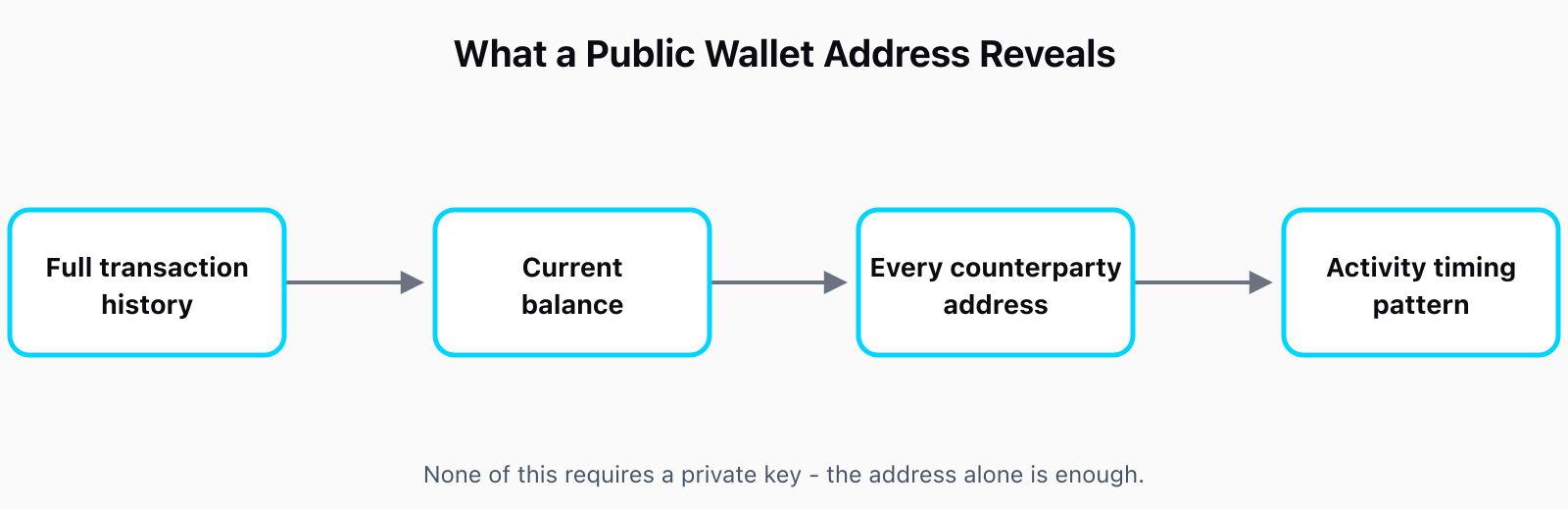
Every transaction an address has ever sent or received sits on a public ledger forever, with a timestamp and an amount attached. Paste the address into a block explorer and you get the current balance, every counterparty address it has touched, and roughly how active the wallet has been since it first appeared on-chain. None of that requires special tools. A compliance analyst, a scammer, and a curious stranger all read the identical record.
A KU Leuven study published July 9, 2026 found the leak runs deeper than the explorer page. Researchers tested 36 Ethereum-compatible wallet extensions and found that 23 of them let a hidden page or embedded frame request wallet data without a visible prompt - meaning an ordinary website you're just browsing can quietly pull your address. In 22 of the 36, a permission a site had already been granted stayed active even after the Web3 app asked for it to be revoked. Seventeen of the wallets tested also leaked signals that link several of a single user's addresses together, and those 17 alone serve roughly 23 million users combined. Lead researcher Weihong Wang put it plainly: managing your own keys gives you control, but not automatically privacy.
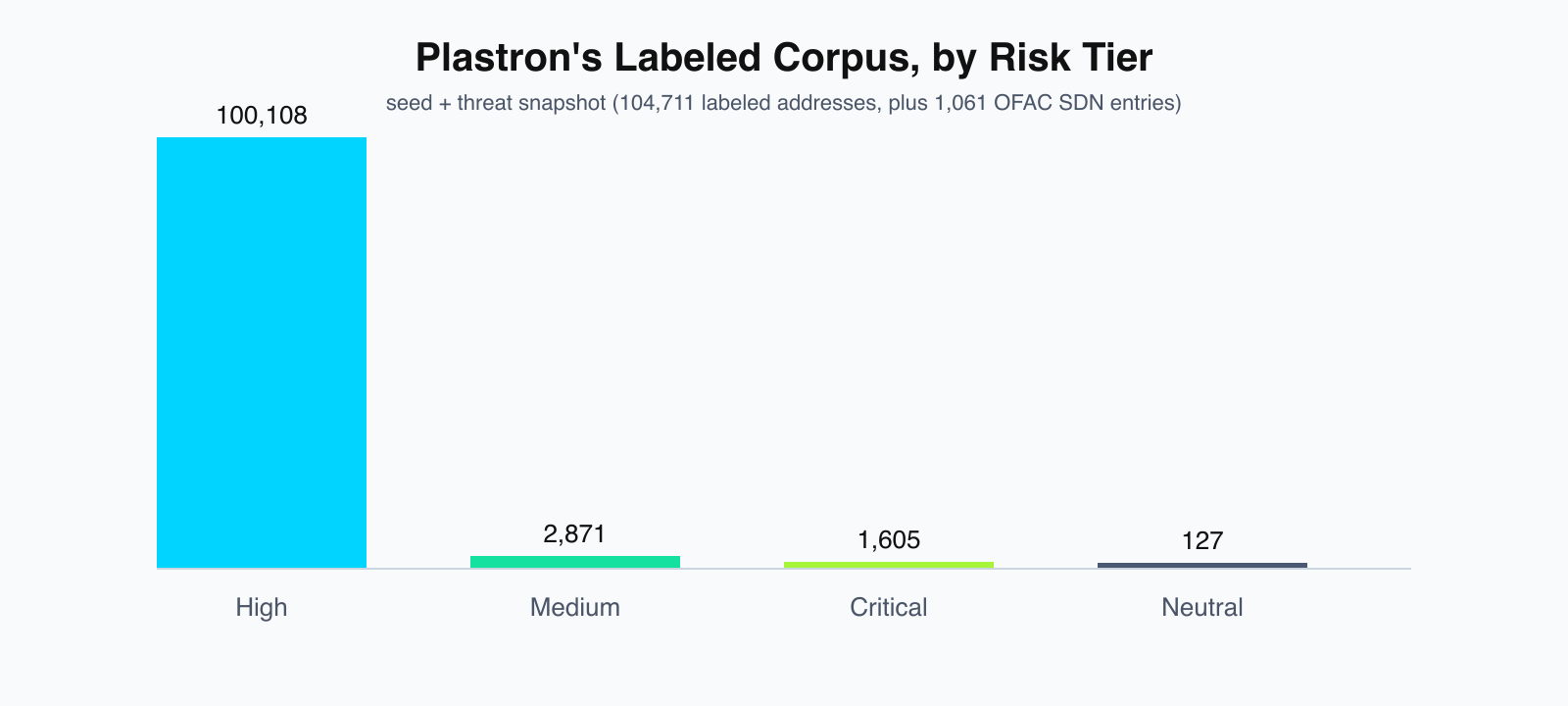
Etherscan and similar explorers will show you this same picture for free, one address at a time, with no risk scoring attached. Screen the address with Plastron instead and you get the sanctions, mixer, and stolen-funds exposure layered on top - run against more than 100,000 labeled addresses, plus 1,061 pulled straight from OFAC's own sanctions list.
Why Does a Permanent Public Trail Matter?
Because nothing about it expires. A wallet that received a routine payment in 2022 can surface in a completely different context years later, and the record doesn't care that the context changed. Counterparty links compound the same way: an address that transacted with a mixer, a drained protocol, or a sanctioned entity carries that link forward indefinitely, through every wallet it later interacts with. A clean-looking balance today says nothing about the three, five, or ten hops behind it.
That permanence cuts both ways. It's what lets investigators trace stolen funds years after a hack. It's also what lets a stranger reconstruct your spending habits from an address you posted once, on a forum, to settle a $40 bet.
How Do Exchanges and Scammers Use the Same Trail Differently?
An exchange runs your deposit address through wallet screening before it credits your account, checking exposure to sanctioned entities and stolen-fund clusters through clustering heuristics that link your address to others you've used. A scammer reads the same public history for the opposite purpose: watching an address's recent activity to craft a convincing lookalike address that shows up in your history and hopes you copy the wrong one next time.
Both of them are reading a ledger you can't take back.
How Do You Limit What Your Address Gives Away?
Use a separate address for anything posted publicly - a donation page, an invoice, a tip jar - and keep it apart from the wallet holding your main balance. Most wallets can generate a fresh receiving address in seconds, and treating each public use as its own address stops a single leaked string from mapping your entire holdings.
Before you post an address anywhere, check what it already shows. Run it through a screening tool yourself and read the same report an exchange or a counterparty would see - the risk tier, the exposure, the pattern an outsider could build from it without ever touching your keys.
None of these four require a private key. The address alone is enough to read all of it.The same public data a stranger can read is what Plastron checks against more than 100,000 labeled addresses and OFAC's full SDN list before showing you a risk tier.
FAQ
Does sharing my wallet address let someone drain it?
No. Draining a wallet requires the private key, which an address never reveals. Sharing an address only exposes its history and balance, not control over its funds.
Can I create a new address to hide my transaction history?
A new address starts with no history of its own, but it doesn't erase the old one, and the moment it transacts with a previously used address, the two can often be linked right back together through clustering analysis.
Does a hardware wallet keep my address activity private?
No. A hardware wallet protects the private key from theft; it has no effect on what the address itself shows once it appears on a public blockchain.
Do mixers or privacy coins fix this exposure?
They change what a given address shows, not whether exposure matters - and using one can itself become the exposure, since mixer and privacy-coin activity is exactly what wallet screening flags as a risk signal.
Is my exchange account linked to the address I post publicly?
If you've ever sent or received funds between that address and an exchange deposit address, the exchange's own screening can connect the two through the same clustering techniques covered above.
Disclaimer: This article is for educational and informational purposes only and is not legal, financial, tax, or compliance advice. Crypto carries risk; you act on this information at your own risk. Always do your own research and consult a qualified professional before making decisions. Views are the author's own and do not constitute financial, legal, or investment advice.
About Plastron
Plastron is a free, non-custodial wallet screening tool. It checks Ethereum and six EVM chains for AML and KYT risk — sanctions exposure, mixer contact, and stolen-funds proximity — and returns a risk report in seconds. It reads public on-chain data only: it never takes custody of funds and never asks for private keys.