TL;DR: OTC desks run a two-step wallet check, screening the address for ties to illicit funds and confirming you actually control it, before they'll release a large crypto trade.
Your OTC desk has quoted a price, the wire cleared, and now they want a wallet whitelist form before releasing a single coin. That request isn't arbitrary paperwork. The same anti-money-laundering law that covers a $50 exchange trade covers this one too, just enforced by a smaller compliance team with a much bigger check to write if it lets something slip through.
What is a crypto OTC desk?
An OTC (over-the-counter) desk matches large buyers and sellers away from the public order book, so a trade of a few million dollars doesn't move the market the way it would on an exchange. Minimum ticket sizes typically run $75,000 to $250,000, and the desks collectively move more than $100 million a day across bitcoin, ether, and stablecoins. None of it settles until compliance clears the wallet on both sides of the trade, which puts the desk in the same regulatory bracket as a VASP handling retail deposits. A desk that can't show it screened both wallets has no defense left when a regulator asks why a trade cleared.
The two checks every wallet has to pass
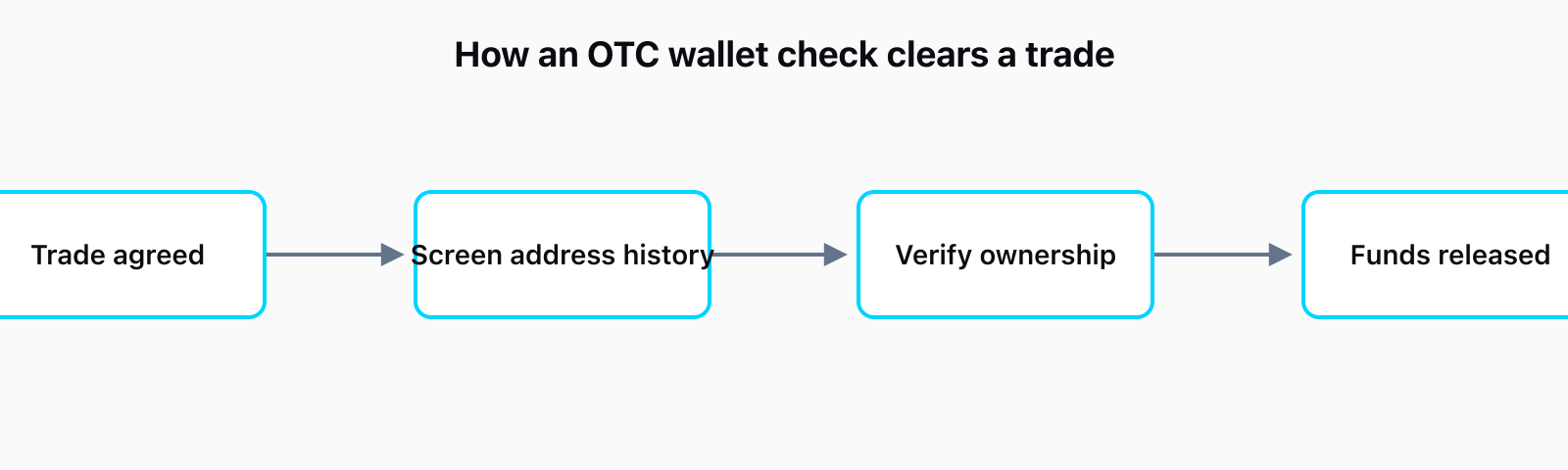
Every wallet gets vetted twice before a trade clears. First, the desk screens the address itself: does it show a direct hit on a sanctions list, or sit a few hops from a mixer, a hack, or a darknet market? Second, they verify you actually control it, usually through a signed message or a small confirmation transfer, so a screened-clean address that belongs to someone else doesn't slip through.
A trade doesn't settle until both checks pass: the address history and proof that you control the wallet.
Screening without ownership proof is worthless. Anyone can point at a clean address they don't own, so desks that skip the second check are trusting a stranger's word on a six or seven-figure transfer. Ownership verification also closes the door on a common trick: routing a trade through a freshly funded wallet that has no history to screen at all, precisely because a blank address can't fail a screen it never triggers.
Why does a $504 million DOJ case matter here?
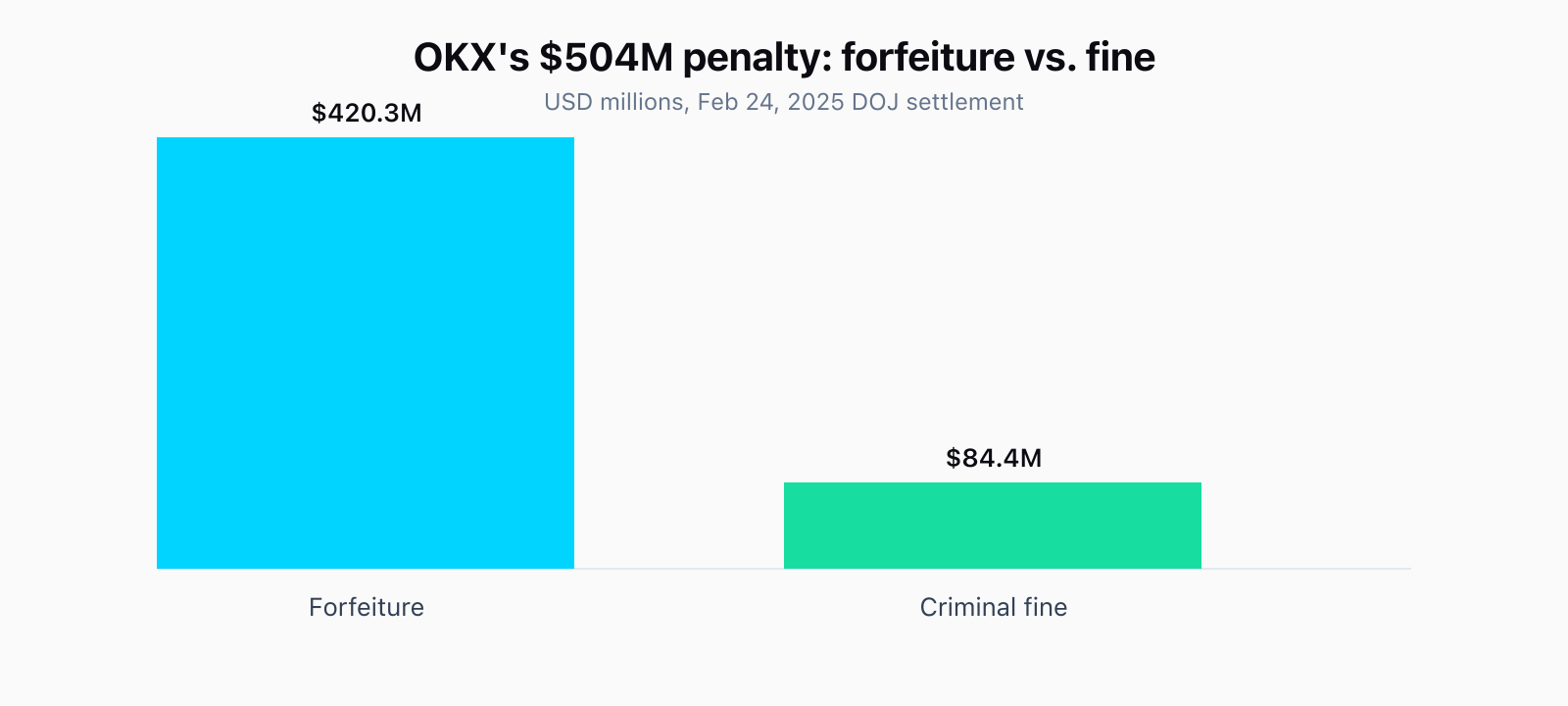
On February 24, 2025, OKX pleaded guilty to violating US anti-money-laundering law and agreed to pay $504 million, split between a $420.3 million forfeiture and an $84.4 million criminal fine. The Justice Department said staff had told US customers to enter a random country and a fake ID number to get past onboarding checks, and the exchange went on to process more than $5 billion in transactions a working compliance program would have flagged. OKX also accepted a three-year compliance monitor as part of the deal, running through 2027.
An OTC desk that skips wallet checks is betting its license on the same math. A single unscreened counterparty can turn one trade into the transaction that ends the desk's banking relationships.
What most of that screening risk actually is
It's easy to picture OTC compliance as pure sanctions-list matching. Most of it isn't. Of the 3,901 wallets in Plastron's own labeled dataset, 3,354 are tagged scam or fraud, and only a slice trace back to the 780 addresses on the OFAC SDN list. A wallet funded by a romance-scam payout looks nothing like a sanctioned one on paper, and a desk that only checks OFAC will miss it every time.
The gap matters because sanctions screening is a solved problem: match an address against one published list and move on. Fraud and stolen-fund exposure isn't solved the same way, since it depends on tracing hops through DeFi swaps, bridges, and mixers rather than a single lookup.
Most of the OKX penalty was forfeiture of funds tied to accounts that never should have cleared a wallet check.
How do you get your wallet cleared before an OTC trade?
Start before you ever contact a desk. Trace where the funds in your wallet actually came from, not just the last hop, since a clean-looking last transfer can still sit two or three hops from a hack or a mixer. A compliance analyst can do this by hand on Etherscan, clicking through every counterparty one transaction at a time, which is exactly why manual review takes desks days instead of minutes.
Screen the same address instantly, with every hop's risk category shown at once, by checking a wallet with Plastron before you ever send it to a desk. If a hop traces to a flagged counterparty, fix it before the desk finds it. Not after. Have a written explanation of where each large deposit came from ready, since a desk that has to ask twice slows the trade down far more than the screen itself.
FAQ
Do OTC desks report trades to regulators?
Yes. A VASP running an OTC desk carries the same suspicious-activity-reporting duty as an exchange, and a wallet that fails screening usually triggers a report even if the trade itself never executes.
Can a clean wallet still fail OTC screening?
Yes, if you can't prove you control it. Screening checks the address's history; ownership verification checks that the history belongs to you, and desks require both before releasing funds.
How long does OTC wallet screening take?
A few minutes for an automated check against a labeled address list and the OFAC SDN list. Hours to days if a compliance analyst has to manually trace hops through a block explorer instead, since each counterparty has to be checked on its own before the desk can sign off.
Is OTC trading only for institutions?
No. Minimum ticket sizes of $75,000 to $250,000 put it out of reach for most retail trades, but any buyer or seller who can meet that floor can use a desk, not just funds or exchanges. The wallet-screening requirement applies the same way regardless of who is on the other side of the trade.
Disclaimer: This article is for educational and informational purposes only and is not legal, financial, tax, or compliance advice. Crypto carries risk; you act on this information at your own risk. Always do your own research and consult a qualified professional before making decisions. Views are the author's own and do not constitute financial, legal, or investment advice.
About Plastron
Plastron is a free, non-custodial wallet screening tool. It checks Ethereum and six EVM chains for AML and KYT risk — sanctions exposure, mixer contact, and stolen-funds proximity — and returns a risk report in seconds. It reads public on-chain data only: it never takes custody of funds and never asks for private keys.