TL;DR - Six federal agencies missed the GENIUS Act's July 18 rulemaking deadline without finalizing a single stablecoin rule, so nothing changes for your USDC or USDT today - the real deadline is January 18, 2027.
You hold USDC or USDT, you saw yesterday's headline about a stablecoin deadline, and now you're wondering if your balance is about to get locked. It isn't. And the reason is almost funnier than the panic: the six agencies writing the rules missed their own deadline.
The GENIUS Act's Deadline Passed. The Rules Didn't.
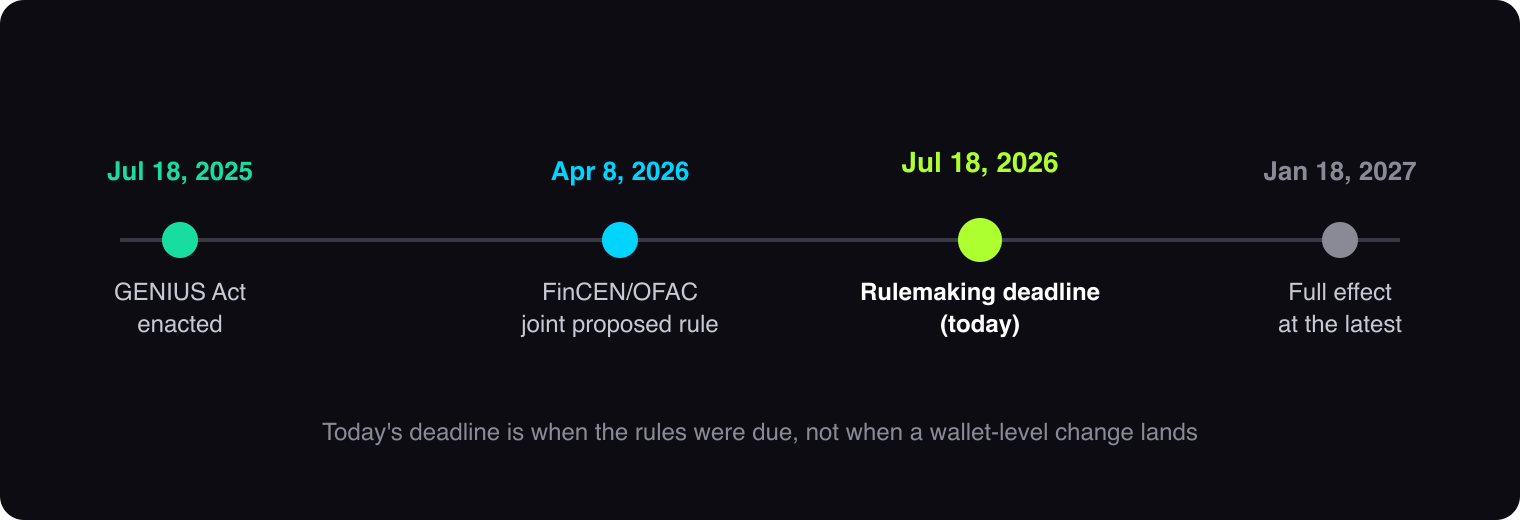
Congress enacted the Guiding and Establishing National Innovation for U.S. Stablecoins Act on July 18, 2025. It gave the OCC, FDIC, NCUA, Treasury, FinCEN, and the Federal Reserve exactly one year to finalize the rules implementing it. That clock ran out yesterday, July 18, 2026. Not one of the roughly seven proposed rules - OCC's core implementing rule, FDIC's prudential standards, NCUA's two separate proposals, Treasury's state-regulation principles, and the joint FinCEN/OFAC customer identification and sanctions program rule - was finalized in time.
The miss wasn't close. NCUA's second proposal had a public comment period that closed on Friday, July 17, one day before the statutory deadline, which made finishing that rule through normal notice-and-comment process mathematically impossible. Add in substantive pushback from industry commenters (BlackRock among them) that agencies still have to answer, and the picture is less "regulators dropped the ball" and more "the schedule was never realistic."
Four dates that matter. Yesterday was the rulemaking deadline the agencies missed, not the date issuer obligations take effect.
What Actually Changes for a Stablecoin Holder Today?
Nothing in your wallet interface changed on July 18. The tokens you already hold move exactly like they did the day before. A missed deadline doesn't create a new legal obligation; it just means the obligation that was supposed to exist by now, doesn't yet. The GENIUS Act's actual operative effect still lands on the earlier of January 18, 2027, or 120 days after final rules publish - whichever comes first.
You can check whether a specific counterparty address already carries a blacklist flag by pulling up Etherscan and reading the token contract's blacklist mapping one address at a time. Screen a wallet with Plastron instead and you get sanctions, mixer, and stolen-funds exposure across Ethereum and six other EVM chains in a single pass, checked against a corpus of 3,901 labeled addresses, before you decide whether to accept a transfer.
Why Issuers Are Headed Toward Financial-Institution Status Anyway
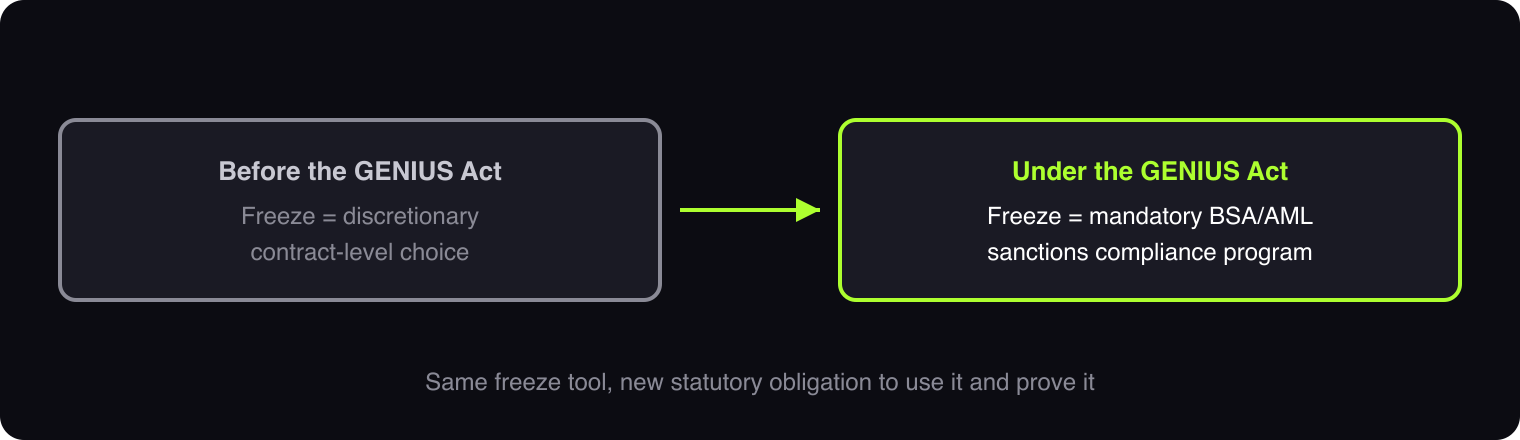
Before the GENIUS Act, Circle and Tether froze addresses because their token contracts let them, not because a federal statute told them to. A discretionary freeze policy can change with a press release. A statutory Bank Secrecy Act obligation can't - it comes with examiners, reporting duties, and penalties for skipping it. That's still where this is headed, missed deadline or not.
The proposed FinCEN/OFAC rule, filed April 8, 2026 with its comment period closed June 9, 2026, would classify Permitted Payment Stablecoin Issuers as financial institutions required to run an active OFAC sanctions program. The SDN list alone runs to 780 individually tracked addresses - exactly the kind of counterparty an issuer's compliance program is built to catch downstream, once the rule actually exists.
The freeze mechanism itself hasn't changed. Its legal status is still shifting from discretionary to mandatory - just later than Congress planned.
Does a Missed Deadline Mean My USDC or USDT Freezes Tomorrow?
No. The freeze mechanism isn't new, and neither is the timeline slipping. Tether's addBlackList function and Circle's blacklist function have existed for years, and issuers have used them on lawful requests long before this rulemaking clock started - see our breakdown of how the on-chain blacklist actually works. What the GENIUS Act still adds, once its rules land, is a legal floor under that behavior.
A verdict worth stating plainly: your risk didn't change today because a deadline came and went. It changes on whatever date the rule actually publishes, and that date just moved.
How Is This Different From the Freezes Circle and Tether Already Run?
Under the current, still-discretionary regime, an issuer chooses how aggressively to screen. Once the rule finalizes, examiners will ask for evidence of a working sanctions program, and a thin one becomes a supervisory finding instead of just a reputational risk. That pushes issuers toward broader screening and less tolerance for addresses sitting a few hops from a sanctioned wallet.
Self-custody doesn't opt you out of any of this. A token sitting in a hardware wallet you control can still get blacklisted at the issuer's contract level, because the freeze lives in the token's code, not in your custody setup - the same principle covered in our guide to government seizure and recovery options for frozen crypto.
FAQ
Did the GENIUS Act freeze any wallets on July 18, 2026?
No. July 18, 2026 was the statutory deadline for six federal agencies to finalize implementing rules, and they missed it - not one of roughly seven proposed rules was finalized in time. No individual wallet or transaction changed because of the missed date.
Why did regulators miss the GENIUS Act deadline?
Partly timing: NCUA's second proposal had a comment period that closed just one day before the statutory deadline, leaving no realistic path to finalize it in time. Agencies also still have to work through substantive industry comments before publishing final versions.
When does the GENIUS Act's full effect actually start?
The earlier of January 18, 2027, or 120 days after final rules are published. The missed July 18, 2026 deadline doesn't move that date earlier or later - it just means the rules that were supposed to exist by now don't yet.
Does holding stablecoins in a self-custody wallet protect me from a freeze?
No. The freeze is enforced at the token contract level by the issuer, so a blacklisted balance is stuck no matter whose private key controls the wallet holding it.
How do I check if a stablecoin counterparty is already flagged?
You can read the issuer's on-chain blacklist mapping directly through a block explorer, or run the address through a wallet screening tool that checks sanctions, mixer, and stolen-funds exposure across chains in one query instead of one contract at a time.
Disclaimer: This article is for educational and informational purposes only and is not legal, financial, tax, or compliance advice. Crypto carries risk; you act on this information at your own risk. Always do your own research and consult a qualified professional before making decisions. Views are the author's own and do not constitute financial, legal, or investment advice.
About Plastron
Plastron is a free, non-custodial wallet screening tool. It checks Ethereum and six EVM chains for AML and KYT risk — sanctions exposure, mixer contact, and stolen-funds proximity — and returns a risk report in seconds. It reads public on-chain data only: it never takes custody of funds and never asks for private keys.