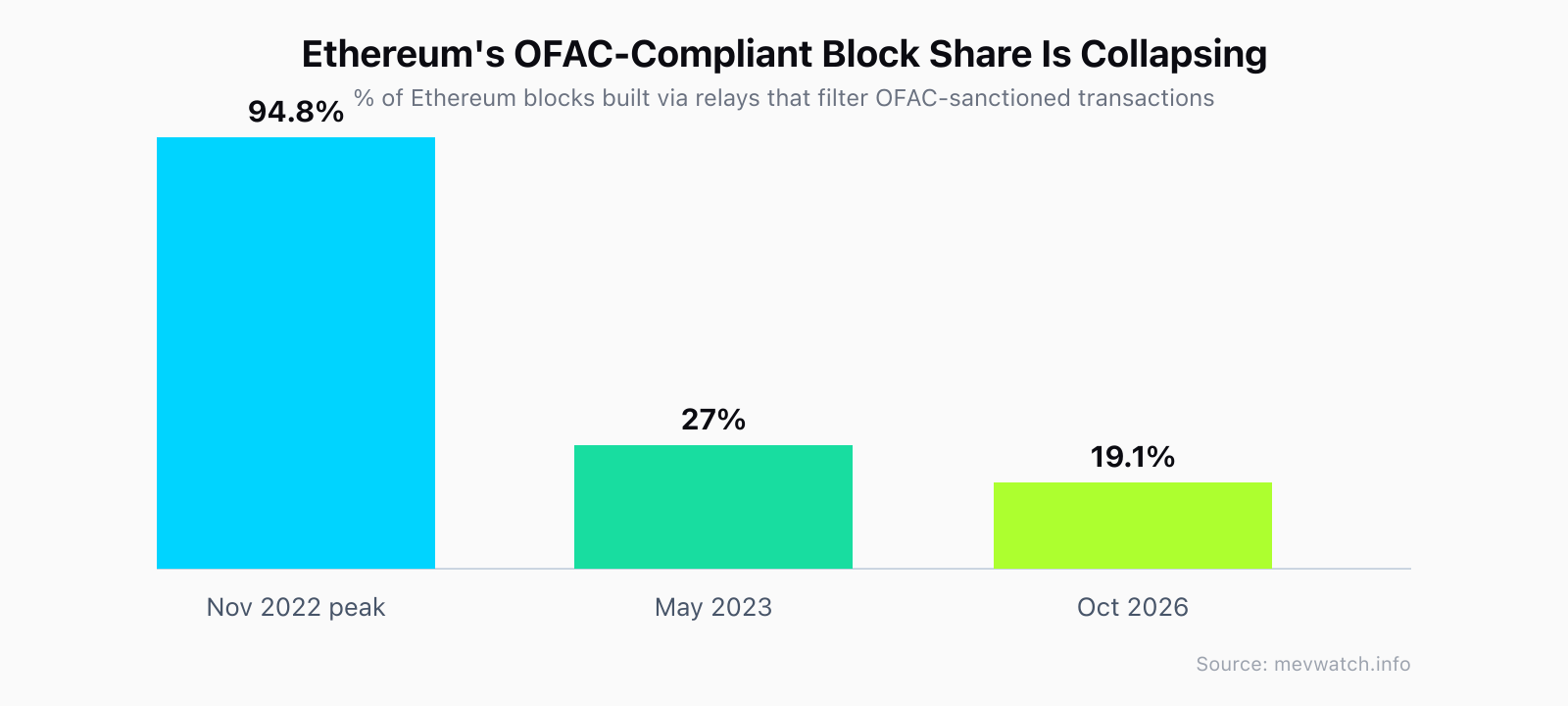
About one in five Ethereum blocks today still pass through relays that filter OFAC-sanctioned addresses, down from a peak of 94.8% in November 2022.
A sanctioned address showing up in a block doesn't mean Ethereum broke its own rules. It means a chunk of validators chose, voluntarily, not to enforce anyone else's. That distinction gets lost in most explanations, which lump three separate layers together: the protocol itself, the relays that assemble blocks for validators, and front-end apps like wallets or DEX interfaces that block addresses in the browser. Only one of those layers produces the "OFAC-compliant blocks" number people quote, and it has nothing to do with whether your transaction is legal.
What does "OFAC-compliant" mean on Ethereum?
It refers to block builders and relays that exclude transactions involving addresses on the US Treasury's sanctions list. After OFAC sanctioned Tornado Cash on August 8, 2022, several relay operators, including Flashbots, started filtering sanctioned addresses out of the blocks they built through MEV-Boost, the software most Ethereum validators use to outsource block construction for extra fee revenue.
The protocol never changed. A validator who skips a compliant relay and builds its own block, or uses a neutral relay, can still include a sanctioned address. Censorship on Ethereum is a market choice made relay by relay, not a consensus rule written into the chain.
How much censorship is actually happening right now?
As of October 10, 2026, mevwatch.info put the censoring-relay share at 19.1% of delivered blocks, with a trough of 15.4% five days earlier. That's down roughly 40% over the prior month and a long way from the November 2022 peak, when 94.8% of blocks ran through relays enforcing the sanctions list. By May 2023 the share had already fallen to 27%, as validators shifted toward neutral relays like Ultra Sound Money.
The list those relays check keeps growing regardless of relay-market swings. Plastron's own screening corpus carries 780 OFAC-listed entries alongside roughly 3,900 other labelled addresses, and Treasury adds to the sanctions list every few weeks.
Validators keep walking away from OFAC-filtering relays - the censoring share has dropped by roughly three-quarters since its 2022 peak.
Does this affect your own transaction?
Only indirectly, and only if you're sending to or from a sanctioned address. A compliant relay doesn't reject your transaction outright. It just refuses to be the one that includes it, so your transaction waits for a neutral relay or a validator building its own block. During the Tornado Cash sanctions, affected transactions landed a few blocks later than normal instead of failing. Twelve seconds per block adds up fast when several in a row skip you.
Most wallets never touch this layer at all. It only bites addresses that sit on, or interact directly with, the sanctions list itself.
Can you tell if a wallet has this kind of exposure?
Relay filtering and wallet-level sanctions screening are two different checks answering two different questions. A relay decides whether to build your block. A screening tool decides whether your counterparty, or a counterparty several hops back, touches a sanctioned entity. You can look up an individual transaction's builder on Etherscan after the fact, but that tells you nothing about the wallet's broader exposure. Screen the wallet with Plastron instead, and you get direct and indirect exposure to every OFAC address, mixer, and flagged service the corpus tracks, not just the one relay decision that happened to apply to one transaction.
That matters because exposure is cumulative and relay filtering is not. A wallet can clear every relay check it ever hits and still carry five-hop exposure to a sanctioned entity that would flag it on an exchange.
Is Ethereum's censorship problem getting better or worse?
Better, by the only metric that's been tracked consistently since 2022. The censoring share has fallen in almost a straight line from its November 2022 peak, and validators have had four years to pick neutral relays if they wanted to. They increasingly do. Critics still argue that any nonzero compliant share proves a government can lean on infrastructure operators to filter a permissionless network, and that argument hasn't gotten weaker just because the number dropped. Both things are true at once: censorship is less common than it was, and the mechanism that makes it possible hasn't gone anywhere.
FAQ
Is Ethereum censorship-resistant?
Partially. The base protocol doesn't filter transactions, but the relay market that most validators rely on for MEV-Boost blocks can and does, which is a soft form of censorship sitting one layer above consensus.
What is MEV-Boost and why does it matter here?
MEV-Boost lets a validator outsource block building to specialized builders through a relay, in exchange for higher fee revenue than building the block itself. Because most validators use it, whichever relays they pick decide whether sanctioned addresses get filtered.
Did Flashbots stop filtering OFAC-sanctioned addresses?
Flashbots has offered both a compliant and a non-compliant relay option since the policy drew criticism in 2022. Validators choose which one to point their MEV-Boost configuration at.
Does a censored transaction eventually get included?
Yes, in almost every documented case. It just waits for a validator or relay that doesn't filter it, which can mean a handful of extra blocks instead of immediate inclusion.
Disclaimer: This article is for educational and informational purposes only and is not legal, financial, tax, or compliance advice. Crypto carries risk; you act on this information at your own risk. Always do your own research and consult a qualified professional before making decisions. Views are the author's own and do not constitute financial, legal, or investment advice.
About Plastron
Plastron is a free, non-custodial wallet screening tool. It checks Ethereum and six EVM chains for AML and KYT risk — sanctions exposure, mixer contact, and stolen-funds proximity — and returns a risk report in seconds. It reads public on-chain data only: it never takes custody of funds and never asks for private keys.