TL;DR - A dust attack sent tiny HTX-linked deposits to Kraken users, and automated sanctions screening froze balances as large as $4.2 million before any wrongdoing was proven.
Between August 17 and August 24, 2026, wallets tied to sanctioned exchange HTX pushed almost 12,000 dust transfers into Kraken customer accounts, and Kraken's compliance system locked the largest one it found - a $4.2 million balance - while it worked out what to do with the money. Most write-ups on dusting attacks still treat the risk as a privacy leak. This one turned a compliance filter into a weapon.
What happened between Kraken and HTX in August 2026?
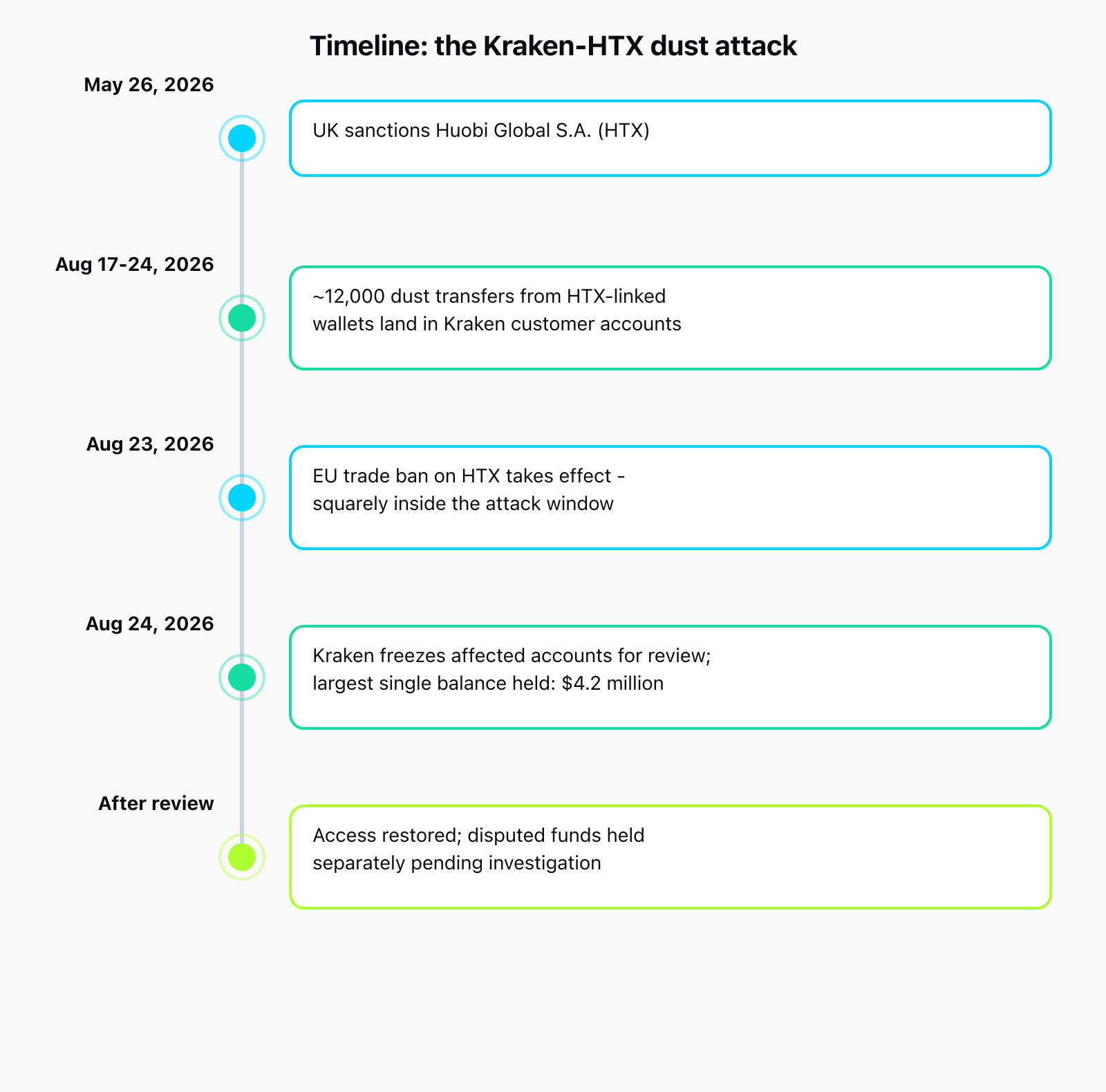
Kraken called it a dust attack, and the numbers back that up. Nearly 12,000 transfers, each worth a few cents to a couple of dollars, arrived from wallets that analytics firm Arkham Intelligence tied to HTX, the exchange formerly known as Huobi. HTX had already been hit twice by regulators: the UK sanctioned Huobi Global S.A. on May 26, 2026, and an EU trade ban on dealing with HTX took effect August 23, 2026 - squarely inside the attack window.
Kraken's automated sanctions screening did exactly what it's built to do. It saw incoming funds from a sanctioned-linked address and froze the receiving accounts for review. The largest single balance caught in the sweep was $4.2 million. Access came back once the review cleared, though the disputed funds themselves stayed held separately.
HTX denies sending any of it. The exchange says the wallet may have been misattributed, or used by a third party without its knowledge.
The EU's trade ban on HTX took effect in the middle of the attack window, which is likely why the dust carried enough sanctions weight to freeze real balances.
Why did a few cents freeze a $4.2 million balance?
Sanctions screening doesn't grade transfers by size. A wallet linked to a sanctioned entity is a binary flag, and $4.2 million sitting next to a two-cent deposit from that wallet gets treated the same as $4.2 million sent directly by it.
That's the exploit. Send dust from a tainted address to thousands of unrelated accounts, and every one of those accounts now shows an incoming transaction from a sanctioned-linked wallet. A screening system can't tell a targeted attack from a real transfer without a human checking context - the amount, the pattern, who actually controls the funds.
Kraken's read on the motive was blunt: spread sanctioned exposure as widely as possible, so automated checks lock as many accounts as they can reach. Fewer than a hundred dollars moved the needle on millions in frozen balances. That's the whole attack.
Is sending dust to trigger a freeze a new attack style?
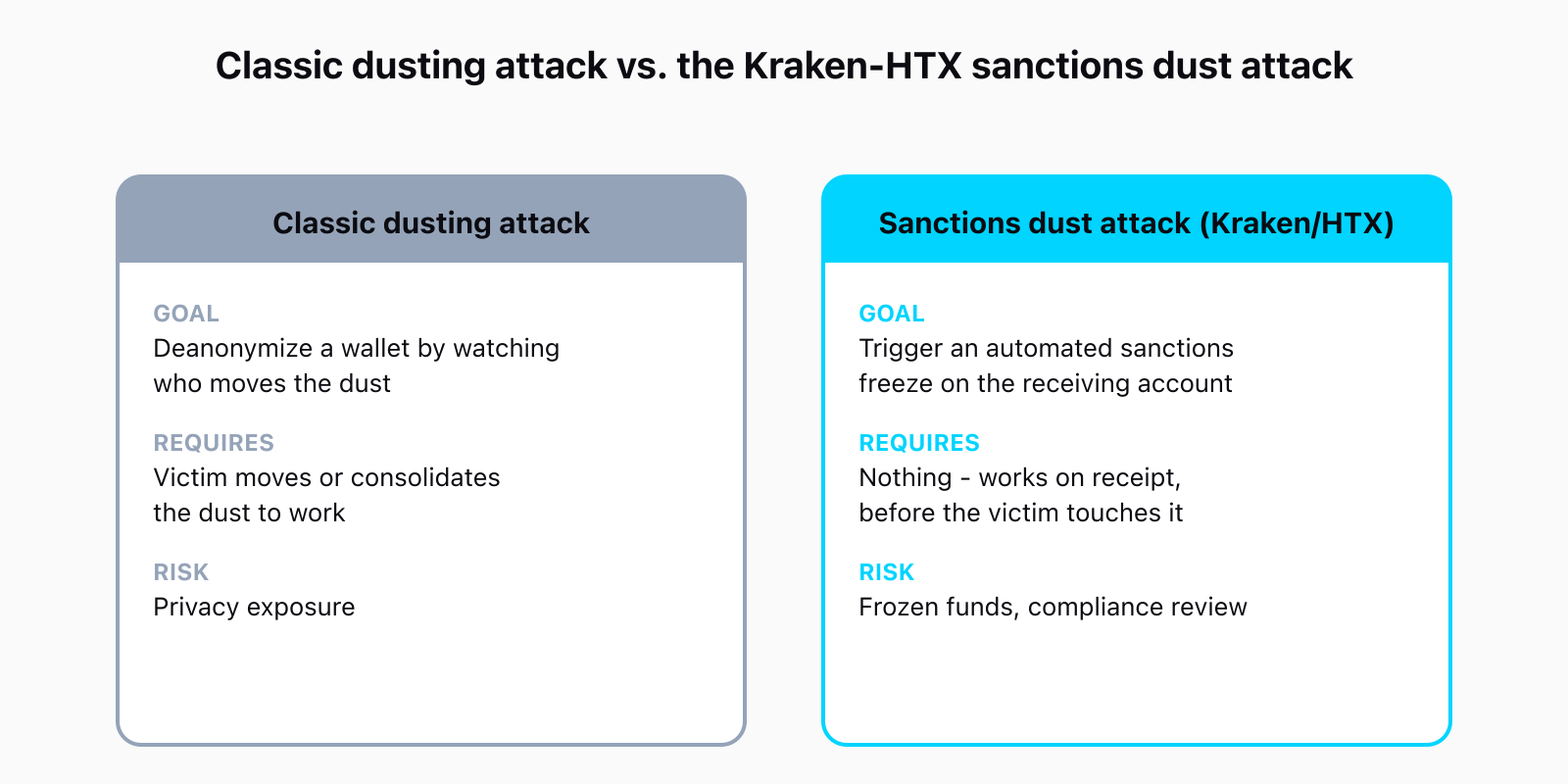
Not entirely new, but this is a real escalation. Older dusting attacks sent tiny amounts to deanonymize wallets - link addresses together by watching who moves the dust, then unmask a real identity behind a pseudonymous chain.
This attack skips the tracking goal and goes straight for the compliance trigger. Nobody needed the victims to move the dust or interact with it at all. The freeze happened on receipt, before anyone touched a thing.
Similar small transfers reportedly reached wallets tied to Coinbase and Binance before Kraken's case became public, which suggests this wasn't a one-off test. It reads like a repeatable technique against any platform running standard sanctions screening.
The new variant doesn't try to break your anonymity - it weaponizes the compliance filter that's supposed to protect the exchange.
Could the same dust attack hit your exchange account?
Yes, and there's no way to opt out of receiving it. Anyone can send crypto to a public address without permission, and refusing unsolicited deposits isn't how any blockchain works.
What determines your exposure is what's already in your transaction history and what lands in it next. Every deposit, dust included, becomes part of the graph a screening tool reads when it decides whether to hold your withdrawal, and that graph doesn't expire on its own. Plastron's own labeled dataset tracks 3,901 addresses tied to scams, sanctions, and stolen-fund clusters, including all 780 entries on the current OFAC SDN list - a fraction of what actually needs watching, but enough to catch a direct hit like this one instantly.
A wallet that's never touched HTX, Tornado Cash, or any sanctioned service can still end up flagged the moment one of those wallets decides to target it. Screening tools generally weight direct exposure more heavily than dust, but policy varies by platform, and a review still takes time even when the outcome is a clean pass.
What should you do if sanctioned dust lands in your wallet?
Leave it alone. Don't move it, swap it, or consolidate it with other funds - interacting with dust is how some attacks actually work, and it adds a transaction to your history that didn't need to exist.
Check where it came from before an exchange asks you to. Anyone can look up the sending address on a block explorer like Etherscan and see its balance and prior activity, but that only shows raw transaction data - it won't tell you if the address is tied to a sanctioned entity, a mixer, or a stolen-funds cluster. Screen the sending address with Plastron instead, and get a risk read across sanctions lists, mixer exposure, and known scam clusters in seconds, before it turns into a deposit you have to explain.
If a deposit does get held, don't go silent. Reply to support with what the screening tool gives you: the sender address, its risk category, and the fact that you never solicited the transfer. That's the fastest path through a review built to catch exactly this kind of case.
Will exchanges get better at telling attack dust from real transfers?
Probably, but not fast. Kraken's response - freeze first, review second, restore once cleared - is the standard playbook, and it worked here in the sense that nobody's money was actually stolen. It just took days most users never signed up for.
The harder fix is technical: screening systems that weight transaction size, sender behavior, and pattern recognition instead of a flat address match. A few platforms are reportedly testing exactly that since this case made headlines. Until it's standard, the burden sits with whoever receives the dust, not whoever sent it.
That's backwards, and everyone in this story knows it. HTX is still investigating who actually controlled the sending wallet. Arkham's attribution isn't proof of intent. And Kraken's own account leaves room for HTX being a victim of impersonation here, not the source.
Disclaimer: This article is for educational and informational purposes only and is not legal, financial, tax, or compliance advice. Crypto carries risk; you act on this information at your own risk. Always do your own research and consult a qualified professional before making decisions. Views are the author's own and do not constitute financial, legal, or investment advice.
About Plastron
Plastron is a free, non-custodial wallet screening tool. It checks Ethereum and six EVM chains for AML and KYT risk — sanctions exposure, mixer contact, and stolen-funds proximity — and returns a risk report in seconds. It reads public on-chain data only: it never takes custody of funds and never asks for private keys.