TL;DR - The EU's sanctions package bans EU persons from dealing with HTX starting August 23, 2026, but that ban does not put your personal wallet address on any sanctions list.
An EU trade ban and a wallet-level sanctions hit are two different events, and mixing them up is exactly how a clean address ends up frozen at the wrong exchange. On July 23, 2026, the Council of the European Union adopted its 21st sanctions package against Russia. It named 218 individuals and entities, and buried inside Annex XLV sits HUOBI GLOBAL SA, the legal entity behind the exchange most people know as HTX. Seven other crypto platforms landed in the same package: EXMO, Rapira, BitPapa, Aifory Pro, WhiteBird, NoOnecrypto, and Exnode. If you ever deposited to or withdrew from HTX, the news alone is enough to make you want to run a check on your own address.
What did the EU actually do to HTX?
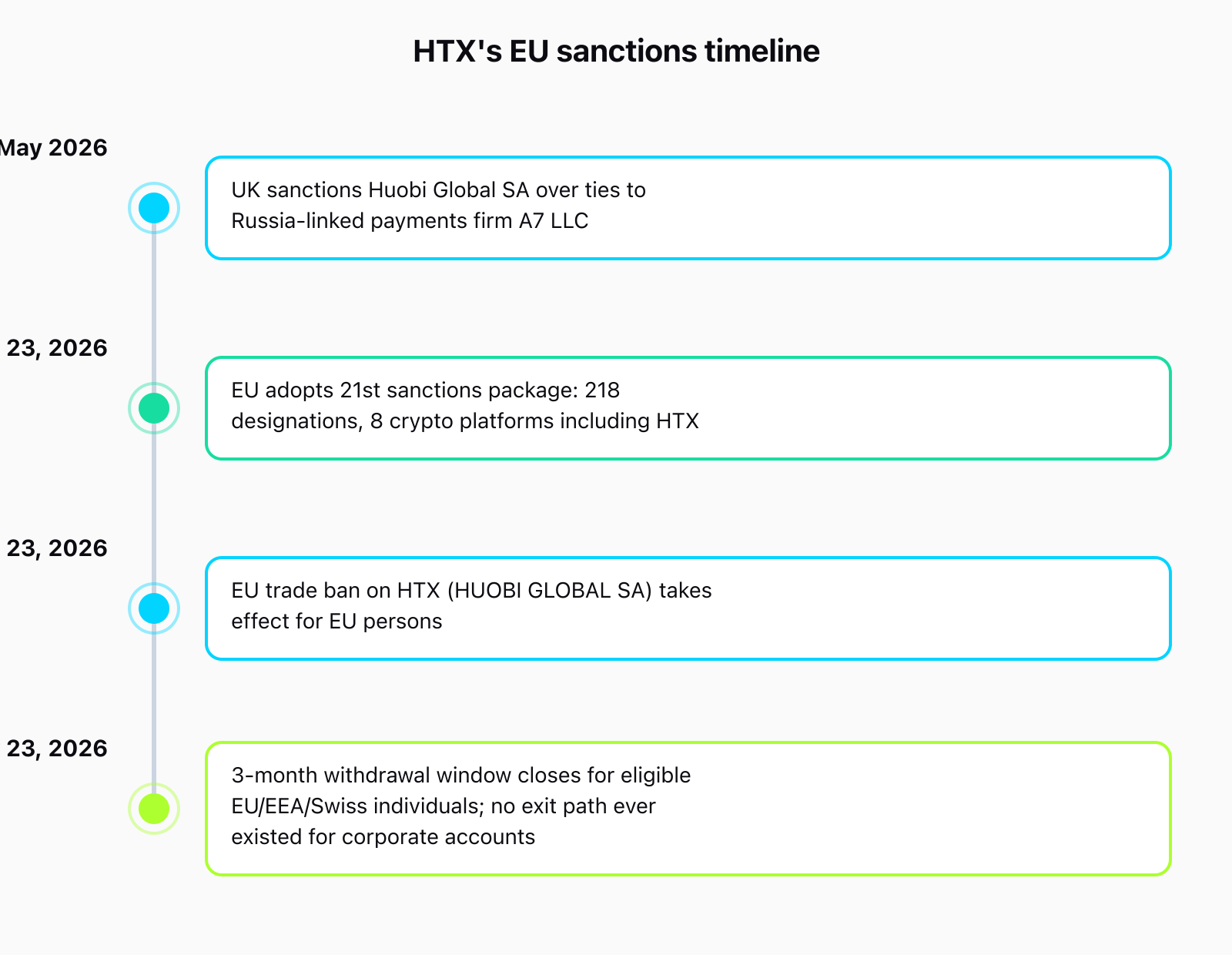
Article 5ad of the amended regulation forbids EU persons and entities from dealing, directly or indirectly, with HUOBI GLOBAL SA once the measure takes effect on August 23, 2026. That is a trade ban on an entity, not an address added to a blocklist. The UK had already moved first, sanctioning Huobi Global SA back in May 2026 over what its government called reasonable grounds to suspect the exchange supported Russia by providing financial services to A7 Limited Liability Company, a Russia-linked cross-border payments firm. The EU's package leans on the same theory: platforms that quietly kept Russian money moving after earlier sanctions rounds.
HTX has operated under the Huobi name for years, with TRON founder Justin Sun serving as an adviser to the platform. Neither the EU nor UK action names Sun personally in connection with the HTX designation. The target is the corporate entity, and Article 13 of the underlying Regulation 833/2014 gives the ban a long jurisdictional reach, covering EU nationals and EU-incorporated entities wherever they transact.
Two separate regulators moved against the same exchange three months apart, and the withdrawal window for eligible individuals only runs three months past the ban.
Does an EU listing like this flag every wallet that used HTX?
No, and this is the distinction that matters most. OFAC's Specially Designated Nationals list works at the address level. Treasury names a specific wallet, and any wallet that transacts with it inherits exposure through Plastron's screening logic. The EU's HTX action doesn't work that way. It's an entity-level dealing ban aimed at EU persons, not a published list of tainted addresses. Your wallet doesn't pick up an EU sanctions flag just because you once traded on HTX.
What actually matters for a screening tool is whether the specific deposit or withdrawal address you used ever separately touched a sanctioned wallet, a mixer, or a stolen-funds cluster. HTX's own hot wallets could carry exposure from unrelated incidents entirely apart from this EU action. That's a different question than "did the EU sanction the platform," and it's the one worth answering with a real scan rather than a headline.
Why do EU users only get three months to get funds out?
The regulation carves out a narrow exception. Eligible EU, EEA, and Swiss nationals or residents can apply for authorization to withdraw funds or close an HTX account, but the application window closes three months after the ban starts, so roughly November 23, 2026. Any authorization granted is itself only valid for a maximum of three months. Approved funds have to land at an institution formed under EU member-state law, or a third-country entity owned by one. Self-custody wallets are not named anywhere in the text as a qualifying destination, which leaves a real gap for anyone planning to withdraw straight to a personal address.
Corporate accounts get nothing. There's no authorization pathway for a business entity once August 23 passes. A company still holding funds on HTX after that date is stuck: any transaction is a sanctions violation on its face, with no application to file and no clock to watch.
What happens to wallets that never withdraw before the deadline?
Funds sit exactly where they are. The EU didn't seize HTX's wallets the way law enforcement seized eXch's infrastructure in 2025. It made dealing with the entity illegal for EU persons going forward. A corporate account with no exit path effectively becomes untouchable under EU law, not because a court froze it, but because every path to move it now counts as a violation. A shutdown by law enforcement seizure works differently from a sanctions listing, and the two get confused constantly in threads asking whether "my exchange got banned" means the coins themselves are dirty.
Is HTX also on the US OFAC list?
Not as of this package. This is purely an EU and UK action; Treasury's OFAC list runs on its own designation schedule and its own legal authority. Plastron's own corpus currently tracks 780 addresses on the OFAC SDN list inside a broader dataset of 3,901 labeled wallets covering scams, hacks, mixers, and sanctioned exchanges, and none of those 780 entries exist because of this EU package. A wallet can be entirely clean on OFAC and still carry EU exposure once August 23 passes, and the reverse holds too. OFAC, the UK, and the EU keep three separate lists on three separate clocks, and checking only one of them is how compliance teams miss things.
How do you check your own wallet's exposure to HTX?
Pull up the deposit and withdrawal addresses HTX gave you and look at what those specific addresses touched, not just whether you used the exchange. You can do this manually with Etherscan, tracing each transaction hop by hand across however many chains you touched. Screen the address with Plastron instead to see sanctions, mixer, and stolen-funds exposure across Ethereum and six chains at once, including a direct HTX exposure check. If you're weighing this against a US-only view, the EU AML angle covers what that regime flags that OFAC doesn't.
Disclaimer: This article is for educational and informational purposes only and is not legal, financial, tax, or compliance advice. Crypto carries risk; you act on this information at your own risk. Always do your own research and consult a qualified professional before making decisions. Views are the author's own and do not constitute financial, legal, or investment advice.
About Plastron
Plastron is a free, non-custodial wallet screening tool. It checks Ethereum and six EVM chains for AML and KYT risk — sanctions exposure, mixer contact, and stolen-funds proximity — and returns a risk report in seconds. It reads public on-chain data only: it never takes custody of funds and never asks for private keys.