TL;DR - Usually no - criminal charges for receiving stolen crypto generally require that you knew or should have known it was stolen, but you can still be forced to return the funds even if you are never charged.
This fear hits people who never went looking for trouble: you sell something online, get paid in crypto by a stranger, or receive a transfer that later turns out to trace back to a hack or a scam. Suddenly the money in your wallet has a history you did not create. The part most explainers skip is that "will I be charged" and "will I keep the coins" are two separate questions, and the answers can point in opposite directions.
Can you be criminally charged for receiving stolen crypto you didn't know was stolen?
In most US states, the crime of receiving stolen property has a knowledge element. To win a conviction, prosecutors generally must show you knew the assets were stolen, or that you had reason to know. Honest ignorance is a defense in many places, which is why a one-off recipient who had no cause for suspicion is rarely the target.
The catch is that the standard is not the same everywhere. Some states convict on a lower "reasonable cause to believe" test, and a few set the bar low enough that a careless recipient can be charged. Federal and state statutes are worded differently, so the same facts can land differently depending on where you are. The plain answer: usually not, if you truly had no reason to suspect, but the outcome turns on your state and on what you knew at the time.
What does "knew or should have known" mean for crypto?
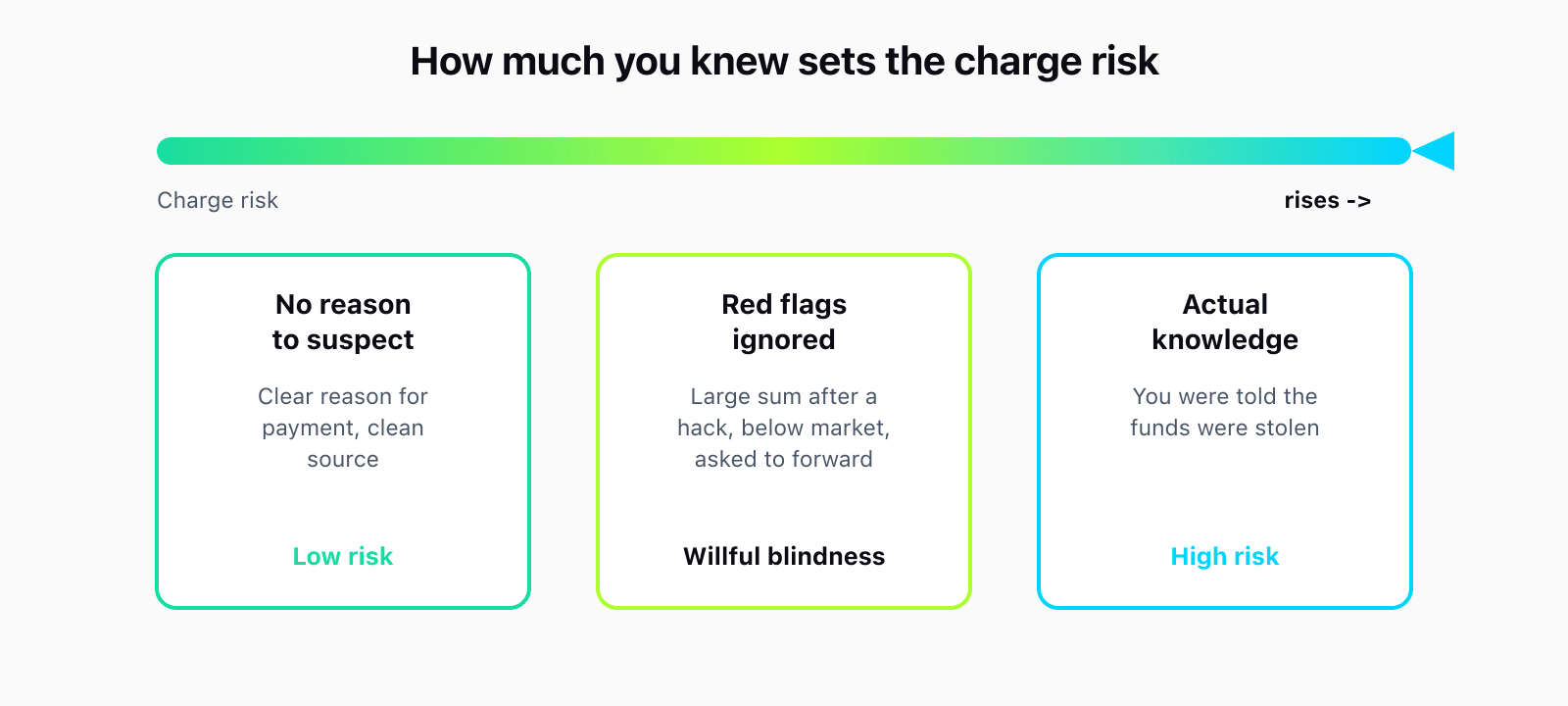
Think of knowledge as a spectrum, not a yes-or-no switch. At one end is actual knowledge: someone tells you the coins came from a theft. In the middle sits willful blindness, where the signs are obvious and you look away on purpose. At the other end is the "should have known" test, where a reasonable person in your shoes would have spotted the problem.
For crypto, common red flags that push you toward the "should have known" end include a stranger sending a large sum with no real reason, funds that arrive right after a publicized exchange or protocol hack, an over-the-counter deal priced far below market, or a request to quickly forward the money somewhere else. Ignoring signals like these is what turns an innocent receipt into a chargeable one. The defensive move is the opposite: when something looks off, check the source and keep a record of what you found.
Criminal exposure rises as you move from an innocent receipt with no warning signs toward ignoring obvious red flags or knowing outright.
Could you lose the crypto even if you are never charged?
Yes, and this is the part that catches people off guard. Under a long-standing common-law rule, a thief cannot pass good title to stolen property. That means a later buyer or recipient, even an honest one, can be ordered to return the assets to the rightful owner through a civil claim. No criminal charge is needed for a court to unwind the transfer.
On-chain, a second layer applies. When you try to move tainted funds to an exchange, its compliance system can trace the deposit back to a hack, scam, or theft and freeze it during review, regardless of your intent. Stablecoin issuers go further: the companies behind USDC and USDT can freeze those tokens at the contract level when law enforcement flags an address. So you can be completely innocent and still find the money stuck or clawed back. Our guide on what tainted crypto actually means covers how that exposure spreads, and what to do if you received funds from a hacked protocol walks through the cleanup.
How is sanctions exposure different from receiving stolen property?
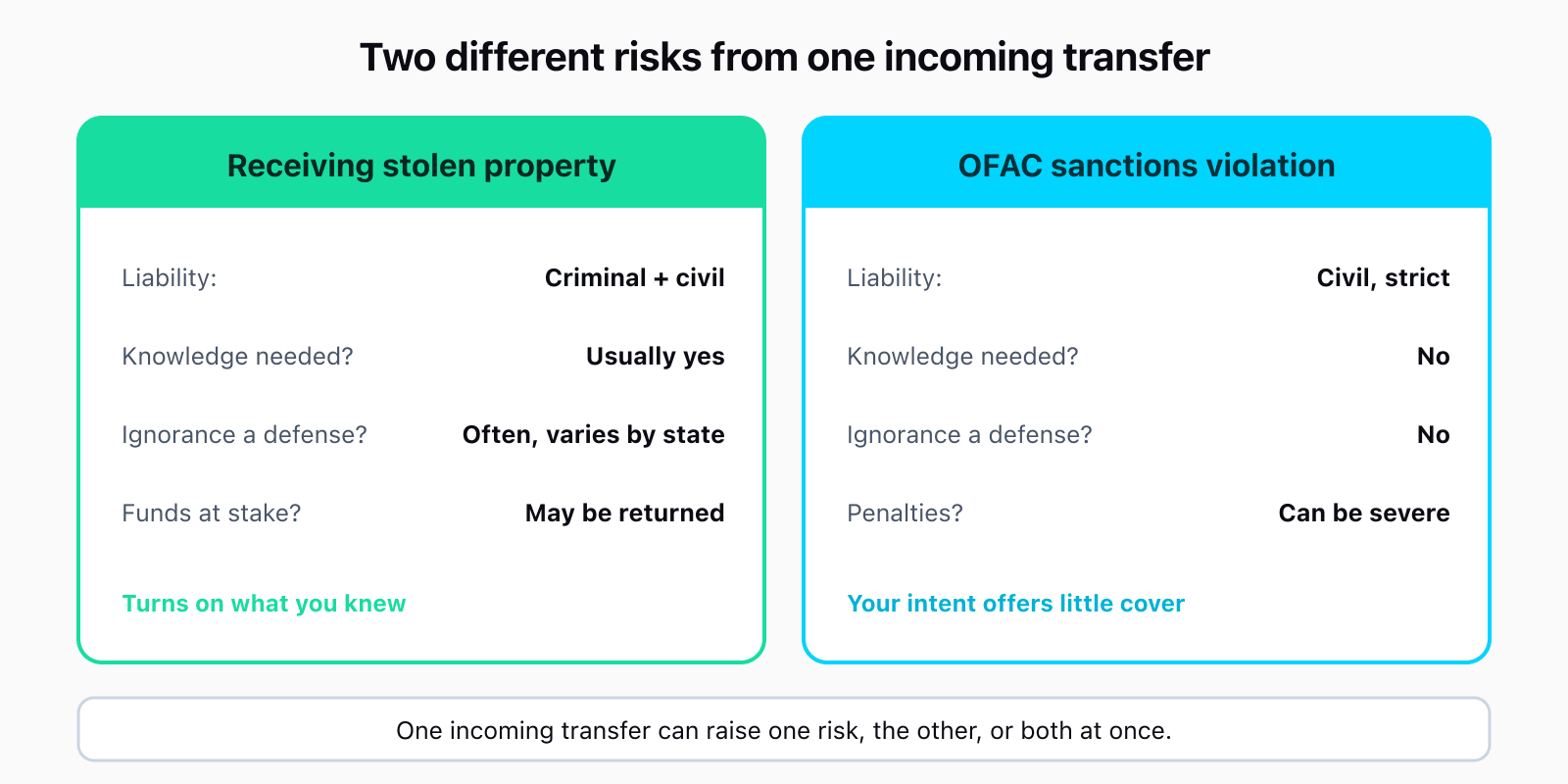
Sanctions are a separate regime with a much harsher rule, and people often confuse the two. Receiving stolen property is knowledge-based: in most places, no knowledge means no crime. A US sanctions violation under OFAC is the opposite - civil liability is strict, so you can be penalized for a transaction tied to a sanctioned address even if you had no idea it was sanctioned.
That gap matters when the funds you received trace back to a sanctioned entity, such as a blocked mixer or an SDN-listed exchange, rather than an ordinary theft. There your state of mind offers far less cover than it does for stolen property. The practical takeaway is to treat sanctions exposure as the more serious risk and to screen for it specifically. We cover the criminal-versus-civil split in more depth in our piece on OFAC liability for a ransomware payment.
Stolen-property charges hinge on what you knew; sanctions liability does not, which makes screening for sanctioned sources the higher priority.
How can you check crypto before you accept it?
The best protection is to look before the money lands, because once tainted funds are in your wallet the problem is yours to untangle. You can inspect a sender's address by hand on a public block explorer such as Etherscan, reading its incoming transfers and following each counterparty backward, but that is slow and usually stops at the first hop. Rather than tracing it manually, screen the address with Plastron to see sanctions, mixer, and stolen-funds exposure across Ethereum and six other chains at once, with no wallet connection needed.
Checking first does double duty. It lets you walk away from a bad payment while you still can, and the record of having checked is itself evidence of good faith if anyone later asks why you accepted the funds. If you take crypto from customers or counterparties, build the habit into your process - our guide on screening a wallet before accepting crypto lays out the full workflow.
FAQ
Is receiving stolen crypto a crime if I had no idea?
In most US states the offense of receiving stolen property requires that you knew, or had reason to know, the assets were stolen, so genuine ignorance is usually a defense. The standard varies, though, and some states convict on a lower "reasonable cause to believe" test. Outcomes depend on your jurisdiction and the specific facts.
Do I have to give back crypto that turned out to be stolen?
Often yes. A thief cannot pass good title, so a court can order even an innocent recipient to return stolen assets to the rightful owner through a civil claim. That can happen whether or not you are ever charged with a crime.
What should I do if I think I received stolen or scam crypto?
Stop moving the funds, since each transfer can deepen your exposure and look worse later. Record how and why you received them, screen the source to understand the exposure, and consider getting legal advice before you act. Reporting to the relevant authorities can also help establish that you acted in good faith.
Does screening a wallet protect me legally?
Screening is not a legal shield, but it helps in two practical ways. It lets you refuse a risky payment before it settles, and a documented check supports a good-faith argument that you took reasonable steps to avoid tainted funds.
Disclaimer: This article is for educational and informational purposes only and is not legal, financial, tax, or compliance advice. Crypto carries risk; you act on this information at your own risk. Always do your own research and consult a qualified professional before making decisions. Views are the author's own and do not constitute financial, legal, or investment advice.
About Plastron
Plastron is a free, non-custodial wallet screening tool. It checks Ethereum and six EVM chains for AML and KYT risk — sanctions exposure, mixer contact, and stolen-funds proximity — and returns a risk report in seconds. It reads public on-chain data only: it never takes custody of funds and never asks for private keys.