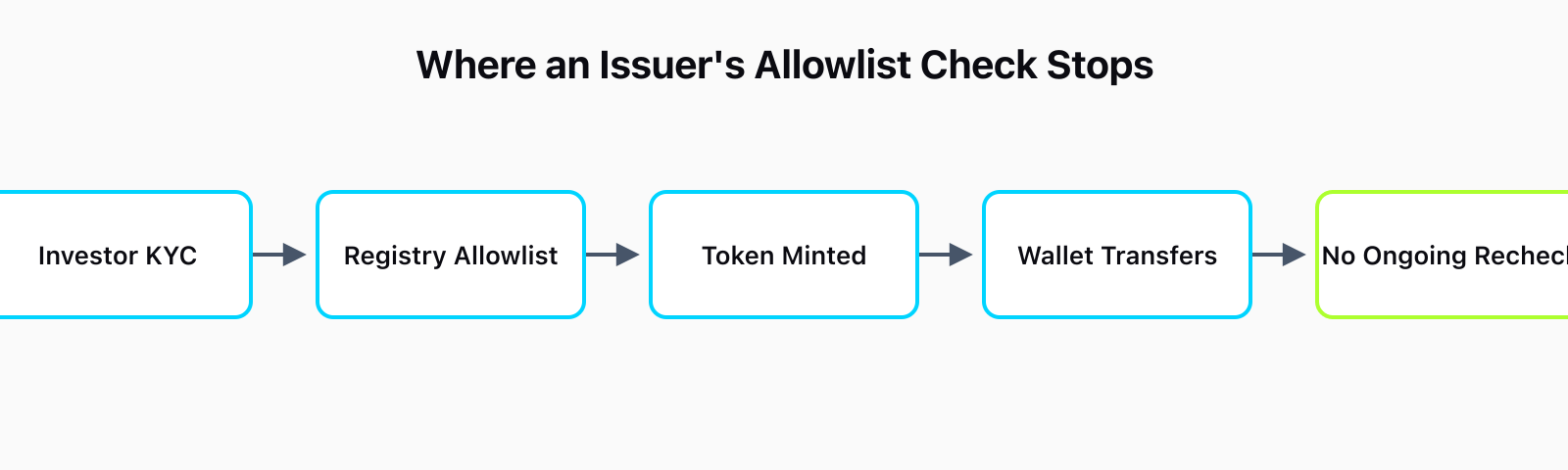
A tokenized treasury's on-chain allowlist blocks wallets it hasn't approved, but it doesn't keep checking an approved wallet's broader transaction history for sanctions or stolen-fund exposure.
On January 28, 2026, the SEC's Divisions of Corporation Finance, Investment Management, and Trading and Markets said tokenizing a security doesn't change what it legally is. The statement split tokenized securities into two buckets - issuer-sponsored and third-party-sponsored - and made the same point about both: wrap a bond or a treasury fund in a token, and the underlying rights don't move. What the statement never addresses is the wallet holding that token. BlackRock's BUIDL fund, run through Securitize, already screens who gets onto its allowlist. It says nothing about what that wallet does afterward.
The Allowlist Problem With Tokenized Treasuries
BUIDL - BlackRock's tokenized Treasury fund - only exists on-chain because Securitize runs the compliance layer underneath it. A new investor clears KYC, AML, and an accreditation check first. Only a qualified purchaser gets through that gate, which in practice means an institution or a high-net-worth account with several million dollars behind it. Pass that check and Securitize adds the wallet address to an on-chain registry.
The token contract reads that registry on every transfer: send BUIDL to an address that isn't on it, and the transfer reverts before it settles. BlackRock can freeze a holder's tokens or force a redemption if a regulator requires it. The fund has grown to roughly $2.5 billion across six-plus chains, by one tracker's count as of May 2026.
It's identity screening, done once.
An issuer's allowlist checks identity once at onboarding and again against the registry on each transfer. Nothing in that chain re-screens the wallet's transaction history afterward.
What Does an Issuer's Allowlist Actually Check?
An allowlist answers one question: has this specific wallet address been approved to hold the token. It checks that once, at onboarding, and again at the exact moment of a transfer, by looking the address up in a registry - not by looking at where the wallet's money came from or where it went before.
A wallet-screening check asks a different question: does this address, right now, show exposure to a sanctioned entity, a mixer, or stolen funds, traced across its transaction history rather than a yes-or-no flag in a database. A wallet can pass the first check and fail the second. An allowlisted address that later receives funds from a drained DeFi protocol, three hops back, keeps its allowlist status. The registry never asked.
Eligibility isn't exposure.
The Gap Opens at Custody Changes and Resales
Securitize's registry assumes the wallet behind an approved address stays the same wallet, controlled by the same person, for as long as it holds the token. That assumption breaks in a few predictable ways. A custodian holding BUIDL on behalf of several clients can sit behind one allowlisted address, so the registry sees the custodian, not the end client moving a position between sub-accounts. A compromised private key hands control of an allowlisted wallet to someone who never went through KYC. An investor's own status can change after onboarding, too - added to OFAC's SDN list, say - with nothing in the token contract rechecking that against the registry on its own.
Analytics firms like Elliptic flag a further workaround: wrapping the token, moving it across a bridge, or routing it through an omnibus smart contract that pools several beneficial owners behind one address. None of the three changes who the address is registered to. All three can change who actually controls it.
A registry freezes a snapshot.
Can a Sanctioned Wallet Actually End Up Holding One of These Tokens?
In practice, yes - through exactly the paths above, not through the front door. Securitize's onboarding check is unlikely to let a listed SDN entity straight in - a straightforward application-stage match against OFAC's own list catches that. The real exposure sits downstream: a wallet that was clean at onboarding, added to the registry, and only later touched by a sanctioned counterparty, a mixer, or funds traced back to a hack. The registry has no mechanism to re-run that check on its own.
Tether treats a narrower, after-the-fact version of this problem seriously enough to run a standing policy of freezing stablecoin balances tied to OFAC's SDN list once a match turns up. Tokenized RWA issuers reserve similar freeze powers in their own terms, but freezing after a match is found still depends on somebody running that match in the first place.
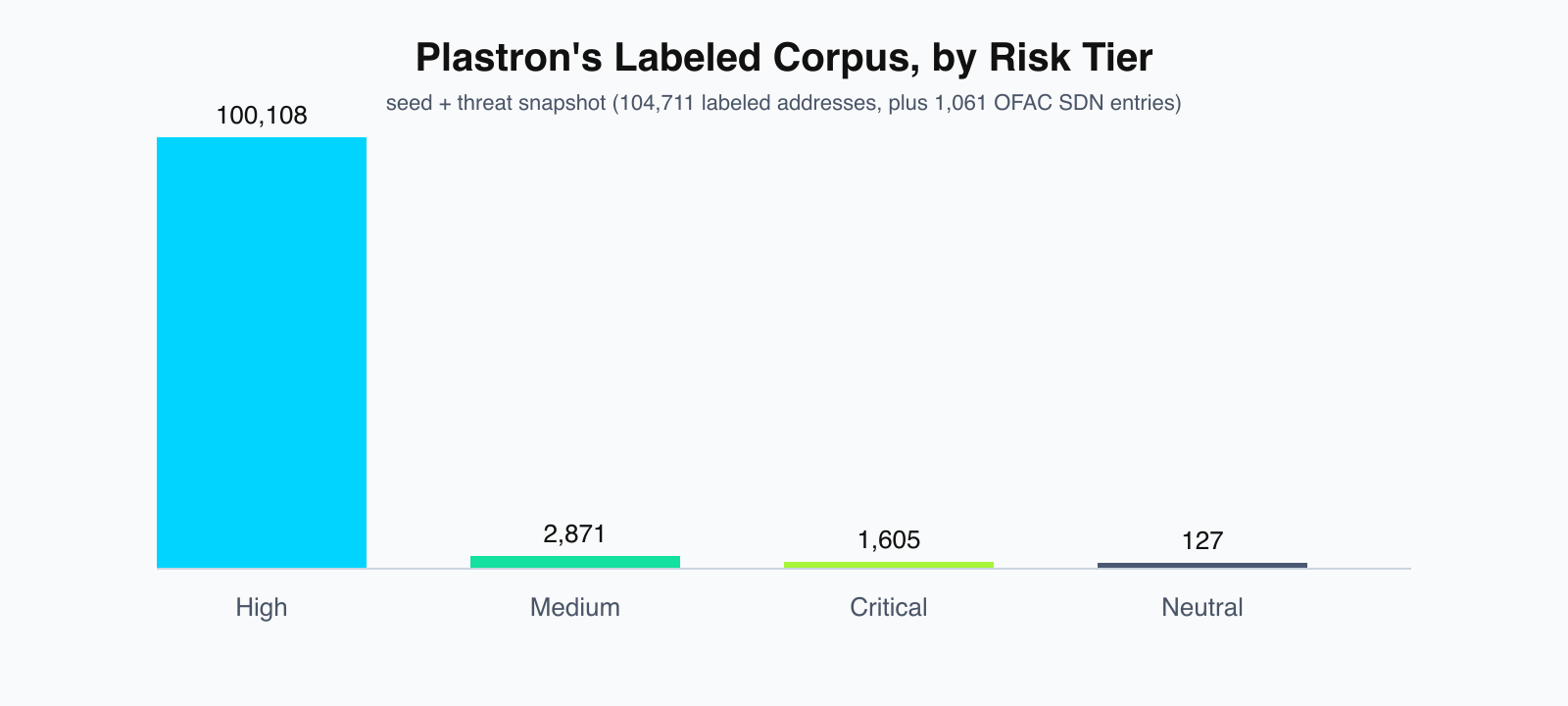
You can check an investor's status on Securitize's own portal, and it will tell you whether a wallet is currently approved - nothing about what that wallet has touched. Screen the address with Plastron instead, and you get the same OFAC SDN check plus exposure across mixers and stolen-funds clusters: more than 100,000 labeled addresses, plus 1,061 pulled straight from OFAC's own list, checked against the wallet's actual transaction graph rather than a registry entry.
Most of Plastron's 100,000-plus labeled addresses sit in the high-risk tier. None of that classification depends on whether an address ever cleared an issuer's allowlist.
Does a Clean Allowlist Status Mean the Wallet Stays Clean?
No, and that's the whole point of treating allowlist approval and wallet screening as two separate controls rather than one. An issuer's registry protects the issuer: it keeps ineligible investors out and gives the fund a legal basis to freeze or force redemption when it has to. Wallet screening protects the person on the other side of a transfer - the OTC desk, the custodian, the next buyer in a secondary sale - who has no visibility into Securitize's registry and no reason to assume a token's allowlist history says anything about the wallet's broader risk. Treat the two as substitutes for each other, and the gap between them is the part nobody's watching.
One check gates entry. The other watches what happens after.
FAQ
Is BUIDL the only tokenized asset that uses an on-chain allowlist?
No. Franklin Templeton's BENJI fund and most other tokenized Treasury and private-credit products use some version of the same pattern: KYC at onboarding, a registry checked on each transfer, and freeze or redemption powers reserved for the issuer. The exact contract design varies, but the core limitation applies across most of them - the allowlist checks identity, not transaction history.
Does an allowlist ever catch a sanctions match?
Yes, at onboarding. A new applicant's name and wallet get checked against sanctions lists before the registry adds them, which stops a listed entity from being approved in the first place. What it doesn't do is re-run that check later, after the wallet has been active for months and started transacting with other addresses.
Can a tokenized RWA issuer freeze a wallet after the fact?
Most issuer terms reserve that power, and Tether already exercises a version of it on stablecoin balances tied to OFAC's SDN list. Freezing still depends on someone flagging the wallet first - the terms give the issuer authority, not detection.
How is this different from the ERC-4337 smart-account blind spot?
Different mechanism, same shape of problem. The ERC-4337 gap hides the real wallet behind a bundler's address. The tokenized-RWA gap hides ongoing risk behind a one-time allowlist check. Both let a screening tool declare victory without looking at the address that actually matters.
Does wallet screening cover tokenized RWA tokens directly?
Yes, for the wallet holding the token. A wallet-screening check reads the same Ethereum or EVM address whether it last touched a tokenized Treasury fund or an ordinary swap, and returns the same sanctions, mixer, and stolen-funds result either way. It doesn't check an issuer's private allowlist status - only Securitize or the relevant transfer agent can confirm that. Stablecoin issuers run a related but separate freeze mechanism worth knowing about too.
Disclaimer: This article is for educational and informational purposes only and is not legal, financial, tax, or compliance advice. Crypto carries risk; you act on this information at your own risk. Always do your own research and consult a qualified professional before making decisions. Views are the author's own and do not constitute financial, legal, or investment advice.
About Plastron
Plastron is a free, non-custodial wallet screening tool. It checks Ethereum and six EVM chains for AML and KYT risk — sanctions exposure, mixer contact, and stolen-funds proximity — and returns a risk report in seconds. It reads public on-chain data only: it never takes custody of funds and never asks for private keys.