TL;DR - Washington D.C. sued Athena Bitcoin in September 2025, arguing a crypto ATM operator can be liable for a scam if it ignored red flags and pocketed hidden fees while victims lost money.
The complaint reads like a checklist of everything a compliance program exists to catch, and it alleges Athena caught none of it. This is the first case testing whether a kiosk operator, not just the scammer on the other end of the phone, can be on the hook for money that moved through its own machines. That matters for the dozen-odd companies running similar kiosks the same way, and for anyone who still uses one.
What Does the Lawsuit Against Athena Bitcoin Actually Allege?
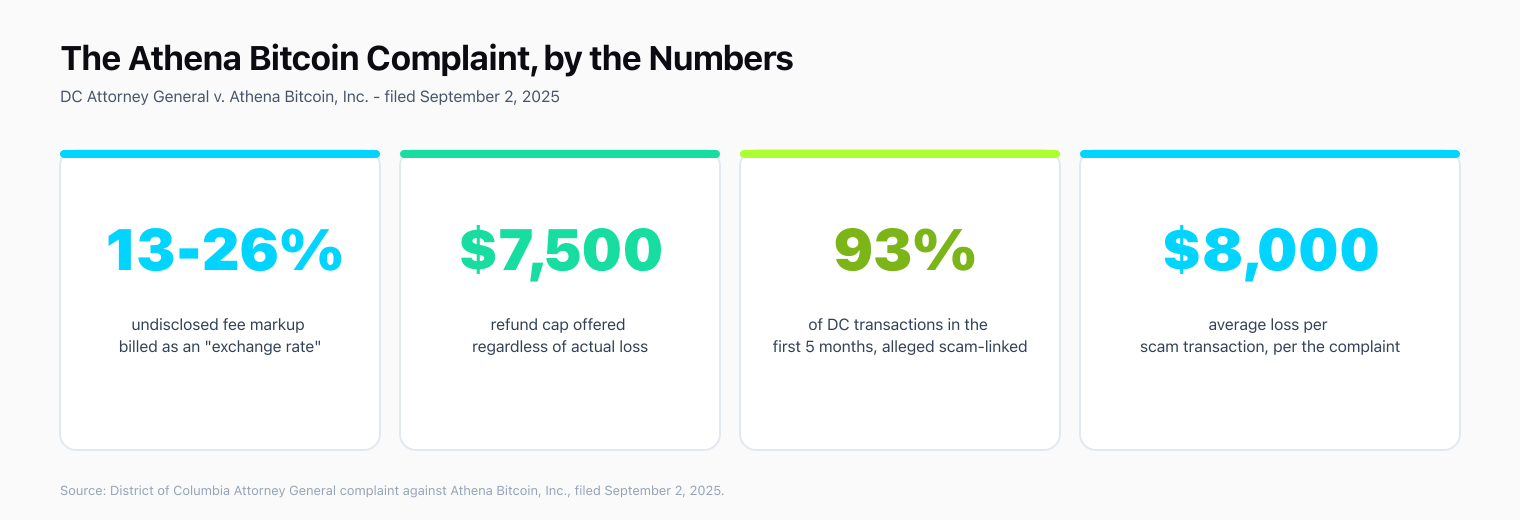
The District of Columbia's attorney general filed the complaint on September 2, 2025, against Athena Bitcoin, Inc. It splits the allegations into three parts. Athena charged a 13% to 26% markup on trades while calling it an "exchange rate," which hid the true cost from customers. Its machines showed vague warning prompts while victims stayed on the phone with a scammer walking them through each screen. And when victims complained, Athena told them crypto is final and capped refunds at $7,500, far below what most people actually lost.
The victim numbers in the filing are blunt. An estimated 93% of Athena's DC transactions in its first five months of operation were scam-related. The median victim was 71 years old. The average loss per transaction ran about $8,000.
The DC Attorney General's complaint against Athena Bitcoin puts real numbers on the fee markups, refund limits, and scam-transaction share it alleges.
Can a Crypto ATM Operator Really Be Sued for a Scam?
Yes, and the theory here doesn't run through federal anti-money-laundering law at all. DC sued under its consumer protection statute, which targets the operator's own conduct: the hidden fees, the weak warnings, the refund policy. That's a different track from the Bank Secrecy Act duties covered in our FinCEN vs. OFAC breakdown, where the exposure is registration and reporting failures, not a customer's individual loss.
A consumer protection claim doesn't need to prove Athena laundered anything. It only needs to show the company's marketing, warnings, and refund practices were unfair or deceptive under DC law, then let the transaction data speak for itself. If a judge agrees, expect state attorneys general elsewhere to file near-identical complaints against other kiosk brands.
Why Does One Wallet in the Complaint Matter So Much?
Buried in the filing is a single destination wallet that took in nearly $300,000 from 56 different victims within five days. Of that, $185,000 moved through Athena's own machines, the same address, over and over, in a window that should have tripped any transaction-monitoring rule worth having.
Plastron's own address corpus already tags 3,354 of its 3,901 labeled wallets as scam-linked. A wallet receiving dozens of unrelated cash deposits inside five days is exactly the pattern that category exists to catch. A rule that flags repeat inflows to one address before the fifth or sixth deposit isn't advanced monitoring. It's basic arithmetic.
Could Other Kiosk Operators Face the Same Claim?
Athena isn't structurally unusual. Plenty of kiosk brands run the same high-markup, thin-monitoring model, and FinCEN's Notice FIN-2025-NTC1, published August 4, 2025, already reminds every one of them that Bank Secrecy Act registration and reporting duties apply regardless of machine count. Two different regulators are now circling the same industry from two different directions: one enforcing federal AML paperwork, one testing consumer-protection liability in court.
If DC wins or settles on favorable terms, the complaint becomes a template. Any state AG with a kiosk operator and a stack of elder-fraud reports can file a close copy. That's a bigger deterrent than a FinCEN notice, because it puts an actual dollar figure on ignoring the warning signs. Senators have already pressed the ten largest US operators, including Bitcoin Depot, CoinFlip, and RockItCoin, over the same gap between transaction limits and actual fraud outcomes. A courtroom win against one of them changes the conversation from a stern letter to a damages number.
What Should You Actually Do Before You Feed Cash Into One?
Read the on-screen fraud warning. Then do the one thing the warning can't do for you: check where the money is actually going. Some people try this manually on a public explorer, which shows raw transaction history but nothing about sanctions exposure, mixer contact, or stolen-fund links. Screen the destination address with Plastron instead, and you get sanctions, mixer, and stolen-funds exposure across seven chains before you confirm the deposit, not after your receipt prints.
Our seven-point kiosk scam checklist covers the caller-side red flags. This case covers the machine's side of the same transaction. Neither replaces the other.
A deposit made on a stranger's instructions is always a mistake, whichever operator's machine you used.
Is Athena Bitcoin still operating in Washington D.C.?
Yes, as of the filing Athena continued operating its machines in the district while the case proceeds through court. The lawsuit seeks penalties and changes to its practices rather than an immediate shutdown.
Did FinCEN take separate action against Athena?
No. FinCEN's August 2025 notice addressed the kiosk industry broadly and named no specific operator. The Athena case is a District of Columbia consumer-protection lawsuit, not a federal enforcement action.
What happens if the lawsuit succeeds?
A win or settlement would likely force changes to fee disclosure and refund policy and could set a legal template other states use against different kiosk brands facing similar complaint patterns. It would also give plaintiffs' lawyers in other jurisdictions a working blueprint instead of a blank page.
Can I get my money back if I lost funds through a crypto ATM scam?
Refunds from the operator are rare and often capped well below actual losses. Report the transaction ID and wallet address to the FBI's IC3 immediately, since the first hours are when an exchange can still freeze a receiving account.
Disclaimer: This article is for educational and informational purposes only and is not legal, financial, tax, or compliance advice. Crypto carries risk; you act on this information at your own risk. Always do your own research and consult a qualified professional before making decisions. Views are the author's own and do not constitute financial, legal, or investment advice.
About Plastron
Plastron is a free, non-custodial wallet screening tool. It checks Ethereum and six EVM chains for AML and KYT risk — sanctions exposure, mixer contact, and stolen-funds proximity — and returns a risk report in seconds. It reads public on-chain data only: it never takes custody of funds and never asks for private keys.