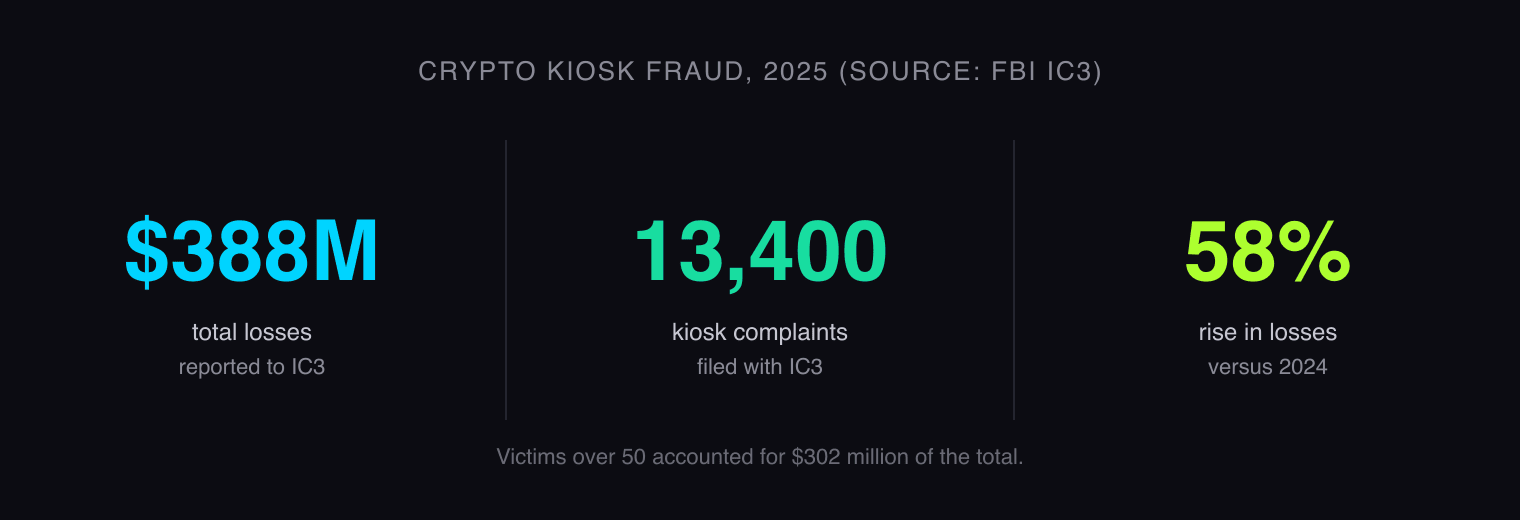
TL;DR - Crypto kiosk scams cost Americans $388 million in 2025, and once a machine confirms your deposit the transaction cannot be reversed.
On May 15, 2026 the FBI's Internet Crime Complaint Center reported 13,400 crypto kiosk complaints and $388 million in losses for 2025, a 58% jump from the year before. More than half of that money, $302 million, came from victims over 50.
Before You Start
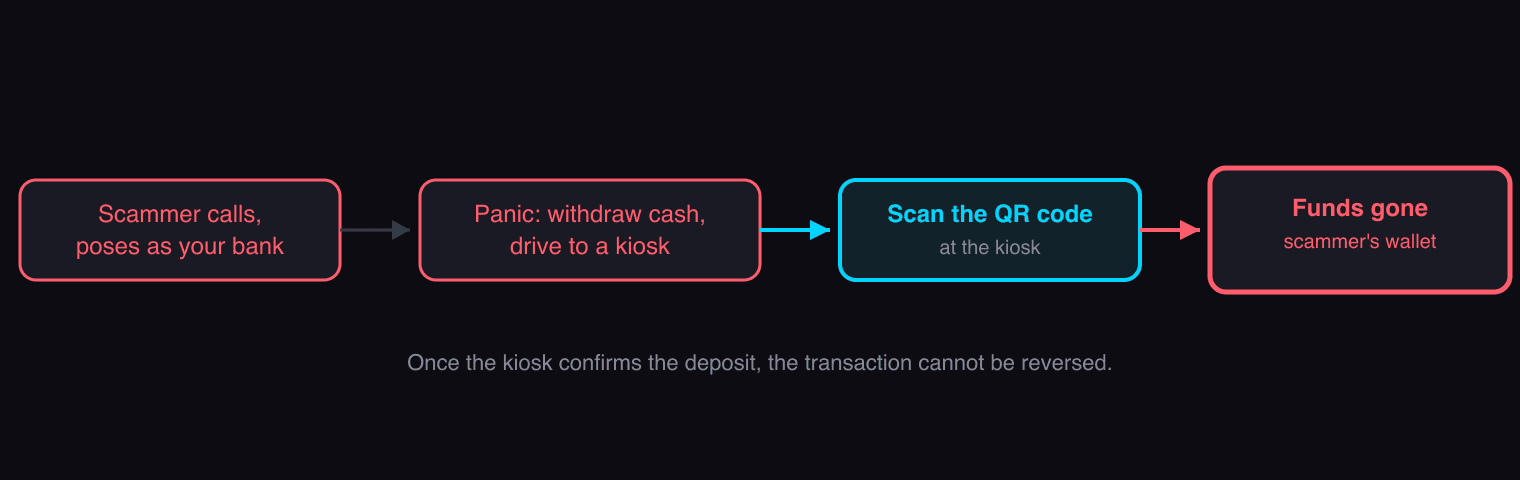
This checklist is for anyone a stranger has just told to move money into a crypto kiosk today. That includes a caller claiming to be your bank's fraud department, the IRS, tech support, a romantic interest you've never met in person, or a recruiter offering a remote job. All of them run the same script: manufacture urgency, then walk you to a nearby kiosk with wiring instructions dressed up as a QR code.
No legitimate agency asks for cryptocurrency. Not the IRS, not Social Security, not your bank's fraud line, not a court. Hang up. Call back yourself, using a number you find on your own, not one the caller gives you.
FinCEN flagged this exact pattern in Notice FIN-2025-NTC1, published August 4, 2025: bank-imposter and tech-support scripts that end with a kiosk deposit are now common enough that the agency told banks and credit unions to watch for them.
The notice names four recurring pretexts. A bank imposter warns you that your account has been compromised and the only safe move is converting savings to crypto. A tech-support caller claims malware is draining your accounts right now. A romance contact you've never met in person asks for help moving funds through a wallet. A recruiter offering easy remote pay asks you to receive crypto and forward it through a kiosk. Different opening line, same closing instruction.
The Checklist
Work through these seven checks before you feed a single bill into a kiosk. The checklist is short. Follow it in order.
Hang up first, verify second. Call your bank, the IRS, or the company directly using a number you look up yourself, never one a caller reads to you.
Refuse to scan any QR code someone sent you by phone, text, or email. A kiosk QR code is how the scammer's wallet address gets loaded instead of yours.
Treat phrases like "protect your funds" or "avoid arrest" as the scam script itself. No bank, court, or federal agency ever tells you to move savings into crypto.
Stop if the request involves a stranger you've only met online, romantic or professional, asking you to send or receive crypto on their behalf.
Read the kiosk operator's on-screen fraud warning before you confirm. Most machines now flash one before a large deposit, and it exists because you're probably being scammed.
Never stay on the phone while operating the kiosk. A caller walking you through each screen is a live version of the same fraud.
Screen the destination wallet address before sending anything, and walk away if you cannot verify who controls it.
Why Do Scammers Steer You to a Kiosk Instead of a Bank Wire?
Kiosks skip every safety net a bank wire has. There is no fraud department to flag the transfer, no 24-hour hold, and no chargeback once the machine confirms the trade.
FinCEN's August 2025 notice lists the exact red flags a bank teller is trained to catch: an unsolicited call, a request for high-denomination cash, a customer who seems confused or coached over the phone, and someone lingering near a kiosk or helping a stranger use one. A kiosk operator sees none of that context. It sees cash going in and crypto coming out.
Every crypto kiosk scam follows the same four steps: an impersonation call, a panicked cash withdrawal, a QR scan, and an unrecoverable transfer.
The same notice also directs banks to scrutinize kiosk operators themselves, flagging accounts that show a pattern of scam-linked deposits, unclear beneficial ownership, or a refusal to post the fraud warnings regulators expect. A kiosk that skips the warning screen or waves off a large first-time cash deposit is itself a red flag, not just a convenience.
Some victims try to check the destination address themselves on a public tool like Etherscan before sending anything, which shows raw transaction history but nothing about sanctions exposure, mixer use, or stolen-fund links. Plastron runs that same address through sanctions lists, mixer exposure, and stolen-fund tracing across seven chains in seconds, so you can screen the address with Plastron before any money moves, not after.
A kiosk deposit made on a stranger's instructions is always a mistake. No exceptions.
What Happens the Moment the Kiosk Confirms Your Deposit?
The transaction settles on-chain within minutes, sometimes seconds, and there is no bank on the other end to call. Once the kiosk prints a receipt, the crypto has already left for the scammer's wallet.
The FBI's IC3 lists the same warning signs at the machine itself: an unexplained QR code in your hand, a first-time large cash withdrawal, visible confusion while you're on a call, or someone lingering at a kiosk to help a stranger use it. Any one of those is reason enough to stop and walk away.
Report it anyway. Fast. IC3 asks for the transaction ID, the wallet address, the kiosk location, and anything you know about the caller, because the first hours after a deposit are when a kiosk operator or exchange can still freeze the receiving account before the crypto moves again. Keep the paper receipt the kiosk prints. It carries the transaction ID IC3 needs, and most victims throw it away before they think to file a report.
Who Do Crypto Kiosk Scams Target Most?
People over 50 filed more than half of 2025's kiosk complaints and lost $302 million of the $388 million total, making them the primary target of nearly every script researchers have documented.
Senators Jack Reed, Sheldon Whitehouse, and Dick Durbin pressed the ten largest Bitcoin ATM operators, including Bitcoin Depot, CoinFlip, and RockItCoin, to add fraud curbs after years of complaints that transaction limits and warning screens alone weren't stopping the losses.
The trend line only moves one way. The FBI told the Senate Judiciary Committee that 2023 kiosk complaints already topped 5,500, with losses over $189 million, and Americans over 60 filed most of them. FinCEN's own notice cites a 99% jump in complaints from 2023 to 2024, with losses near $246 million as of that year. IC3's 2025 figures of 13,400 complaints and $388 million mean losses have roughly doubled in two years running, even as kiosk operators added the warning screens Congress asked for.
IC3 logged 13,400 crypto kiosk complaints in 2025, with losses of $388 million, a 58% jump in losses from the year before.
Age is not a random detail here. It is the variable the script is built around, because a slower, more trusting call is easier to keep on the line long enough to reach a kiosk. Share this checklist with anyone likely to get that call before they get it.
Disclaimer: This article is for educational and informational purposes only and is not legal, financial, tax, or compliance advice. Crypto carries risk; you act on this information at your own risk. Always do your own research and consult a qualified professional before making decisions. Views are the author's own and do not constitute financial, legal, or investment advice.
About Plastron
Plastron is a free, non-custodial wallet screening tool. It checks Ethereum and six EVM chains for AML and KYT risk — sanctions exposure, mixer contact, and stolen-funds proximity — and returns a risk report in seconds. It reads public on-chain data only: it never takes custody of funds and never asks for private keys.