Samourai Wallet's founders are now in federal prison, but wallets that used its Whirlpool or Ricochet mixing tools still carry the same screening exposure Tornado Cash addresses do.
Prison time for two developers doesn't erase five years of on-chain history. Every UTXO that ran through a Whirlpool CoinJoin round is still sitting in the same clustering graph analytics firms have mapped since 2019. The sentencing didn't soften anyone's stance on it, either. Compliance teams now cite a federal money-transmitting conviction as the reason to keep flagging mixer-touched deposits, not a reason to relax.
What Happened to Samourai Wallet's Founders?
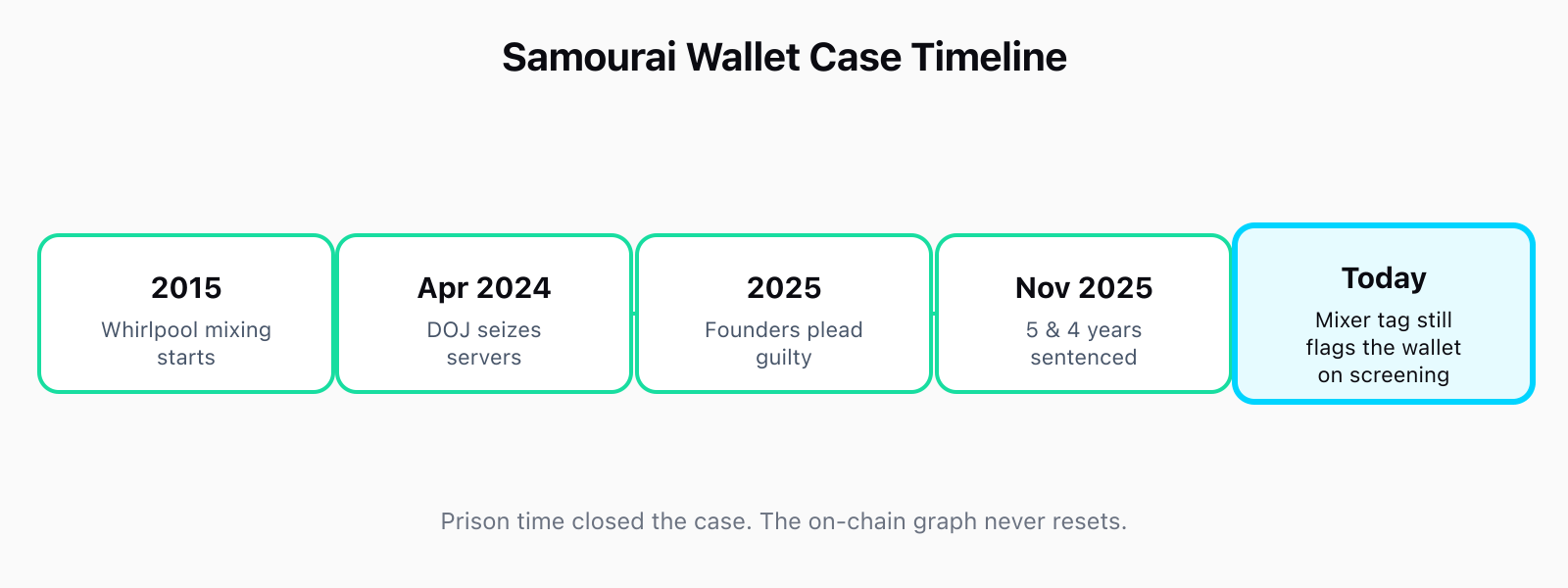
Keonne Rodriguez and William Lonergan Hill built and ran Samourai Wallet, a non-custodial Bitcoin wallet with built-in mixing features, from around 2015 until federal agents seized its servers in April 2024. Rodriguez was sentenced to five years in prison on November 6, 2025. Hill followed on November 19, 2025, with four years. Both pleaded guilty to conspiracy to operate an unlicensed money-transmitting business, according to IRS Criminal Investigation, which put the total laundered through the platform at more than $237 million across over $2 billion in processed transactions.
Both men forfeited over $6.3 million in fees and were fined $250,000 each, with three years of supervised release to follow. The case was built around drug proceeds, darknet market payouts, and funds tied to sanctioned jurisdictions moving through the app's Whirlpool and Ricochet features. The case is closed. The graph isn't.
What Did Samourai Wallet Actually Do?
Whirlpool ran CoinJoin rounds. Groups of users pooled their bitcoin into one transaction with equal-sized outputs, breaking the direct input-to-output link a chain analyst would otherwise trace. Ricochet added a few extra hops after a Whirlpool round, routing coins through addresses the sender didn't control before they reached their final destination. Neither feature moved coins off-chain. They rearranged the graph.
That distinction matters now. A CoinJoin transaction is still fully visible on the Bitcoin ledger, and nothing about the sentencing changed what's on it. What changed is how confidently a compliance officer can point at a mixer-touched wallet and call the exposure deliberate.
Does a Whirlpool-Mixed Wallet Get Flagged Today?
Yes. Exchange risk engines don't check whether a service is still running or whether its founders went to prison. They check whether an address's funds passed through clusters tagged as a mixer, and Samourai's clusters were tagged years before the arrests. Plastron's own dataset carries 28 addresses classified specifically as mixer infrastructure inside a broader set of 3,901 labeled entities, and mixer exposure sits near the top of the risk weighting alongside sanctioned addresses and stolen-fund clusters. The exposure doesn't expire.
A manual look at a block explorer like mempool.space will show you the raw CoinJoin transaction. It won't tell you how many hops separate your current balance from a tagged cluster, or how an exchange's risk model will score that distance. Screen the wallet with Plastron and you get the hop count, the OFAC and mixer exposure, and the full picture across seven chains in one pass.
Some of those mixer-tagged clusters have sat in screening datasets since before the 2024 server seizure. Age doesn't remove the tag. It just means the cluster has had longer to accumulate downstream addresses that inherit the same flag.