TL;DR - Polymarket flags or freezes a wallet when it has touched a sanctioned address, a mixer, or a flagged fingerprint, and the only fix is passing manual compliance review or screening the wallet first.
Your order won't go through, your USDC sits in a read-only wallet, and support hasn't replied in three days. That's the pattern most people describe when Polymarket blocks a wallet mid-trade. It rarely comes with a clear reason.
Polymarket runs two different surfaces with two different compliance postures, and mixing them up is where most of the confusion starts. Here's what actually trips the block, and how to check a wallet before it happens to you.
What makes Polymarket flag a wallet in the first place?
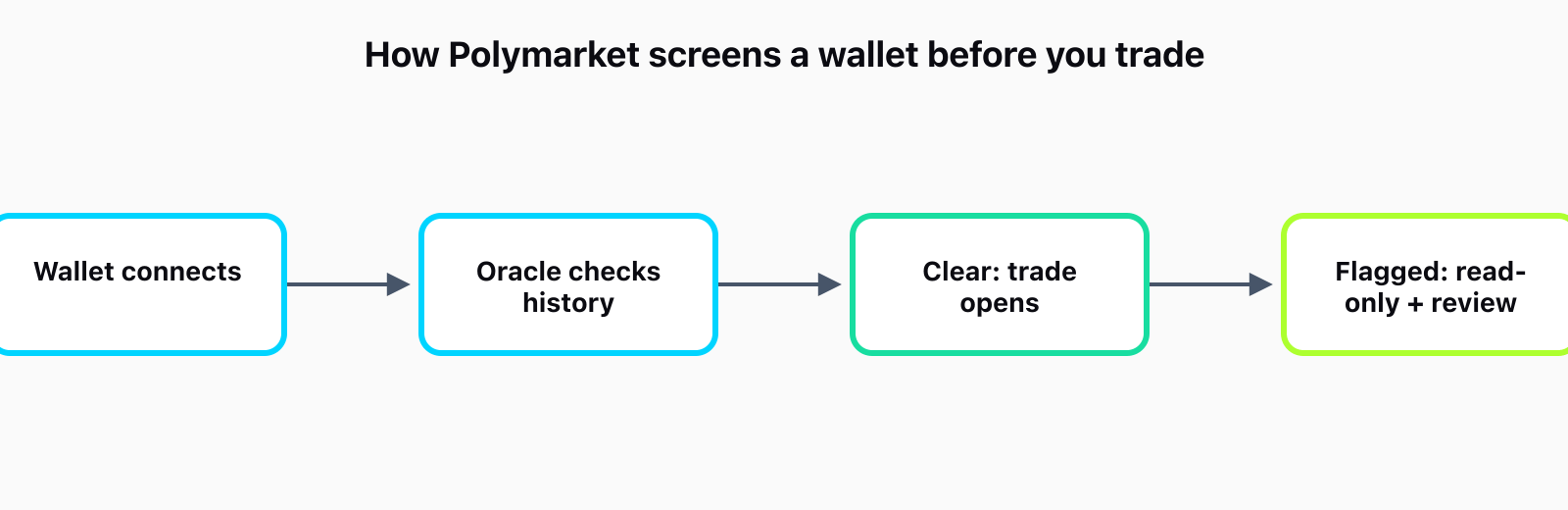
The wallet-based app at polymarket.com screens every address that connects, using an on-chain sanctions oracle to check for a direct match against government sanctions lists. That catches the obvious case. It also catches less obvious ones: funds that passed through Tornado Cash or another mixer, coins that moved through several wallets in a pattern chain analytics flags as laundering, or an address already tied to fraud in someone else's case file.
None of this requires you to have done anything wrong yourself. A wallet that received an unsolicited transfer from a tainted address inherits that exposure the moment the transaction lands. Screen first. Then connect.
The oracle check happens once, at connection - after that, the wallet is either clear to trade or stuck in read-only until a human reviews it.
Is Polymarket's offshore app different from Polymarket US?
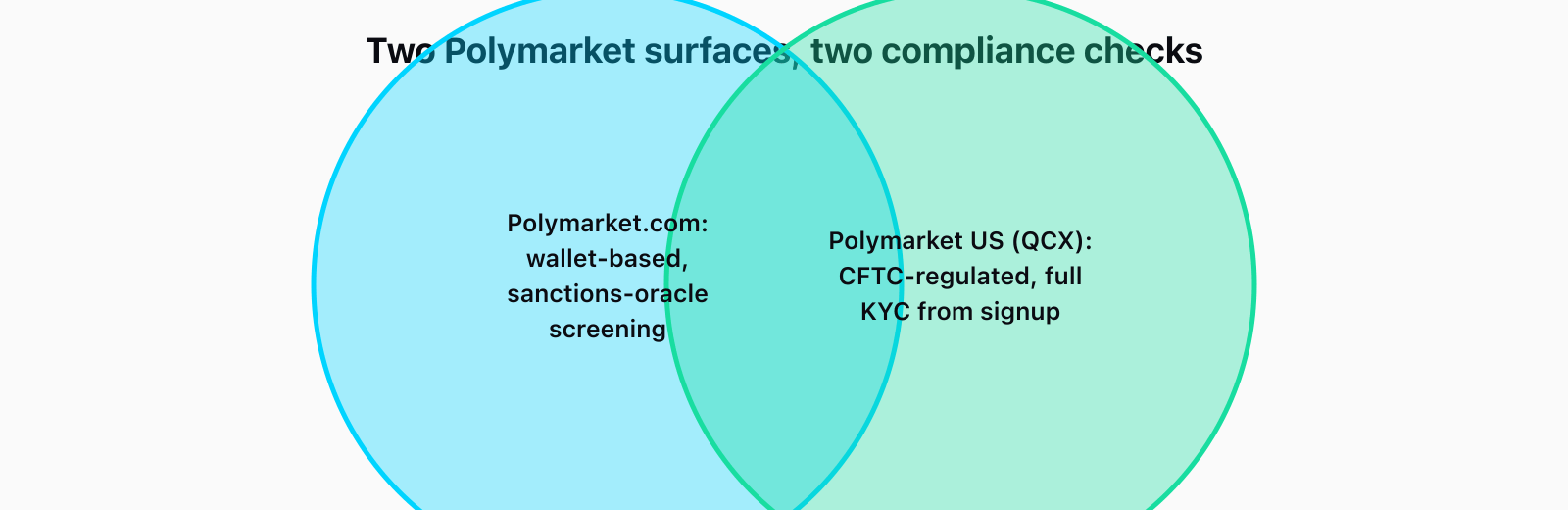
Yes, and the gap explains a lot of the confusion online. Polymarket.com is the original offshore market, wallet-based and largely KYC-free unless a flag fires. Polymarket US runs on a separate rail entirely: the company bought QCEX, a CFTC-licensed exchange and clearinghouse, for $112 million in July 2025 to build it.
The CFTC granted an Amended Order of Designation in November 2025, the Polymarket US app went live in December 2025, and its waitlist came off in May 2026. That platform runs full identity verification from account creation, the way a licensed derivatives exchange has to. The offshore app leans on wallet screening instead, precisely because it doesn't collect your identity up front.
This isn't Polymarket's first run-in with the CFTC. The agency fined the company $1.4 million in January 2022 over unregistered event contracts sold to US users, and that settlement is a big part of why the offshore app still geofences comprehensively-sanctioned countries and treats wallet history as the front line of compliance. Two platforms, two different checks, same regulator watching both.
Same company, two rails: one screens the wallet's history, the other verifies who you are before you ever connect one.
What happens once your wallet gets flagged?
A sanctions match is the hard stop: no appeal path inside the app, and the position gets closed with no way to reopen it. Softer flags, like a distant mixer link or a pattern match, put the account into read-only mode. You can withdraw what's already there. You can't open a new position until compliance reviews the case, and there's no published timeline for how long that takes.
The only real channel for pushing back is emailing support directly with an explanation and, if you have one, proof the exposure was passive. That's a slow process, and it's the same manual review every wallet-based platform runs once a flag fires.
What compliance actually wants is specific: the transaction hash that brought the flagged exposure in, a plain explanation of why you didn't choose it, and confirmation you haven't moved funds since. Send a vague appeal with none of that and expect the case to sit untouched. Send the hash and the timeline, and reviewers have something to check against the same chain data the oracle already flagged.
Can a VPN or a new device trigger the same block?
It can, separately from anything on-chain. Polymarket checks IP reputation to catch consumer VPN ranges, and it logs device and browser fingerprints. Show up on a fingerprint the system has already tied to a flagged account, even a different wallet on a different day, and the new session gets pulled into review too. Behavior matters as much as history: a fast deposit-trade-withdraw cycle at a seven-figure size reads as risk on its own, whatever the wallet's exposure looks like. We've covered the VPN angle in more detail for exchanges generally in our piece on VPNs and exchange flags, and the pattern holds here too.
How do you check a wallet before you deposit?
Looking a wallet up on a block explorer shows you the raw transaction list, not a risk verdict, so it won't tell you whether an old inbound transfer is the thing that gets you blocked. Screening the address with Plastron before you connect it shows the same exposure a compliance team would see: sanctions hits, mixer contact, and stolen-funds links across Ethereum and six other chains, in one pass and before any money moves.
The check matters most for a wallet you didn't build from a fresh seed. Plastron's own labeled dataset now covers more than 3,900 addresses tied to scams, hacks, and mixers, and 3,478 of those carry a high-risk rating on their own. If your wallet has ever touched one, an unscreened deposit into a prediction market is exactly where that history resurfaces. This isn't unique to Polymarket - DeFi front-ends like Uniswap run the same kind of check, just with a different threshold.
Can a flagged wallet ever get cleared?
A confirmed sanctions match doesn't clear. Treasury controls that list, not Polymarket, and no amount of support email changes an address that's actually on it. A softer flag, built from a distant hop or a fingerprint collision, can clear once a human reviews the transaction history and confirms there's no real link. Expect that to take days, not minutes, and expect to be asked for more than one explanation before the account opens back up.
Fresh wallets carry no history and no risk score. That's still the fastest way to trade on a platform that screens before it lets you in.
Rather than checking one source at a time, screen the address with Plastron to see sanctions, mixer, and stolen-funds exposure across Ethereum and six chains at once.
Disclaimer: This article is for educational and informational purposes only and is not legal, financial, tax, or compliance advice. Crypto carries risk; you act on this information at your own risk. Always do your own research and consult a qualified professional before making decisions. Views are the author's own and do not constitute financial, legal, or investment advice.
About Plastron
Plastron is a free, non-custodial wallet screening tool. It checks Ethereum and six EVM chains for AML and KYT risk — sanctions exposure, mixer contact, and stolen-funds proximity — and returns a risk report in seconds. It reads public on-chain data only: it never takes custody of funds and never asks for private keys.